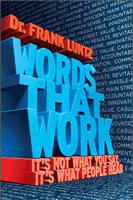
 Have you ever wondered how to make people react to what you say? While some people are better crafting words than others, this book shows how the pros do it. Written by the person responsible for crafting the words for the political parties, this book gives rules for effective wording.
Dr. Luntz doesn’t come up with his ideas in a vacuum. He uses focus groups and instant response dial sessions. Ideally, focus groups are (pre-screened to be) homogenous – people reveal their innermost thoughts to people like themselves. The problem with a focus group is that a dominant person can get bully others. A dial session is more personal; everyone in the group hold a wireless dial device which they turn to reflect how much they feel positively or negatively about what they are seeing. The dial session also gives everyone equal input. Both sessions can be recorded and scientifically analyzed. However since a dial session can be larger, you get better data to base your decisions.
Here are his rules:
- Simplicity: Use small words.
- Brevity: Use short sentences.
- Credibility: People have to believe it to buy it
- Consistency: Repeat (even it it bores you to tears).
- Novelty: Redefine an old idea.
- Sound: Rhythm matters.
- Aspiration: Say what people want to hear.
- Visualization: Paint a vivid picture.
- Questioning: Rhetorical questions require personal responses.
- Context: Why is this message important?
An effective message must be in alignment: the message, messenger, and recipient must all be “on the same page”. A perfect message delivered poorly isn’t as valuable. Neither is the right message for the wrong audience.
For example, which phrases are better:
- “drilling for oil” or “exploring for energy”?
- “estate tax” or “death tax”?
- “personalization” or “privitization”?
- “free market economy” or “globalization”?
- “foreign trade” or “international trade”?
- “health care choice” or “the right to choose”?
- “deny” or “not give”?
- “private accounts” or “personal accounts”?
- “Washington” or “Government”?
Your message must first educate people (to the problem you’re solving). Then, provide them information about the problem. Finally, you motivate them to solve it.
Saying that you’re using “common sense” solutions gets people to agree sooner.
Don’t sell services, sell solutions.
His ideas have many applications: in your correspondence, marketing, advertising, and presentations. He even provides ways of using language to help you in your personal life: How to avoid a ticket (apologize), How to say you’re sorry (with flowers), How to ask for a raise/promotion (future goals), How to write an effective letter (start strongly), etc.
“People forget what you say, but they remember how you make them feel.” – Warren Beatty
P.S. – Other great business words to use/avoid are listed in Selling For Dummies (Tom Hopkins):
| Don’t Say |
Say |
| Contract |
Paperwork, agreement, loan |
| Cost or Price |
Investment, amount |
| Down payment |
Initial investment, initial amount |
| Monthly payment |
Monthly investment, monthly amount |
| Buy |
Own |
| Sell or Sold |
Get them involved, help them acquire |
| Deal |
Opportunity, transaction |
| Objection |
Area of concern |
| Problem |
Challenge |
| Pitch |
Presentation, demonstration |
| Commission |
Fee for service |
| Sign |
Approve, endorse, okay, or authorize |
 How much pain would your business feel if suddenly you couldn’t email your clients? What if you lost your correspondence file or your phone lost its dial tone? We tend to avoid thinking about a business catastrophe until it hits close to home. And when problems hit, we need them fixed yesterday and are willing to pay a lot to make them go away.