Monthly Archives: December 2007

How Can I Improve My B2B E-Newsletter?

I work for a B2B software company, and I am about to send out the second issue of our quarterly e-newsletter. I would like to send out issues more frequently, but since I am the only one developing content, I am limited in what I can do.

My question involves what to do about new subscribers – is it advisable to send out back issues to new subscribers, and then follow up with the next issue in a week or so? I’m also putting back issue articles on our website, so it may not be fresh content for some.

Or, if I cannot produce a 5-article newsletter every month, should I start breaking the newsletters into smaller chunks? Maybe offer monthly news briefs? I don’t want to spread the content thin, but I don’t want to wait 4 months to touch base with subscribers again, either.

###

Since the ultimate purpose of your e-newsletter is to generate more sales, the more frequent your name is in front of your prospects/clients, the better. One well-written article a month is much better than 3-5 every quarter.

Don’t forget to ask your clients what articles they would be interested in seeing – you might be surprised.

As for back issues, archive them online, and send new ones at the next cycle, making sure each of your newsletters have a link to your previous issues as well.
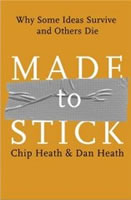
Made to Stick

Order Made To StickHave you ever wondered why you remember what you do? The authors have distilled the essence of “sticking” (remembering a message) into 6 principles (“SUCCES”):

1) Simplicity: One great idea stated (or displayed) well. A classic sticky message is a proverb (“A rolling stone gathers …” and “A bird in the hand is worth …”). The message is short, concrete, and wise.

2) Unexpectedness: Challenging your knowledge creates curiosity. A message that starts with a provocative question gets the reader invested in the message (“Which of these animals is more likely to kill you? A shark or A deer?”).

3) Concreteness: Nouns are remembered better than verbs. Showing something is much better than talking about it.

4) Credibility: Do you believe the messenger? The more details you provide, the more believable the message. Does the messenger personally know the benefit to the problem you’re solving?

5) Emotions: Do you care about the message? The message needs to focus on a specific (“concrete”) individual. Does the messenger really care about solving a problem?

6) Stories: We seldom remember facts. We remember stories. It’s how we’re wired.

Crafting a message that uses these values is not trivial. You need to make sure you have something worth remembering, something that matters to improving someone’s life. You need to pique interest and provide useful information.

Marketing in a Flash

In A FlashLet’s say that business is slow, so you want to market a new product you’re selling. How can you get the word out “yesterday” and get measurable results?

Direct mail. A simple flyer can be created in a day or so. Printing and attaching labels (if you do this in-house) is another day or so (depending on your mailing list size). If you’re sending via bulk mail, or you need to use a printer’s services to print postcards, etc., you’ll need more time. Minimum time until seen: 1 week.

Print. If you already have a regular print campaign (in a publication), then it’s simply a matter of creating the new advertisement and waiting until the next submission date. Minimum time until seen: 3 days (for a daily publication).

Radio/Television. If you already have a campaign, then you need to record (and edit) a new message. If you need to create an ad, it’ll take time to interview agencies, hire talent, negotiate contracts, etc. Minimum time until seen: 2-3 weeks.

Press Release. To create a press release and submit it to the “wire” takes less than a day. There’s no guarantee that your press release will ever be published.

Blog. Respond (on-target) to a well-visited blog and introduce your solution. Minimum time until client contact: immediately (if your comment is approved).

Telephone. You can start calling your existing clients as soon as you’ve crafted your “message”. Minimum time until client contact: immediately (once you’ve got them on the phone).

Email. You can start emailing your existing clients as soon as you’ve crafted your “message”. Minimum time until client contact: 1 hour.

Internet Pay-Per-Click (or Pay-Per-Action). Creating a campaign is as simple as signing up, bidding on your keywords, and establishing an account. Minimum time until seen: 1 hour (immediately, once the account is established).

Internet Viral Video. Create a (series of) funny or novel (short) videos. Upload them to a free video directory. Start blogging (or have your friends blog) about the video. Minimum time until seen: immediately (once you’ve uploaded it and told people about it).