Monthly Archives: March 2008

How Can I Create Effective Web Site Content?

My client want to produce effective web site content and advertising materials suited for target audience. They also want to deeper understanding of what our target consumers are into, what they are thinking, what they like, what make them tick and so on to clearly communicate lifestyle tone, personality and slat of the Web brand. We are assigned to develop a package of market research to provide information for the objectives above. Could you advice me on this. Please note usability test is quite new in my country, and I look forward to get any your advice on this proposal.

###

Jay’s Answer: It sounds like you need to understand more about your target audience first. With the proliferation of the Internet, you should be able to find a number of sites that cater to your audience. In addition to sales sites, look for forums where the audience talks about their problems and other offer solutions. Once you understand what they are talking about, then start asking questions of the group: ask for their input, etc. Offer to compile the responses to your questions and email them to everyone who’s interested.

Develop your website, and invite people from the forums to visit it and give your input. They are your beta testers, and they give you great feedback. However, they’ll only give you half the story – the other part is compelling content. Make sure your home page clearly identifies who you’re targeting and what problem of theirs your solving. Make sure to have a compelling call to action to get visitors interested. And use analytics (such as Google Analytics) to study what’s happening on your website.

10 Rules For Effective Home Pages

Home PagePeople make a split-second judgment of your website. Is it “talking to them?” Is it worth their time to continue reading it? Are you getting the traffic you want? Are visitors converting to customers?

Having reviewed hundreds of websites I wanted to share some rules to help improve your home page:

  1. Who’s the audience? Your home page must clearly identify who you’re talking to. This allows the reader to quickly pre-qualify them self.
  2. What’s the point? Every page in your website should have a primary goal – an action you want the reader to take. Do you want them to sign up for your newsletter? Buy something new? Create a “call to action” to encourage them to do what you want (“Get your copy of ‘Top 10 insider secrets’ by clicking here”).
  3. Title. The title is used for the window’s title as well as in the name of your site in search engines. Your home page title should at least contain your business name.
  4. Menu structure. Menus are generally horizontal (underneath the banner/logo) or vertical (left side). Having multiple ways to navigate is confusing. Put your menus in places where people look. Make sure to have a “Contact” and “About” page.
  5. Footer. Make sure your contact information is on every page. You don’t want your potential customer to have to work to find you.
  6. Scan-ability. People don’t read websites like they read books. Their eyes bounce around looking for “landmarks” to help them evaluate the site. Therefore, clearly use headings and subheadings to make it easy to find sections. Don’t write long paragraphs. Have lots of white space.
  7. Fonts. This is related to scan-ability – you want to create a natural scanning sequence. Use one (or two) font families (for example, Arial) at most. Make your general text easy to read for your demographic (for example, make it 14pt for older eyes) and headings at least 14pt. Use bold and italics to help draw the eye to specific words. Don’t use animated text. Use colors only for very important thoughts.
  8. Graphics & alt tags. Make sure your graphics reinforce your “message” and “look”. Graphics also can act like whitespace if used properly. Don’t forget that all your graphics should have alt-tags (it helps the search engines “read” your site).
  9. Columns (1 vs 2 vs 3). The more information you present, the harder it is to figure out what to read. For that reason, I prefer one-column or two-column (with special offers/information in the right column).
  10. Keywords. Use the right keywords to make it easy for people to find you using the search engines. What are the right keywords? The ones people use (for example, using Adwords).

Make sure that when you change your home page you measure its effectiveness. Are you getting more traffic with the new look/text? Are you getting less traffic but more sales? The best solution to effective home pages is the one that works for your business.

In addition to a careful eye, there are many free tools that can help analyze your website. Here’s one: Website Grader

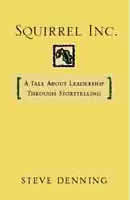
Squirrel, Inc.

Squirrel Inc. BookStories have the power to ignite, educate, unify, lead, share values, and focus attention. We’re born to tell and listen to stories. Why are we shy to use them to help us in business?

While I’ve already written of how to tell your marketing story, Stephen Denning writes about organizational storytelling. His book is a fable showing how can you use a story to help you inside your business.

Next time you’re tempted to use a PowerPoint slide show or present information for your business, consider instead crafting a story. It will no doubt take you longer to prepare your story, but the results can be dramatic. No glazed eyes staring at handouts or screens. Instead, people will be focused on you, listening and imagining.

The book’s story focuses around a squirrel company that needs to change its business model. It has been a company that helps squirrels bury nuts. But one visionary in the company wants the company to instead help squirrels store nuts. How the visionary learns to convince their peers, their boss, and eventually the board is the fable.

The book lists the high-value forms of organizational storytelling, so you can match the right type of story to achieve a certain result. Here’s a brief synopsis:

  1. To spark action
    • The story must be true and focuses on a positive outcome
    • Have people say: “Just think..” or “Just imagine…”
  2. To build trust
    • Reveal some true strength/vulnerability from your past
    • Have people say: “I didn’t know that about you”
  3. To transmit values
    • Describe how leadership did something before
    • You must walk the talk
    • Have people say: “That’s clearly the right way…”
  4. To get people to work together
    • Tell a story that others can relate to
    • Have people say: “That reminds me…”
  5. To neutralize gossip
    • Commit to tell the truth, but show the humor in the situation
    • Have people question the gossip
  6. To share knowledge
    • Tell the problem, setting, solution, and explanation
    • Have people say: “We need to keep on eye on that…”
  7. To lead people
    • Describe a positive outcome about the future
    • Have people say: “When do we start?”

If you don’t feel comfortable telling stories to people, join a public speaking club to exercise your story-telling muscles (or take an improvisational acting class). Remember that you’re not trying to get people to buy tickets to hear you speak (yet) – you’re just trying to learn a new tool to communicate ideas with others.

Is Online Social Net-working?

Online NetworkingMaybe you’re already a member of LinkedIn, FaceBook, MySpace, or any one of the myriad of social networking websites. You’ve heard people talking about “Web 2.0” and how everyone is online. You clearly don’t want to miss the next wave.

Perhaps you’ve heard about the student artist who posted some of her pictures online, and the next thing you know she’s a millionaire, has hired her friends to help her market her art, and she’s the next “big thing”. When will it be your turn for online fame?

The key to networking effectively is to concentrate your effort to be part of the community. This means that you need to be involved: reading others’ postings, commenting, asking questions, and sharing information about yourself (or business).

Common Online Networking Mistakes

  1. Not showing up. Online, if you don’t write, you’re invisible. Make sure that your “voice” is heard (and you read others’ postings).
  2. Wrong network. Are you the proper demographic for the network (or are you targeting the right network)?
  3. Wasting time. Because the communities are so large, it’s easy to get distracted online. Focus on why you’re a member, and limit your time online to prioritize your activity.
  4. Self-importance. If you’re a member of MySpace, you’re 1 of 217 million. If you write online, will anyone care?
  5. Words are words. Online people communicate (mostly) by text. While you may try to intuit the mood or psyche of the writer, it’s just text. At an in-person networking event, you can at least watch the person’s body language during conversations.

Join a network if it appeals to you, but realize that becoming an expert in that network is hard. It’s even harder to make any money as one in a crowd. Instead, leverage your online marketing effort to improve your marketing message, and get people to contact you directly. It’s much better to have someone’s undivided attention.

You also might be interested in: I’m On LinkedIn – Now What??? and FaceBookAdvice.com for more tips on how to make better use of your social network.