
Monthly Archives: June 2008

What Is A Good Tagline For A Year-Round Bar?

Our summer bar needs a tagline to tell clients that it is also open in the winter. Clients are locals. In the winter it is a small, cozy bar. In the summer, it is a large open club, under the stars. We don’t care about the summer now, we want a tagline for the winter.

We thought of: ‘Perfect winter time’ and ‘Winter cocooning starts here’

###

Jay’s Answer: Do the locals visit your bar in the summer? If not, you’ll need to find out why. If they do, but don’t come in the winter, is it because of lack of a crowd?

It sounds like you basically have 2 different clubs: a summer and winter club. They feel different. Market them differently ("The Winter Club is Now Open"). Create speed-dating events. Family events. Ladies-Only nights. Book clubs. Public speakers. Live mike night.

You’ll have to match your demographics with your community to discover what works for you.

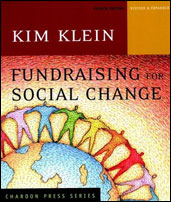
Fundraising For Social Change

Buy This Book If you work for (or with) a non-profit, this book is a must-read. Kim Klein (the editor) focuses on key problem all non-profits face: acquiring, retaining, and upgrading donors.

Acquiring is the process of getting new people to donate to your organization. Typically this is done with direct mail, web site asks, and some special events. The goal is to create an impulse donation.

Retaining is the strategy of converting an impulse donation into a habit.

Upgrading converts the “regulars” to give more than they have before. Typically this is done via a personal call, letter, or special “insider” event.

###

Finding Donors. Did you know that in 2004, 75.6% of contributions came from individuals (11.6% of foundations, 8% bequests, and 4.8% corporations)? Or, 7 out of 10 adults in the US and Canada give away money?

Asking For Money. What’s the #1 way to get donations? Ask for them! You need to identify people who: are able to make a gift, believe in your organization, and can be contacted. Formally, you ask for letter first with a letter detailing your organization and a request for monies for a specific need, following up with a phone call, and ending with a face-to-face meeting. Informally, a phone call followed by a letter would suffice.

Special Events. A special event is a two-fer: a fund-raising opportunity plus increased publicity. During the event, there must be a pitch to let people know now is the time to donate. Consider having some friends of your organization purposely start the donation process to break the ice.

Direct Mail. Use direct mail to: get someone to give for the first time, get donors to repeat their gift, and get donors to renew their gift. On a direct mail piece, expect less than 1% response (higher quality lists produce greater response) – so you’ll need to play the numbers game. Before starting a direct mail campaign, calculate the cost of the mailing vs. the likely result of the donation to arrive at a net income per donor. There a lot of information in the book about crafting the copy of the mail piece.

This book is a gold-mine of non-profit fundraising strategy. If you work with non-profits, read it often.

Marketing Snake Oil

The Dark Side Of Marketing The Dark Side Of Marketing

For the longest time, I associated people who market and advertise with evil. I hated seeing advertisements telling me “if only I bought this, I would be cool also”. I couldn’t imagine what type of person became a marketer or advertiser. Now I am one.

Marketing that attempts to change our belief systems or undermine our values I consider evil . It lives by appealing to our insecurities, showing us a shortcut to happiness. It preaches fear, isolation, failure and shows salvation by living your life differently. A number of years ago advertisers made a fundamental switch in how they talked about their product. In the “old” days, a company would tell you all the wonderful things that their products did and problems they solved. You would chose your product on its own merits. Some consumers that tried those products and didn’t get the promised results wound up in court, claiming a breach of promise. After defending too many lawsuits, the companies wanted a safer way to promote their goods. The result is now companies show a lifestyle, and then show how their product fits into that lifestyle. There isn’t a claim that the product will help you achieve the lifestyle (or any other promise for that matter) – just an association between what product and lifestyle. This works wonderfully, since our brains are wired to fill in the gaps (“Gee, if I had that product, I would look/feel/act/love like that”).

The good side of marketing doesn’t attempt to sway. Instead it simply tries to help customers find the solution to their existing problem. In some cases, marketing attempts to educate you that you have a problem. The good side of marketing is actually helping people. You’re doing a genuine service (and making money doing it).

Good marketing is harder than evil marketing, since you really have to understand what problems people have and try to fix them. Good marketing can also focus on people’s fear, isolation, and failure, but it solves it authentically, not with a mirage.

Gaming the SEO System

I recently heard an interview of a web “guru” who’s showing people how to get their website noticed quickly. Their first steps were straightforward: create a blog, keyword optimize it, and publish it. So far, so good.

The next step involved generating backlinks (links to you site) and social bookmarks (a “thumbs-up” vote for something people find interesting). Instead of waiting for this to happen organically, the guru pays people to comment and bookmark their sites. Since people are interested in the “next hot thing”, the bookmarks beget other backlinks, and the traffic builds quickly. It works.

But, is this ethical right ? Not so long ago, movie studios got into trouble when reporters figured out that some reviews were written by the studio (or someone that the studio paid). Some interviews (of people coming out of the movie) that raved about the movie were also studio-generated. The studios got bad press, and the practice (supposedly) stopped.

The problem is, it’s not yet easy to figure out who has paid-for-posts/bookmarks, and who has authentic ones.

Be careful: it’s a slippery slope to trade off your ethics for dollars.
Optimize Your Website For Search In 3 Steps

Search Engine Logos Since the purpose of having a website is for people to find you online, I wanted to go over some basic strategies for ensuring that people searching for your types of services/products find your small business’s website.

The goal of optimization is to have your website listed before your competitors ("ranked highly") (ideally on the first page of search results, which most people don’t look beyond).

Most search engines report the result of searches in two groups: sponsored ads and normal ("organic ") searches. Sponsored ads appear because the company has agreed to pay the search engine (via a pay-per-click [PPC] ad campaign) money whenever people click on their ad for specific keywords. PPC is a great way to generate traffic quickly, but it’s often not cost effective long-term. Long-term you want your website to appear organically highly ranked.

When a person does a search, the goal of the search engine is to show the most relevant websites that likely match the person’s search terms . The goal of optimizing is to make your site highly relevant for specific search terms.

  1. Identify the search terms you want to rank highly for . As in all forms of marketing, you need to think like the person who’s looking, not as the business who’s selling. That means you need to know what keywords people use to search for businesses like yours. This information is easy to find from pay-per-click programs, such as Google Ad Words Keyword Tool . Don’t forget to also spot trends (using a tool such as Google Trends ) in keyword searches, since you want to catch "up-and-coming" searches that might be ranked low now.
  2. Use the keywords in relevant pages in your website . Keywords are seen in: the main body of the web page, meta tags (less important, but still worth having), and the alt-text in your images. Use keywords naturally – remember the point is to have more customers. If your website isn’t human-readable, then all your work will be for naught. Also, make sure that if you want to target customers in a region, you use your region in your keyword phrases.
  3. Get links to your website. Search engines rank websites by their "authority ". One way they measure authority is how many (and which) other websites link to them ("backlinks "). One backlink from an top-class website is worth hundreds of poor-quality links. You can get backlinks from a wide variety of sites: organizations that you’re a member of, blogs, and directories. One tool I recommend is Directory Submitter , a free tool to get backlinks. Be warned: Google is in the process of penalizing websites with paid backlinks. Also: submit your websites to the search engines (if you have not already) so they can explicitly add your site to their directories: Google , Yahoo , and MSN .

There is a lot more to search engine optimation (SEO) that these tips. Don’t forget there are professionals that can help you with your search engine optimization (I’d be happy to recommend some).