Monthly Archives: July 2008

What’s a Good Slogan For A Christmas (Popcorn) Gift?

I work for a trucking company and one of our customers is a kettle corn company. For the holidays we are giving bags of this popcorn out to each of our other customers that we deliver to. We have permission from them to put our own fun label saying happy holidays on it from the company and we are looking for something catchy. Something like "We just popped in to say Happy Holidays" Or something like that. Any ideas?

###

Jay’s Answer:

  • Our corny present to you
  • Thanks for being sweet to us…
  • When you think of trucking, whose name pops up?

How Can I Create A Brochure For an English Daycare School?

My brother’s English language school in Greece has a pre-junior class for 6 year olds that learn the foreign language as they play. It is unique and innovative for Greece and it is going very well.

He needs to give leaflets to kids at school. It has to be impressive so as to keep it as well as and give it to their mothers.

I think he should create a separate logo with cartoon characters for starts, but another school has already done it (they copied the whole idea of a junior school in fact).

The leaflet could be a weekly schedule, but small kids do not need a weekly program really.

###

Jay’s Answer: Don’t send the flyers home with the students. Mail them to the parents directly. Enclose them in an envelope with the return address of the school. That will further get the parents’ attention.

The logo isn’t the key – the content of the class is. Why would parents want to enroll in the English language school – what’s the benefit to the child? The parents? What is the competition like for other pre-junior classes (not just English pre-junior)?

Having testimonials from other students and parents ("We loved learning English", "Our Travel To England Was More Fun", "My Child Helped Us Get Directions!", etc.) in the leaflet is also key.

Don’t send the leaflet weekly. Send it out before the beginning of the next semester and mid-semester (or when you have something new to announce). You also want to have a "call to action" – something like "Enrollment Closing Soon!"

Waiting For Your Cat To Bark?

Buy This Book The subtitle of this book (“Persuading Customers When They Ignore Marketing”) gives a hint about its purpose: how to appeal to your prospective customers. While the book can be enjoyed by any small business owner, the information is a bit more sophisticated than the usual “here’s some simple ways to improve your business’ marketing”.

The authors have developed Persuasion Architectureâ„¢ which attempts to overcome the traditional obstacles to connecting with your customers:

  1. Uncovery : Identifying the key benefits for your customer.
  2. Wireframing : The steps of the marketing “experience”.
  3. Storyboarding : The mock-ups of the marketing experience.
  4. Prototyping : The “final” marketing pieces.
  5. Development : Ensuring that the prototype matches the wireframe experience.
  6. Optimization : Measuring the results and refining the message.

Persuasion Architecture attempts to figure out all the different ways a prospective customer would need information, and provide it to them ahead of time. They’ve extended the traditional business school model of AIDA (Attention -> Interest -> Desire -> Action) to AIDAS (Attention -> Interest -> Desire -> Action -> Satisfaction), since satisfaction is what generates word-of-mouth mentions.

For me, the best parts of the book were chapter fifteen (“Personas” – which described the different filters people use to get information) and chapter 20 (“The Human Operating System” – which described the basic 4 ways people ask questions).

The key points about personas:

  • Topology: How is your product used? What are the competitors? How did people solve the problem before your product came about?
  • Psychographics: How do different people behave (based on lifestyle and personality profile)
  • Demographics: Where are our customers and what do they look like?
  • Empathy: How can you “do for others as they would like it done to them?”

The 4 ways people ask questions:

  • Methodical: focus on HOW (“What are the details? What’s the fine print?”)
  • Spontaneous: focus on WHY or WHEN (“How can you get me to what I need quickly? Do you offer superior service?”)
  • Humanistic: focus on WHO (“How will your product or service make me feel? Who are you? Can I trust you?”)
  • Competitive: focus on WHAT (“What are your competitive advantages? What are your credentials?”)

I would have liked to see some specific step-by-step examples of applying the Persuasion Architecture to existing businesses (rather than identifying some businesses that use a feature or two of the process). Nonetheless, the book can serve as a good checklist for developing (or improving) your marketing strategy.

The $100,000 Question

$100,000 bill “So, what do you think my web-based business worth?”, someone recently asked me. I questioned them about previous year’s income, expenses, traffic, page rank, and the amount of effort they put into the business.

After listening to their answer, I realized that fifty people when asked this same question, will probably provide fifty different answers, and that all of these answers are likely wrong.

What does matter is what someone is willing to pay for it.

When selling a house, for example, real estate appraisers start by looking at comparable sales in the neighborhood and adjusting the value based on the positives and negatives the home has. The number they arrive at is a historical value. Lenders require them. Real estate agents love them. Sellers try to optimize them. But the house is only worth what someone is willing to pay for it

Business brokers will likewise place a value on a business based on historical earnings (which don’t guarantee future earnings), potential for growth, market niche, etc. But again, the value of the business is in the eye of the purchaser. Of course, if there are tangible assets in the business, those can be liquidated for a known value.

For a web-based business, it all comes down to perception . Is the business making money or is it likely to do so? If there’s lots of unique traffic, then there is additional possibility to make money by selling ad space.

The problem in negotiating “worth” is when there’s a discrepancy between the perception of the buyer and the seller. The buyer is looking for flaws to justify a price reduction. The seller highlights the uniqueness to justify a top price. Both want to walk away from the deal feeling like they “won”.

Instead of getting caught in the perception game, consider the cost for not buying or not selling. If you’re exhausted running the business, then what’s it worth to you to reduce your stress? How about the late nights worrying about the new competition that’s threatening to overshadow your success? When was the last time you took a vacation?

You might regret the sale or purchase, but if you did your “homework” to verify the “numbers”, and you got wise counsel to help with the transition, then everything that happened is investment in your education.

Besides death, taxes, and change, there are no guarantees in life or business.

(Since people love hearing about online businesses that “hit the lottery”, read the story about pizza.com selling for $2.6M or a story about Fund.com and Harmony.com for $10M)

Boost Your Store’s Foot Traffic For Free

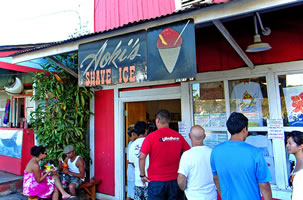
Store Queue
Photo by tata_aka_T

To get more customers into your store, make it easier for people to find your business online. Use Google’s Local Business Center to get your business listed in Google Maps, include a photo of your store, a description of your services, and even downloadable coupons for free. The entire process takes less than 15 minutes and you can easily change your store listing at any time.

  1. If you don’t already have a Google account, get one here . A Google account is also a necessity for using Google Analytics, Google Pages, etc.
  2. Create your Local Business Center Account
  3. Enter your business name, street address, phone number, website, and description. While you don’t need a website, Google requires a valid street address and phone number.
  4. Categorize your business (major categories include: retail stores, organizations, business to business, entertainment, transportation, travel, education, services, health & medical, restaurants, government offices, and real estate)
  5. (Optionally) Specify your hours and payment options.
  6. (Optionally) Upload pictures of your storefront or goods.
  7. (Optionally) Add details such as keywords, price ranges, and/or areas served.
  8. Confirm your listing (either by phone or postcard).

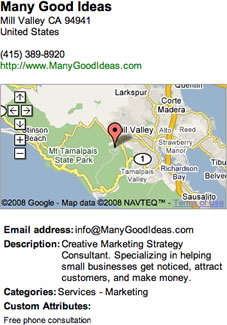
Many Good Ideas Google Maps Listing

The more information you provide, the easier it will be for people to find you: by location, by type of your business, by the hours of your business, and even what your store looks like. Think of Local Business Center as a free online Yellow Pages listing. Make sure you highlight the key benefits of your store to attract online attention.

Of course, adding a listing alone isn’t going to make your business an overnight success. It will make your business easier to find, and is a great addition to an old-fashioned brick-and-mortar store that doesn’t have a website but does want an online presence.

This tip will help increase awareness of your store online. Getting customers to tell their friends and return back to the store is vital strategy for creating an ongoing stream of clientele.

In addition to Google, many other search engines also allow you to submit your store (in many cases for free) to their business lists: Yahoo , Super Pages , Yellow Pages , MSN , Insider Pages , Local , and City Search .