Monthly Archives: October 2008

Marketing For Obama and McCain Supporters

Obama and McCain Photos

The mistake that grassroot political supporters all make is that they spend a lot of time and money getting their candidate elected, and then….wait.

People seem to think that their job is over by getting their leader in office, and then trusting that their issues will be addressed in the coming administration. When it isn’t, they figure either it’s politics as usual or they made a mistake (and replace their choice with someone better).

Imagine instead if on the first day of office, the newly-elected candidate says:

“Thanks to all the passionate people to get me into office. Your work is just beginning. I want you to keep telling me what your communities need. I need to know what policies are working (and not). I need to know what new laws need to be passed (and scrapped). I want to hear from you directly, not through layers of paid consultants and political action committees

To help you, I will be sending experts to train your grassroots committee chairs to poll, write legislation, and summarize the information in a way that I can easily understand it. I’m just one person leading the country, but I need the country to tell me where to lead. I don’t want to fall into the same mistake that my predecessors have. I want to serve my country by listening to your needs.”

This will convert the supporters into active political marketers for America. Communities will be empowered to do something more than wait until the next election cycle. They’ll be responsible for making sure that they’re in active dialog with the government. The general population will have an avenue for creating change. The President can then inspire Senators and Congress to follow what the people want, instead of pushing their own agendas.

Let’s truly create a government of the people, by the people, and for the people.

How Can I Target Seniors For My Health Club?

I work at a health club and have been tasked with putting together a launch plan for the opening of an area within our gym that targets seniors.

I seem to be stuck on a few matters
– name for this (sub) club
– how to gain awareness/effectively promote our seniors club

Any ideas on the above as well as on marketing to baby boomers in general would be greatly appreciated.

###

Jay’s Answer: It depends on what you intend to do internally with the club and your demographic (besides the age). For example, are you targeting people with poor mobility, senior athletes, new retirees, people living in assisted living, rehab patients (from a stroke, etc.), etc. Also, are you targeting men and women, upper-income bracket, middle-income, etc.? Once they come in, what’s special about their program? Do you have senior trainers who understand older bodies? Do you have large print on your machine and other instructions for older eyes? What about the music that’s playing? Extra seating?

Finding the seniors depends on your specific target. It may be connecting with your local senior living center, service clubs (Rotary, Lions, etc that may have a more senior membership), or a local mobility-assistance store (that sells canes, walkers, wheelchairs, etc.), etc. If there’s a senior fair in your area (where a number of vendors get together to show options for local seniors), that might be another great option.

Names: Body Masters, Senior Strength, Live Longer & Stronger.

What Is a Good Tagline For A Balloon Decorating Company?

We have just started a balloon decorating company but we are also seasoned performers of many venues. We are mimes, face painters, magicians, balloon twisters and balloon decorators to name a few and need a tagline. Our company is balloonscapes entertainment.

###

Jay’s Answer: My first question is: “Who is your ideal audience?” Looking at your website, I’m going to guess not just children’s parties, but also street fairs, and private events (both business and non-business).

Here are some quick thoughts:

  • A New Twist On Party Entertainment
  • Breathe Fun Into Your Next Party
  • Memorable, Fun Events
  • Creating Parties That People Remember
  • Enliven Your Next Event

What Is a Good Tagline For A London Day Care?

I have set up a company called “boys and girls nursery” and we intend to open children’s day care across London and the Home Counties but I am missing a very catchy tagline – any ideas ?

###

Jay’s Answer:

  • Enriching Children’s’ Minds & Bodies
  • Your Kids’ Home Away From Home
  • Safe, Fun, and Smart Play

How To Tell Your Marketing Story

One of the key skills you should develop for marketing your business is the art of telling your business story. A story is remembered long after your business name, tagline, and contact information are forgotten (but can be used to find you again).

This is a four part series on how to craft/tell a great story by Ira Glass (of “This American Life“). He has developed his own style of storytelling and distilled his years of experience into these great videos.

#1: On the basics…

#2: On finding great stories…

#3: On good taste…

#4: On two common pitfalls…

Unpeeling Your Marketing Onion

Onion
Photo by Darwin Bell

One metaphor I use to describe what a marketing strategy is (and how I work) is a small business onion.

Strategy is focused on the very core of your business: “What makes your offering of interest to your prospective customers?”

The core of your business is the answer to the question: WHO are your prospects and WHY they should care about you. Simply saying, “I want everyone who wants to buy my product/services to know about me” isn’t good enough. You have to be very specific to create the core of your marketing effort.

You build your marketing onion through words (copy) and images (graphics) that both appeal to your targeted market and reinforce your core marketing message. You highlight what makes your business unique, and how you compare with your competition. At all layers in the onion your contact information is prominently featured, to make it easy for people to stop peeling and starting dialoging with you.

The outermost layer of your marketing onion is your business name and tagline. That’s the first thing that people see about your business. If you craft it well, then they want to find out more, peeling away layers of your marketing onion until either they realize they need your offering or deciding that it’s not for them.

A great marketing onion looks great, is juicy, and is easily understood. Extraneous information isn’t added (but is available when people want more details).

If you need to develop your marketing onion (or evaluate what you have), contact me. I’d love to help you develop a strong business model for long-term success.

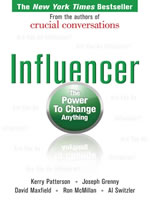
Influencer: The Power to Change Anything

Buy InfluencerAt the core of all great marketing strategies is to clearly identify who your target market is and what their problem is. This book is about the strategies for solving problems.

The core idea is to identify vital behaviors. A vital behavior is a “high-leverage” specific action that has measurable outcome. The author’s favorite example is Dr. Mimi Silbert, the President and Founder of Delancey Street. Since its inception in 1971, her organization has transformed 14,000 hardened criminals into professionals who earn degrees. Dr. Silbert’s vital behaviors are:

  1. Everyone must take responsibility for someone else’s success.
  2. Everyone must confront everyone else about every single violation.

These behaviors took years to develop, but her results are clear: 90% success rate. Too many behaviors, and no one can remember the rules. One or two of these “tipping-point” behaviors and you get results.

The authors believe that if you want to solve any problem, find the people who are studying best practices for that field. These researchers have already identified what works (and doesn’t). If you need to uncover your own best practices, look for places where your problem should exist but doesn’t. Then, uncover the unique behavior of the group that succeeds.

For example:

Best practices for teaching:

  1. Reward positive (even moderately good) performance.
  2. Alternate between teaching and questioning/testing.

Best practices for weight loss:

  1. Exercise on home equipment.
  2. Eat breakfast.
  3. Weight yourself daily.

Best practices for Guinea worm disease eradication:

  1. Strain water before drinking into clean vessels.
  2. If your neighbor has been infected, tell the community.
  3. Keep the infected person away from contaminating the water supply.

The second part of the book focuses on the six sources of influence (think of them as behavioral cues). These influences are needed in-concert to implement the vital behaviors.

  1. Personal Motivation (“Make the undesirable desirable”): Why should someone care?
  2. Personal Ability (“Surpass your limits”): How do they know it works?
  3. Social Motivation (“Harness peer pressure”): Why should they trust?
  4. Social Ability (“Find strength in numbers”): Why should
  5. Structural Motivation (“Design rewards and demand accountability”)
  6. Structural Ability (“Change the environment”)

I wished the authors had more lists of specific vital behaviors listed. Their website (www.VitalSmarts.com) has some additional surveys that they conducted. But I’d love to see a wiki of vital behaviors.

How To Wear Your Sales Message

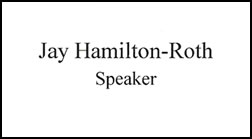
Jay Hamilton-Roth Badge (before)

At a recent conference session I spoke at, an exhibitor came up to me after my presentation and asked a great question: “How can I start a sales conversation with people without being obnoxious?”.

While the conference had an exhibitor hall, the exhibitor was also planning to attend various sessions and wanted some ideas for how to “break the ice”.

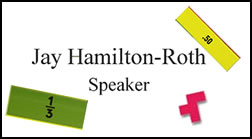
My suggestion was to turn their badge into conversation piece. Most conference badges simply have the attendees name, and some brief biographical information (title, company, location). What I suggested was to take some actual colorful parts to their product, and attach them to their badge.

Since everyone else’s badge was “plain”, their badge stood out. And indeed, people started asking about the colorful things on their badge. The ice was broken, naturally.

Jay Hamilton-Roth Badge (after)Notice I didn’t suggest creating a billboard out of the badge (“Have Questions About XYZ? Talk To Me!”). That sort of message doesn’t create a dialog. It creates a response to the message itself (and a potential lost opportunity to dialog). Instead, my suggestion provides people a way to approach you with their curiosity piqued, and for you to begin a sales dialog. You can pre-qualify your potential client based on their needs, and not on your specific product or service.
Insure Yourself Against Bad Advertising

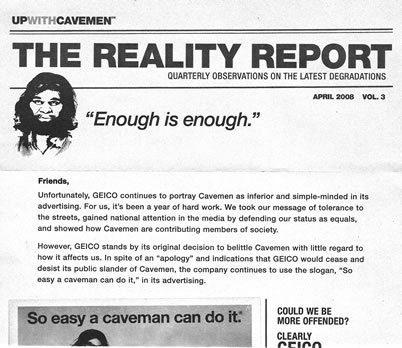
Caveman Insurance Advertisement

I received this advertisement in the mail. It begins:

Friends,

Unfortunately GEICO continues to portray Cavemen as inferior and simple-minded in its advertising. For us, it’s been a year of hard work. We took our message of tolerance to the streets, gained national attention in the media by defending our status as equals, and showed how Cavemen are contributing members of society.

However, GEICO stands by its original decision to belittle Cavemen with little regard to how it affects us. In spite of an “apology” and indications that GEICO would cease and desist its public slander of Cavemen, the company continues to use the slogan, “So easy a caveman can do it,” in its advertising…

It was unclear who sent the letter. On the surface, the sender was writing a “political” letter, complaining about the values espoused by the company. Only after reading the small print it became obvious that the letter was in fact sent by the company itself.

The goal of this letter is to build upon the insurance company’s latest advertising imagery and tagline. It’s certainly clever, but misses the goal: getting prospective clients to contact them because they offer best price/service mix.

Here are some suggestions I’d recommend making to this ad:

  • Contact information . As a minimum, create a URL for this campaign, which would redirect to the real company.
  • Focus on benefit . The direct mail piece was intended to be humorous, but it missed the chance to mention the benefits of this company’s products. This is especially important for people who haven’t seen the advertisements before and are only seeing references to other ads.
  • Make it transparent . At the end of the direct mail, show the “punch line”: Who really made this ad? Why they did it. How to contact them. Why the reader should contact them.