Monthly Archives: January 2009

How Can I Do Brand Image Research?

I need to conduct a phone interview to determine the brand image of a Social Club. So I begin with awareness of the brand and the others, but I want to know which questions or attributes should I use in order to know about the image of the brand?

###

Jay’s Answer: Start with the end goal: what data do you want to have to make a decision? How will you know if your data is correct (and reproducible). Surveys can be used to get data or be used to influence (leading questions). The way you ask questions needs to be consistent and scripted to ensure accuracy and professionalism.

How Should I Market My Webinar Presentation?

  1. Do you prefer events to be developed WITH live video of the presenter, or doesn’t matter?
  2. Do you prefer to dial into a land line, or simply listen through your pc?
  3. Do you prefer to receive PowerPoint, etc. in advance of the event, or is post-event ok?
  4. Do you prefer free events or paid-for events? When will you pay to attend an event? What is the typical maximum amount you would pay?


As I’m interested in your perspectives in this area, please feel free to include any other thoughts around your desired webinar experience – must have’s, do-not-do’s, etc.

###

Jay’s Answer:

  1. Watching someone talk is nice, but not necessary.
  2. Listening through PC (with an ability to use lower fidelity if the video/audio starts “breaking up”)
  3. Post event is fine. Ideally, the audio of the presentation as well.
  4. Free events are fine. What I’d pay for is based on the perceived value of learning what’s being presented.

Also – make sure that the audio/video software is compatible across many computer platforms.

Need Good Tag Line For Financial Services Business

Need suggestions on tagline and suitable logo for a new financial services business I am starting. The name of the business is Goal Financial Services and it will be a boutique business providing mortgage brokering, financial planning and budgeting services to low to mid income earners.

###

Jay’s Answer:

For a logo, try: eLogoContest

Taglines:

  • Grow Your Nest Egg Safely
  • Protecting All Your Dollars Since XXXX
  • Achieve Your Savings Dreams
  • Growing Pennies Into Nest Eggs

How Should I Get Emails To My Customers?

I currently have a list of customers in Quickbooks and want to start sending out an email to everyone in my list. What should I do?

###

Jay’s Answer:

No matter what you choose, your first step is to get the email addresses exported from QuickBooks into a file that your email program can use (for example, http://quickbooksgroup.com/webx/forums/importexport/413).

Using Outlook, you could send a single email to everyone that’s on your list, using the blind cc (bcc:) function. Basically, create your email, send it to yourself, and bcc: all your clients. The clients will receive the email, and won’t be able to see the other names on your list.

  • Pros: you have Outlook, it’s easy to create an email, it’s easy to import into (for example, http://intuitlabs.com/blog/2007/08/email-contact-manager-2/), and it doesn’t cost you anything additional.
  • Cons: the email isn’t personalized, and you have no way of tracking who’s read your email, etc.

To send a customized email to each customer, you’ll need to either perform a mail merge or use a bulk email program. To do a mail merge, you could use: Email Address Manager A bulk emailer is meant to do the mail merge and send the emails in a single package. Here are some options for a bulk emailer: SendBlaster, Email-Unlimited, or FairLogic

  • Pros: you can send a customized email (so each person receives an email to them) using software that’s meant for this purpose. Some bulk email programs can also track the email delivery.
  • Cons: you need to learn/purchase another program and have to update that program on your computer over time.

Lastly, you could use a contact manager to compose and send a customized email to each customer. A contact manager is a web application (so you don’t have to install it on your computer) that’s intended to send out emails to a list of people. Contact managers generally send out fancier looking emails that your plain text and the software can track who opened the email, etc. Here are some options: MyEmma (about $30/month), iContact (about $9.95/month), or VerticalResponse (about $8/month).

  • Pros: you get nicer looking emails and tech support
  • Cons: you pay for the software each month, whether or not you use it. You need to learn to create nice looking templates for sending your emails (or hire someone to create one for you).

Need Slogan For Police Helicopter Anniversary!

I am helping a local police department with a 25th anniversary event for their helicopter division. I would appreciate any suggestions for a slogan for the occasion. The obvious one of “When Pigs Fly” is very cute, but ultimately the PD won’t go for it. They not only do police missions, but also medevacs so they have involvement with the medical side too.

###

Jay’s Answer:

  • 25 years of looking out for you
  • 25 years of keeping you safe overhead

Find Out What They Like: My Marketing Song


When I try to define what marketing is, I find myself thinking about this song from Thomas “Fats” Waller’s Ain’t Misbehavin‘ Musical. While the song is about how to attract a man, the meaning behind the song can apply to your small business marketing. The chorus (“Find out what they like and how they like it and let ’em have it just that way”) is focused on the message of how to appeal to your target audience. The message is simple: find the need an fill it.

However, before you jump in and start trying to uncover out what they like, first focus on who “they” are. Who specifically is your target audience? Male or female? Age? Living where? Married or single? The narrower your focus, the easier it will be to target them.

What do they like? Start by realizing that they probably don’t need what you’re selling. Your goal is to have them want what you’re selling. Targeting a want is best done with an emotional “hook”. Make your offering connect to one (or more) core human desires(s) (such a love, fame, health, etc.) and you have a good start.

If you are trying to convince your target audience that they have been doing things all wrong and that you have a new way to achieve their goals, you will have a tough going. People want what they want. They don’t want to be educated. Ideally, give them what they want and transition them to something better. Giving them what they want does not mean to do what everyone else is doing. Your offering needs to be unique. But it should be familiar.


Find Out What They Like
And How They Like It

I used to wonder right along why I couldn’t hold a man.
Every love affair went wrong until I changed my plan.
We’re having no more trouble now.
My daddy’s nice as he can be.
Ladies I will tell you how, that’s if you’ll take a tip from me.

Find out what they like, and how they like it,
and let ’em have it just that way.
Give ’em what they want and when they want it,
without a single word to say.

You’ve got to cater to a man and if you don’t
he’ll find some other gal to do the things you won’t.
Find out what they like, and how they like it,
and let ’em have it just that way.

Find out what they like, and how they like it,
and let ’em have it just that way.
Give ’em what they want and when they want it,
without a single word to say.

Just add more sugar if he says your jam ain’t sweet
or he will sneak for his dessert across the street.
Find out what they like, and how they like it,
and let ’em have it just that way.

Find out what they like, and how they like it,
and let ’em have it just that way.
Give ’em what they want and when they want it,
without a single word to say.

Now you will lose him if you give him lollipops
when you know he’s crazy just to have some chops.
Find out what they like, and how they like it,
and let ’em have it just that way.

Find out what they like, and how they like it,
and let ’em have it just that way.
Give ’em what they want and when they want it,
without a single word to say.

Now if he claims his lodge is meeting every night,
it means you do not handle all your business right.
Find out what they like, and how they like it,
and let ’em have it just that way.
And let ’em have it just that way.

© 1935 Words by Andy Razaf. Music by Thomas “Fats” Waller.

How To Field Others’ Pitches

Outfielder Catching
Photo by Saquan Stimpson

I learned some lessons about putting out a call for sources for my new Business With Passion TV series.

Have someone review your request. You know who you’re looking for, but it’s easy to not be 100% clear in your request. Have others read you request and note all ambiguities.

Create a special email address. Instead of using your normal email address, create a special address just for this purpose. It’ll make sorting your normal emails simpler.

Respond to every pitch. Having pitched my own business a number of times only to hear…nothing, I was determined that everyone that took the time to pitch me at least received a polite email response.

Use an autoresponder. Had I used a special email address (see above), I could have set it up so that emails to that address received an automated reply confirming their pitch. That would’ve saved me a bunch of time responding to every pitch.

Categorize the pitches. I used my email program to organize the pitches into five categories: Yes, Probably, Maybe, Probably Not, and Definitely Not. If you’re unsure about a pitch’s category, bump it up to the higher category. You can always downgrade the pitch, but you’ll be focusing on the pitches in top-down order.

Prepare an overview. Although you have an image of how you’ll use your sources, your potential sources don’t.Create a single page overview of your project with specific dates/needs. It’ll ensure that everyone is working together.

Pre-screen. Some people look great on paper (e-mail), and some look great in-person. Make sure that your sources match your needs. If you’re going to be doing an audio or video interview, pre-screen the potential guests (by phone). Although there are no guarantees, you will have a better idea of how they will be.

How To Pitch Your Business

Photo by flyfshrmn98

I recently put out a call for sources for my new Business With Passion TV series on “If I Can Help a Reporter Out…“. Because I received a wide range of responses, I thought I’d share some advice for how to pitch yourself (or your client) well:

Read the request. Although my subject was “Passionate Guests for Local Biz TV Show (TV – San Rafael, CA)”, a couple of people thought I was looking for guests for a radio interview.

Don’t underwhelm me. A number of people wrote saying, “I’d be a great guest – check out my website to see more”. I don’t mind digging for information, but only after it’s clear it’s worth my time.

Don’t overwhelm me. One person sent me 20MB worth of high-resolution head shots of their client. Besides taking a while to download, it wasn’t helpful to evaluate their pitch.

Tell me why you’d be great. Ideally, you’ve been on other media (and have clips to share). If not, tell me a story to get my interest piqued. This is tricky, because you need to balance personal information with professional accomplishments. As a producer, I am looking for an interesting person with a story. As a reporter, I am looking for solid credentials.

Don’t sell me your services. Some people sent me their advertisements, complete with price sheets. I’m looking for a guest, not a salesperson.

Don’t pitch me your story idea. A couple of people had their own agendas to push. I might be interested in listening to them after we’ve explored my needs first.

Proofread your pitch. Especially double-check your contact information (including your website’s URL). Spell checking is available in most email programs as well.

Don’t tell me that someone is “perfect”. Unless you know everything about the show, the target audience, the format, etc. you can’t know if there’s a fit. Also please don’t say, “I guarantee your time will not be wasted.”

Look professional. About half of my responses were from public relations firms who were representing their clients. The read the request and pitched a single client of theirs (usually) in a single paragraph/bio. They provided links to their client’s media pages and any current/relevant information. As a result, it made for easy work.

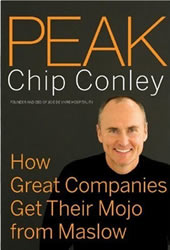
Peak: How Great Companies Get Their Mojo From Maslow

Buy Peak Book

I read this book a few months after presenting my webinar (Can You Take The Crisis and Turn It Into Gold?) and was struck by how the the same ideas that I applied to marketing to consumers (based on Abraham Maslow’s hierarchy of needs) is also relevant within a company, for the customer experience, and for business investors.

Chip has taken Maslow’s pyramid (physiological -> safety -> social/belonging -> esteem -> self-actualization) and simplified it into three need levels: survival -> success -> transformation.

Employees have 3 categories of needs (“relationship truths”): money (creates base motivation), recognition (creates loyalty), and meaning (creates inspiration).

Customers have 3 needs: meets expectation (creates satisfaction), meets desires (creates commitment), and meets unrecognized needs (creates evangelism).

Investors‘ 3 needs are: transactional alignment (creates trust), relationship alignment (creates confidence), and legacy (creates pride of ownership).

Chip’s premise is that most businesses are focusing only on the lowest needs of each group, thinking of basic business survival. But where the opportunity for real growth is in the upper needs of each group.

As a bonus: here’s an interview with Chip about his book:

Can You Take The Crisis and Turn It Into Gold?

(The following is a presentation I made as part of the webinar: Marketing in an Economic Meltdown)

A crisis, according Miriam-Webster’s Dictionary, is “an emotionally significant event in a person’s life”. The crisis is producing fear of the unknown for consumers and their natural response is to reduce their spending.

Because marketing is about knowing what your prospects need, first focus on the emotions behind their decision-making to better connect what you’re offering with what they’re looking for.

As a brief background, psychologist Abraham Maslow wrote the paper “A theory of human motivation”, where he presented the following hierarchy of human needs. From the bottom, they are: physiological, safety, love, esteem, and finally self-actualization.
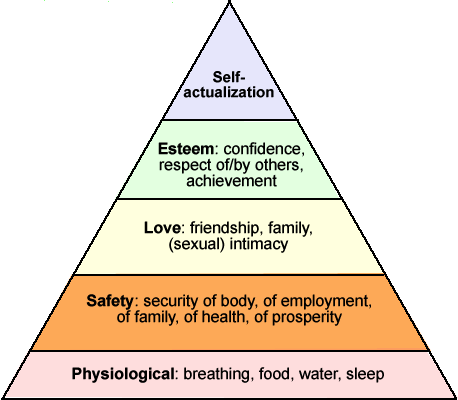
He claimed that you couldn’t focus on higher desires unless those underneath it were satisfied. For example, if you were starving it would be hard for you to focus on your self-esteem; you’d be mostly thinking about eating. People may be interested in the higher desires, but unless the lower ones are satisfied, they’re not going to act on them.

So what does this mean for your business? Your marketing message needs to be focused on (or aligned with) safety to resonate with your prospective clients in times of financial crisis.

So here are 5 ways to resonate “safety” to turn the crisis into a marketing opportunity for your business:

1) Needs vs. Wants

First, position your offering as a need, not a want. Needs are “gotta-haves” while wants are “nice-to-haves”. In times of crisis, people are more focused on needs not wants. If you’re not already in the business of selling needs, you’ll want to highlight your offerings as a need or in conjunction with one.

The following are some of the industries that are seen as needs especially during a financial crisis:

  • Debt Consolidators
  • Outplacement firms
  • Accountants
  • Pharmaceutical companies
  • Healthcare Providers
  • Insurance Brokers
  • Lawyers

2) Small vs. Big Luxuries

Until recently, most consumers have been used to a general feeling of economic success. During a crisis, people still desire luxuries, although big-ticket purchases will be reduced.

So, modify your marketing message to focus on the “small luxury” feeling. For example:

  • If you are Restaurant owner, instead of the esteem-benefit message “Too busy to cook?”, focus on a community-benefit message such as “Relax, rejuvenate, be with friends.”
  • If you own a Travel agency, instead of the self-actualization-benefit message “See the world!”, focus on a discount-benefit message such as: “See your country as never before.”

Also in times of crisis: movie rentals, alcohol, tobacco, ice cream, and local community activities are more popular small luxuries. Where possible, fusion market with these industries or offer these luxuries as desirable premiums.

3) Reframe

Your marketing message needs to target safety instead of a desire higher on the pyramid. Improve your case studies and testimonials to increase confidence in your offering, for example:

  • If you own a retail Jewelry store, instead of the love-benefit message “Show how much you care”, reframe to the financial-safety message “Diamonds are a lifetime investment”.
  • For Seminar providers, instead of the self-actualization-benefit message “Learn something new”, reframe to the employment-safety message “Invest in your future”.
  • For Consulting firms, instead of “Outsource your work to our experts”, reframe the message to be “Reduce your overhead without risk”

4) Divide & Conquer

In times of change, smaller organizations have the benefit of flexibility. Give your separate divisions autonomy to re-approach the market with an entrepreneurial spirit. According to Inc. Magazine’s case studies, the best time to launch a startup is during a recession. One of Method’s founders (a $100M home cleaning products company) says, “starting a business in a recession is like vacationing in the off-season”. GE, HP, Microsoft, and Disney all started during a recession.

To find gold in your industry, resegment your existing client list and retarget your message to them. Be willing to highlight specific products or services in new ways and risk breaking the status quo.

5) Measure

Finally, if you’re not measuring your marketing actions and results, start today. Don’t start a marketing effort without clear metrics and a plan to regularly re-evaluate the results based on impartial data.

In summary, a crisis focuses people’s attention on safety. Creatively show your prospects how your company helps them feel safer and your business will thrive.