Based on feedback and other data it appears that the top 30% of college students welcome my product most. So, the question is how to perform a differentiated or focused targeting of this specific demographics (liberal arts freshmen and sophomores)? Working with universities directly might be the most effective way to go. Other than that, any thoughts?
Do you have any good tips on how to market gym products and gym membership to baby boomers?
###
Jay’s Answer: If someone already is a member of a gym, then you need to identify why switching to yours’ would be better: location? cost? extras? effectiveness? community?
People generally don’t enjoy going to a gym – they enjoy the results from going. Whether that be the endorphins, the appeal of a toned body, or the chance to meet people – that’s the message you want concentrate on.
Last year my boyfriend and I held our first annual community holiday open house to raise donations of nonperishable food for our local food bank, toys for Children’s Hospital, and food, toys, and blankets for a nearby humane society that is in such bad condition, the place should have been condemned years ago. Over 400 brochures were professionally prepared and placed on doors in our neighborhood in a plastic door hanger with chocolate mints, and also left in a few pet-related spa-type stores and businesses in our town.
But this year I DO want to promote my business, as I am trying to grow the business, as well as bringing awareness to these wonderful charities that work nationwide. (A portion of everything I sell in my online shop gets donated to these charities.)
###
Jay’s Answer:
Ask people to send you pictures of their pets for display (on your website, invitation, flyers, etc.).
If you’re collecting donations on behalf of 501(c)3 organizations, you might meet some resistance, since you’re not a 501(c)3 yourself (trust issues).
If you’re still supporting your local Humane Society, have people sponsor specific things: a cage (with their name on it), food for an animal for a week/month/year, medications for low-income owners, etc. Make it tangible and transparent.
Depending on the goal, you could have a people/pet soiree. Or, if people only, have them bring pictures of their animals to help create their name badge.
How about a pet parade, where people and pets walk from organization to organization that are pet-friendly. Have donation jars in each business a month prior, and the parade will go door-to-door to collect the funds. This creates a great photo PR opportunity for everyone.
Owning a franchise is the easiest way to start your business fast. The business name has (hopefully) been well-marketed. People have already experienced the franchise elsewhere in the their travels. You already have suppliers lined up, a well-considered marketing strategy pre-authored, marketing materials – everything to make owning a business turnkey. So what’s the downside?
Franchises are a two-way street. You get the benefit of experience, mentoring, and training. But you also get the restrictions of ensuring compliance with the franchise branding regulations. For example, you may have to sell products that you don’t want to, open hours that are inconvenient, use more-expensive suppliers, and spend more on advertising that you can afford. It also limits your creativity – you must operate within others’ rules or risk losing your franchise (and your investment). Your franchise must reflect well on all the other franchises – since your image can potentially tarnish other franchises – the parent company will spend time and money policing your business.
Franchises require a large initial investment. The companies selling franchises want their money up-front (that’s one of the ways they make their money). The investment is for their best practice training and consultations which can be a great education if you haven’t already done your homework on how to own a business.
If you don’t have the funds, but you have the desire to start a franchise-like business, then get a mentor. Learn everything you can before you open the door for customers. Develop a marketing plan that will attract your ideal customers and that positions your business as distinct from any existing or future (especially franchise) businesses.
Steven Johnson examines a wide number of inventions that have arisen over a large period of time and attempts to determine (where possible) how exactly did the invention arise. His findings show that good ideas seldom arose from the workbench of a solitary thinker/inventor but more likely from a person who actively networks with a wide variety of peers.
In short, first: actively look to solve a problem. You need to understand the domain of the problem, and attempt the simple solutions first.
Next, give your brain time to ruminate on the problem. During this phase, your brain is trying to match the problem to similar things that isn’t immediately obvious. Ideally, record all your thinking (withholding judgment from your thoughts). In the thinking are often the seeds for your solution.
Then, make sure to immerse yourself with other interesting people. Share your problem with them to get their different perspectives and spur on new observations for your problem. Often, your problem has already been solved in some way in a different domain. By exposing yourself to diverse peers, you get more brains seeing your problem’s similarities.
The book ends with these wise words:
“…Go for a walk, cultivate hunches, write everything down, but keep your folder messy; embrace serendipity; make generative mistakes; take on multiple hobbies; frequent coffeehouses and other liquid networks; follow the links; let others build on your ideas; borrow, recycle, reinvent. Build a tangled bank.”
Bonus: Steven Johnson’s TED presentation:
Second bonus: Steven Johnson’s presentation as an animated movie:
Aside: This book is a great companion to the book The Power Of Pull (John Hagel III, John Seely Brown, and Lang Davison).
We spend our lives in search of success. But what does success look like? It depends on who you listen to.
If you listen to our capitalistic society, success is all about how you look to others: your house, your car, your clothing, your partner, your vacations, your purchases, and the company you keep. The road to success is easy: buy more (fancy) stuff. Since there’s always something newer/fancier to buy, businesses are happy to satisfy your need for success. And it’s an endless cycle – you can never achieve success because success is a mirage. As you get closer to it, you find it’s still shimmering on the horizon. And if you manage to achieve some level of “success”, you spend endless hours trying to maintain the image. There isn’t a finish line to success – it’s simply an illusionary moment in time.
Instead, imagine yourself already successful. In this world, success is having meaningful purpose in your life, meaningful friendships, and appreciation for what you already have. The good news about this definition of success is that you don’t have to buy anything. You don’t have to prove anything. You don’t have to look a certain way. Instead, you have to be willing to creating meaning in your life. You have to be willing to ignore the external “buy me” noise and instead focus on the inner “wisdom” voice.
Need some instructions on finding your success? Read Martin Seligman’s Authentic Happiness : Using the New Positive Psychology to Realize Your Potential for Lasting Fulfillment.

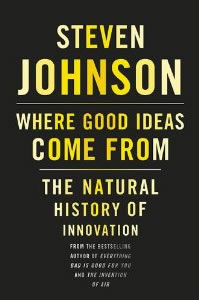 Steven Johnson examines a wide number of inventions that have arisen over a large period of time and attempts to determine (where possible) how exactly did the invention arise. His findings show that good ideas seldom arose from the workbench of a solitary thinker/inventor but more likely from a person who actively networks with a wide variety of peers.