
Photo by Paul Downey
The Internet has provided us all with a double-edged sword: the ability to purchase directly from a supplier instead of a local store. So, how does this affect your business?
If you’re a “middleman”, you need to provide a compelling message not only to choose you over your competition, but also to do business with you (instead of bypassing you entirely). Odds are, you can’t compete on price (nor do you really want to try this as a long-term business model). So, what’s left to focus on? Service. Quick support. Helping the community (if your company provides a local charity “give-back”, for example). Training. Special customization. A human voice and/or face (instead of a toll-free phone number to an automated system). Value-added services (not just focused on a single-vendor’s product, but being able to fix your customer’s entire “system”).
If you’re a “supplier”, it’s your chance to provide easier access to your products or services. Make it easy for people to read all your literature online (including service manuals, troubleshooting FAQs, parts catalog, and how-to guides). Make it easy to order online (using an e-Commerce system). If you’re worried about being deluged with calls from too many “little guys”, then provide a different access on your website for customers vs. dealers.
If you’re a “customer”, determine the true cost of buying direct. How much of the purchase is a commodity and how much is it hand-holding support? Is your purchase time-sensitive?
By understanding the “Internet Middleman” effect, you’ll ensure that your business will be more efficient in the online era.

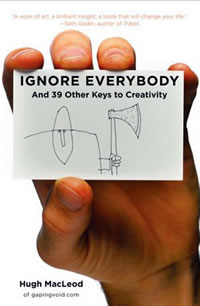 I first heard about Hugh MacLeod from Seth Godin. Seth wrote a story about an advertising executive who prolifically doodled original artwork onto the backs of his business cards (while commuting by train) and gave them away to people he met. The cards became a “calling card” for him – he got noticed. Today his website (Gaping Void) gets over 2 million unique visitors. Cost? His creative time.
 Aside: Another wonderful (and definitely recommended) book on business and creativity is: Orbiting the Giant Hairball: A Corporate Fool’s Guide to Surviving with Grace (Gordon MacKenzie).