Monthly Archives: January 2012

Name My Wedding/Event Planning Business

I am starting my wedding and event and wedding planning.  I am very creative and have the ability to create high class events and weddings and still keep it on a budget. What name would you think best describes this service?

###

Jay’s Answer:   You have some conflicts I wanted to point out. People who are looking for wedding planners don’t think about event planners. People looking for event planners, don’t think about wedding planners. To you, both are parties with guests. But you’re dealing with a very different clientele, and they have different needs (wedding = emotion/love, events = celebration/money).

Also, it sounds like you’re targeting people who don’t have a big budget but want to look like they do. That’s fine, but it’ll limit how your profit (how small a budget are you willing to work with?).

Here are some names to consider:

  • Weddings To Treasure
  • Events For a Song (or Weddings For a Song)
  • Thrifty Events (or Thrifty Weddings)


Launch Your New Business The Right Way

Now Open Sign

(Photo by Taro)

New year, new business idea? Before you start leasing an office space, hiring a web designer, ordering business cards, designing a logo, filing for a fictitious business name, ordering checks, or even registering your new domain name, start by talking to people.

The #1 way to start your new business is through networking. Even after you’ve done all the “checklist” items to start your business, your business success comes down to your customers. So instead of spending time and money setting up shop, first start spreading the word about your ideas and listening to people’s responses.

The #1 indicator for professional success is the size and quality of your professional network. While having having 10,000 Facebook “friends” might be nice, these aren’t the people who are likely to regularly interact with you, respond to your emails, or be willing to meet with you face-to-face. Business success is about relationships – so you need to have a plan to continually build relationships: volunteer your services (or simply your time), formal networking events, informal parties, or simply striking up conversations with strangers (waiting in line, for example). The goal isn’t to sell your (proposed) services – the goal is to establish yourself as a person that’s worth further conversation. Don’t simply collect names to build your network – invest in your time to keep your network “active”. Throw a party. Email them articles that they might enjoy reading. Introduce people in your network to each other. Ask for their input on professional questions. If you’re an introvert, either team up with someone who is an extrovert, invest in learning good social skills, or look for a job in an established corporation.

Once you’re a member of a vibrant network, launch your business. Now you have a community of people who will already know and trust you, and you can focus your energies on the internals of your business, rather than trying to find customers.

Speak With Passion: Using Props & Slides

Speaking On Stage

(Photo by US Embassy Sweden)

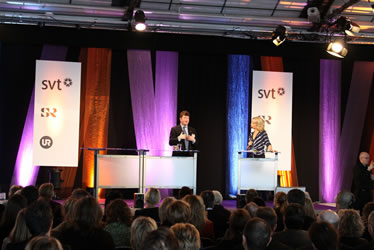
Before you start spending lots of time creating slides or shipping your props across the country for your speech, you need to do your technology homework first and know what the audience will be seeing when you’re on stage.

What does the backdrop look like? A simple black curtain with perhaps a slash of color, elaborate colored curtains, or perhaps even a built-up “set”? Your beautiful piece of artwork (or even choice of clothing) that you want to showcase on stage might simply disappear if the colors are too similar. Will there be a screen that images can be projected onto? Where is it located relative to where you’ll be talking?

How will the stage be lit? You might be squinting through bright lights (and unable to see your audience), or staring into a spotlight (that follows you around the stage), or perhaps the house lights will be up and little or no additional dramatic lighting will be added. The lighting affects not only how you look, but also how visible your slides and/or props will be. If you’re depending upon some dramatic lighting during your presentation, you need to give your show’s producer ample notice to see if your vision and their lighting abilities are a match.

How many people are likely to be in the audience? If there are hundreds (or thousands) of people, will the cute prop you’re bringing onstage be visible by more than the people in the first few rows? If not, will a camera be able to zoom in on what you’re holding and show it to your audience or recorded for later playback? If your personal goal is to have a great presentation for video for example, then it doesn’t matter if the audience can see your prop.
 

Speaking On Stage

Photo by Miriam Olsson

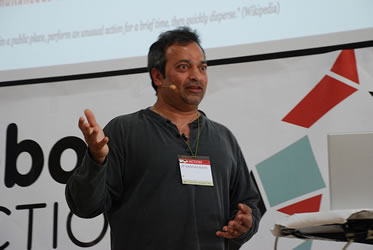
Slides or not? For many presenters, it’s not a question – it’s an assumption that they’ll show their latest PowerPoint deck. From your audience’s perspective, why do they need to see the slide? Is it to show proof of what you’re talking about? Is it visual “eye candy” – something to break up the talk? Is it a requirement that they read along with what you’re saying?

If you do decide to use slides (and/or video), ensure that either: 1) you can bring your laptop (and associated cables) to connect to the projection system or 2) that your show producer has a version of the software that you used to create the slides on-site. If you’re going to use the producer’s software, then ensure that you have version compatibility (their software can read your files). Next, use slides that fit your audience size. The bigger the audience, the simpler the slides should be – since not everyone will be able to read the slide – just get a “gist” of what you’re trying to point out. But just because smaller audiences can read words on your slide, doesn’t give you permission to write down more than a few key thoughts. Be sure that if you use slides, you leave ample time to practice running your slides in the venue with show-like lighting. You might find that your slides don’t stand out nearly as well they did on your computer’s screen.

The microphone. Will your presentation be amplified? Will your presentation be recorded? If there is a microphone – will it be a handheld, on a stand, a lapel mic clipped to your shirt, or a headset mic that hooks on to your ear. Whatever the system, get comfortable with it so you’re not adjusting it during your talk. Also – if there is a microphone, don’t choose to ignore it. The audio might be vital for a video recording, and if you’ve wandered out of range, the video will suffer dramatically.

Remember that your speech is ultimately a live performance. You don’t want to add unnecessary complexity to your performance (that might be a distraction). But if you do choose to make things more complex, practice your presentation as much as your speech.


Marketing To The Choir

Marketing To The Choir

(Photo by Ann Powell Groner)

Let’s say you’re about to sell a new eco-fabulous product. It saves 50% energy, lasts 25% longer, and is made by Fairtrade workers. Who are you going to target your marketing message to: the people who say they’re ecologically aware (“green”) or to people who aren’t?

If you’re targeting your “green” prospects, you’d share all the details of your “eco-fabulosity”. These people “get it” – they understand the key ecologically-friendly points. These people would care about the details, and compare these details with products they are already considering. They would feel good about buying a better choice. You wouldn’t have to educate them to your green-related differentiators – these people are already educated. They are your choir.

If instead you’re marketing to people who either aren’t ecologically aware or don’t care, your message would need to be different. You could spend you message educating them first why they should care about the “green” benefits and then explain why your product is the right choice. Or, you could simply show why your product is the better choice, with an ecological secondary benefit.

The problem is that there’s likely a smaller group of people who “get” your message (the choir). Your new product would simply compete in a small segment, and you’d fight for market share. Your marketing message would be easier to figure out – you’d share your company’s values and show how they align with your customers’.

If you want to grow your business, you’re better off focusing on a niche of people who are under-served and then showing how your product solves their needs better than anything else. The problem is these people might not care about your company’s values, your ecological footprint, etc. They only care about how well your product takes care of them.

Sometimes we forget that by taking the easy road of marketing to the choir, we’re actually hurting our company’s long-term success. Instead of assuming that everyone likes our product for what it stands for, we’re better off focusing on things that matter to our prospective customers.