Category Archives: Creative Business Ideas

Marketing Flotsam

Flotsam on Beach
Photo by Mike Warren

Everyday we’re bombarded with product names and messages. As a business owner, we’re hoping our name rises above the marketing noise and is latched onto by our prospective customer. But the reality is, your marketing effort is more likely than not to fail.

Shouting louder won’t help. We’ve all been to parties where people struggle to be heard. What do you do? You try to talk over everyone else. At the end of the evening, you likely have a sore throat and pained ears, and the sense that you missed some important conversational tidbit.

Being unremarkable won’t help. Keeping up with your competition means you’ll always be seen as “me too”. People want to be aligned with leaders, not followers.

Being disposable won’t help. If people know that if they ignore this marketing message that it’s not a big deal. There’s a similar one coming soon after.

Being unconnected won’t help. The average person seldom buys from strangers. People buy because others have validated the purchase (whether that be Amazon customer ratings, Yelp scores, surveys, or magazine reviews) to ensure they don’t wind up with junk.

So what can you do to increase the chance that your marketing will succeed?

Study the marketing flotsam. What have been the results of similar campaigns been by others? Save your money and time by first looking  through the marketing graveyard.

View each marketing message as a part of the dialogue. A single message is unlikely to convince. Build your message over time, repeating the core values/benefits of your offering.

Measure ROI. Ensure that each action you take you can measure its results. Repeat what’s working.

To ensure that your message is at least noticed, make sure it’s relevant, consistent, and well-targeted.


Marketing Without A Hitch?

Busy street scene
Photo by Michal Fabry

If you’ve been struggling to attract new clients to your business, stop and think. If you’re selling something people have never seen before, then you need to educate them – and that takes both time and money. But more likely, you’re just another business in the pool of choices for people.

Think of your prospects as cars on a road and your business as a hitchhiker on the side of the road, looking for a car to stop and give you a lift. Cars in the fast lane won’t even notice you – you’re not in their field of vision. They have too much invested in going fast and simply being on the side of the road won’t inspire them to slow down, switch lanes, and apply the brakes. Cars in the slow lane are more likely to stop – they have time to look you over and perhaps read your sign for help (“Car Died. Need Lift To Work.”) If your message/presentation invokes trust, then someone is likely to stop.

Customers are likewise busy driving about. If they are fiercely loyal to certain brands/companies, then they are in the fast lane. They’re not looking to switch brands, maybe just switch to the latest offering. So, you’re unlikely to be noticed by them. Instead, focus on people who are entering the roadway – those that have no loyalty yet and are looking for a solution to their problem. If you have the right message for them, you’re likely to get noticed. If you have the right offer and the right trust level, you’re likely to have people slow down to check you out. And perhaps, have them stop and pick you up from the side of the road (and tell their friends about you as well).

Focus your message on those that are likely to want to hear it.

Marketing To DIYers

Do It Yourselfer
Photo by Colleen Koenig

How does your business treat do-it-yourselfers (DIYers)? Do you only offer premium products that require a special service call to install/maintain? Do you offer services that only your skilled factory technicians are allowed to do (otherwise the customer will void their warranty)? Since do-it-yourself-ers (DIYers) make up a vocal minority, make sure that your marketing doesn’t ignore them (or worse, fight against them). If you don’t have a plan to work with DIYers, you’ll eventually be wondering why your always-successful business is starting to struggle.

Some DIYers enjoy learning new skills. Others may simply like save money. Sometimes even it’s just the point of feeling like they could, if they wanted to, do it them self. Whatever the reason, DIYers are never passive customers. They ask a lot of questions. They study your marketing materials very carefully. They want to understand both the short-term and long-term implications of your offering. And once they choose, they’re quite loyal and vocal. They proudly tell others about their latest projects, challenges, and accomplishments. They’ll share their techniques with their friends.

It’s easy to dismiss DIYers as annoying prospects. They don’t follow your standard marketing pitch. They don’t accept what you’re saying at face value. They want to dig for details. They want to engage your technical people at length. If you have your own fleet of service people, DIYers want to know why they can’t do the service themselves. They can read manuals. They have their own tools. They are smart. And they can be stubborn.

Instead of working against DIYers, freely share your (non-confidential) information with them. Let them understand the skills necessary and the risks that they’ll face. You might find that DIYers won’t really want to do the job themselves once they comprehend the full scope of responsibility. And instead of pushing DIYers away, you’ll develop a passionate group of vocal ambassadors.

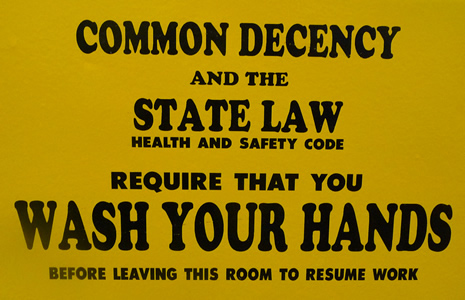
Marketing Courtesy

Decency sign
Photo by Bev Sykes

I got a cold-call message on my answering machine the other day. The person was selling me the opportunity to buy booth space at a local business show. Their phone message ended with the statement, “…please have the courtesy to call me back at (800) 555-1212…”. I didn’t call them back. Would you have?

The problem with the phone call was they knew nothing about my business, my target market, my demographic, my skills, or me. They were likely given a list of business names and phone numbers in the region and proceeded to cold-call everyone. They were banking on the message that “there will be lots of very motivated business owners attending” to hint that simply by being at the show I’ll make money (or at worst, be seen by many prospective clients). They were playing a numbers game. And like any casino, the only one who wins these games is the “house”.

Instead, if the caller first called me to find out more about me, and my business, they would’ve impressed me and then be better able to sell to me in the future. They might create a leads database that knows what opportunities I’m looking for and only pitch me when they have something close. Of course, doing this involves work and skill. You can’t simply hand someone a script and ask them to interview people over the phone to get to their core business needs.

So the next time you try to market your offering to someone, please have the courtesy to find out about them first. Otherwise, you’re simply being rude. And rude people don’t get noticed for the right reasons.

Marketing To Us (And Them)

Busy street scene
Photo by Dar’ya Sipyeykina

One of the easiest ways to market something is to make it easier to join the “club”. You want to be cool? Dress like we do. You want to look like us? Exercise like we do. But is there a risk to using this technique?

First, by putting the “in club” on a pedestal you’re making them a worthy goal. But what happens when “they” start doing dangerous, illegal, or stupid things?

Secondly, the “in club” knows there are lots of wannabes. They actively root them out, and know that many people are “posers”. Looking like you lead the lifestyle and living the lifestyle are two totally different things (unless you’re simply looking at the club’s veneer, and not at its soul).

Imagine you’re selling a magic pill to people who are looking for an easy way to lose weight. It’s made of natural herbs. People who take it lose weight. So you build a marketing campaign to tie the pill with happy, healthy, thin people. All’s fine until the ingredient in your pill causes some major side-effects. While your customers may have lost weight, they may not be facing serious health consequences. This creates three major problems that’s liable to send your company into a downward spiral: (1) fewer people buy what you’re selling, (2) those that bought it, now want retribution, and (3) you’ve lost people’s trust in their ability to lose weight.

(Un)fortunately, there is no magic pill to marketing success. Selling the sizzle is easy. Selling the steak is harder. Selling steaks to people who appreciate your steaks is the ultimate goal.

The Marketing Striptease

Burlesque
Photo by Steven Depolo

The goal of your marketing is to have people stop to pay attention to it, listen to your message, and then take immediate action. But these days, with lots of competition for attention, how can you be successful?

Follow the examples of professional burlesque dancers. They know that their goal is to create interest and hopefully desire in the audience. They first position them self as something worthy of desire, then sloooowly share that connection with the audience. If the pacing is wrong, then the audience loses interest. If the pacing is right, and the energy is focused, then the performer can do no wrong; it has the audience’s full attention.

In your marketing copy, you need to first grab the audience’s attention with a promise that they can’t ignore. You need to confidently state that you’re worthy of attention, and slowly share your worthiness with your audience. If your copy is a menu list of features, then your conversation is over – they look at the menu and either it “clicks” or it doesn’t. But in any event, it’s not memorable.

So start with something enticing – an “image” that the reader can “see” (the image can be carefully written prose, photographs, video, etc.). The only goal of the start is to get their attention. Next, slowly get the reader to see them self in the picture. Is that image even more enticing?

Now, show a little of what you’re describing in detail. Not too much, but just enough to show that you can deliver on your promise. Still reading? Good. Show a little bit more of what you can do. Now what? Ask them to take action – email you, call, complete a form, whatever is appropriate. And so you don’t throw cold water on your prospect – make sure that however you continue the conversation one-on-one, you maintain the same level of seduction.

Marketing Creativity

Creative Play
Photo by Chris Metcalf

Are you an artist, writer, photographer, or doing some other creative work you’re trying to sell? How can you sell your creativity? You can’t. There’s no section in the Yellow Pages for creativity, nor is their a college major in “creativity”. People don’t buy creativity – they buy things and services that help them solve problems.

So before you start advertising your “creative soul” to everyone, stop and think. When someone purchases your offering, what do they get? How does that improve the quality of their life? A painting could be inspirational, or it could add some color to an otherwise barren wall. Your book could change someone’s life, or it could be put on the bookshelf, never to be opened. You don’t really know until you ask someone why they’re buying from you. And when they do, don’t show your shock — just listen.

People think of creativity as something that’s simply magically dropped in to whatever the project needs. A dash of color. The perfect turn of phrase. An interesting perspective of a photograph. A little guitar riff. People might notice the extra creative effort you applied…or not. It really doesn’t matter. You’re being creative for your sake, not your customers’.

Think of your creativity as a gift that you freely give away. The more you give, the more creativity you develop. You can take your creativity and apply it a myriad of ways – that’s your secret joy. If someone notices it – enjoy the serendipitous connection. You’ve found another creative soul. But they’re not asking for your creativity – they’re asking for what you can do for them with it.

Don’t stop being creative. But don’t market yourself as a creative person – people don’t really care. Do market yourself as the person who changes others’ lives for the better.

The Marketing Marathon

Running A Marathon
Photo by Online Photography School

Endurance athletes (who run marathons, bicycle centuries, swim miles) know that they need to pace themselves if they wish to finish successfully. To train these feats, they exercise to build up aerobic capacity and strengthen their body’s core. But they also know that repetitive motion needs to be efficient, since engaging a muscle requires energy. To conserve their energy, they need to move optimally.

Your business has similar needs. Crafting an email, an advertisement, a newsletter, a mailing, a direct mail campaign, or even a customer event takes both energy and money. If you wish your business to last for the long haul, treat running your business as a marathon – not a sprint.

Before you begin a new activity, study the need for it. If an email every month works well, then don’t think that an email twice a month will be even better. Consider seeing if an email every 6 weeks works as well as every month. I’m not advocating for you to become lazy – on the contrary – I want you to be efficient in each of your business and marketing activities.

While it may be tempting to jump in to the latest social media tool to “stay connected with your customers”, if doing so will take energy away from other tasks, understand the trade-off you’re about to make. Something else in your business will get less attention.

People may notice that you’re doing less of a type of marketing than you used to (for example, writing shorter newsletters). Don’t react to what people are saying – react to what they are doing. Are fewer people contacting you? Fewer people purchasing your offering? Fewer referrals?

Figuring out your marketing mix should be an ongoing research project. Don’t be afraid to ramp down efforts that aren’t benefiting your business (either directly or indirectly). Only spend energy on efforts that propel you to your goals efficiently.

Asymmetry

An asymmetric look
Photo by David Goehring

When we market to someone, we’re looking for a reaction (ideally, a purchase). Just like when we talk to someone, we want them to listen. When we don’t get the immediate reaction, we feel like we’ve failed.

I recently ran into a teacher of mine who developed ALS. As I started talking with her, not paying attention to the fact that she was wheelchair-bound. It wasn’t until she responded slowly did it occur to me that her communication skills has slowed down dramatically. Her memory was intact, just her ability to talk at a quick rate was affected. I realized that we would have to talk asymmetrically – she could listen, just not participate as fully.

When we create a marketing campaign, we sometimes forget that not everyone chooses to respond when we want them to. Perhaps the advertisement is filed away, or the press release put into a folder on their hard disk for later. When the time is right, when the person is seeking a solution to their problem, do they start looking through their files for ideas.

And that’s when your marketing campaign will pay off. Only if you’re very lucky will your marketing message arrive to the right person, at the right time, with the right offer. Instead, make your minimal goal to have a marketing message that’s valuable enough to be filed away for later. You want your marketing to be top-of-mind when your prospect is actively searching for help, and be seen as a valuable resource that was kept until now.

Marketing Happiness

Eating A Donut
Photo by D Sharon Pruitt

The marketing equation is simple: convince someone that they’ll be happier if they buy your product or service and you’ll make a sale. Do it often enough, and you’ll be rich. But does buying your offering really equal happiness, or are you selling a pipe dream?

The psychologists have concluded that our brains are wired for wanting and also for happiness. So it would seem logical that when a want is satisfied, then happiness increases. Unfortunately, it isn’t so. Sure, there’s a quick high from achieving the goal, but that doesn’t last, and doesn’t truly increase your happiness. As well described in Eric Weiner’s book The Geography of Bliss, happiness comes from: creativity, community, freedom from failure, and not thinking about if you’re happy.

People deeply know that once their basic needs are satisfied, more things won’t truly make them happy. But if you watch enough media, it’s easy to be swayed to thinking that the latest car, dress, self-help book, CD, or electronic gadget will make you happy, desirable, and a leader.

As a business owner, do you pander to “common wisdom” and try to link your offering with your prospect’s happiness? Or, should you appeal to some lesser emotion and add a dose of logic to build your marketing message?

If your goal is to sell something once, then you’ll be tempted to do what’s easiest, most inexpensive, most common, and “works”. If you goal is to develop a long-term relationship with your customers, then don’t lie to them. You’re not selling happiness. You’re selling solutions to their problems. Happiness is your customer’s responsibility. It’s not sexy, but it does treat people with respect and not simply as business opportunities.