Category Archives: Creative Business Ideas

Can You Take The Crisis and Turn It Into Gold?

(The following is a presentation I made as part of the webinar: Marketing in an Economic Meltdown)

A crisis, according Miriam-Webster’s Dictionary, is “an emotionally significant event in a person’s life”. The crisis is producing fear of the unknown for consumers and their natural response is to reduce their spending.

Because marketing is about knowing what your prospects need, first focus on the emotions behind their decision-making to better connect what you’re offering with what they’re looking for.

As a brief background, psychologist Abraham Maslow wrote the paper “A theory of human motivation”, where he presented the following hierarchy of human needs. From the bottom, they are: physiological, safety, love, esteem, and finally self-actualization.
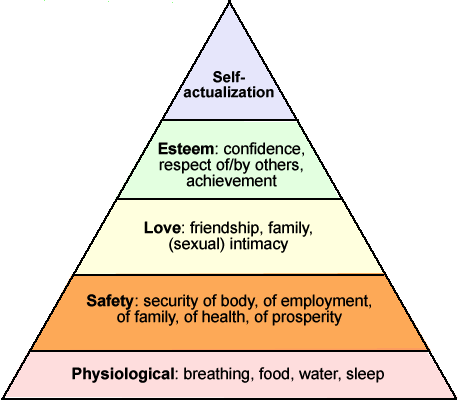
He claimed that you couldn’t focus on higher desires unless those underneath it were satisfied. For example, if you were starving it would be hard for you to focus on your self-esteem; you’d be mostly thinking about eating. People may be interested in the higher desires, but unless the lower ones are satisfied, they’re not going to act on them.

So what does this mean for your business? Your marketing message needs to be focused on (or aligned with) safety to resonate with your prospective clients in times of financial crisis.

So here are 5 ways to resonate “safety” to turn the crisis into a marketing opportunity for your business:

1) Needs vs. Wants

First, position your offering as a need, not a want. Needs are “gotta-haves” while wants are “nice-to-haves”. In times of crisis, people are more focused on needs not wants. If you’re not already in the business of selling needs, you’ll want to highlight your offerings as a need or in conjunction with one.

The following are some of the industries that are seen as needs especially during a financial crisis:

  • Debt Consolidators
  • Outplacement firms
  • Accountants
  • Pharmaceutical companies
  • Healthcare Providers
  • Insurance Brokers
  • Lawyers

2) Small vs. Big Luxuries

Until recently, most consumers have been used to a general feeling of economic success. During a crisis, people still desire luxuries, although big-ticket purchases will be reduced.

So, modify your marketing message to focus on the “small luxury” feeling. For example:

  • If you are Restaurant owner, instead of the esteem-benefit message “Too busy to cook?”, focus on a community-benefit message such as “Relax, rejuvenate, be with friends.”
  • If you own a Travel agency, instead of the self-actualization-benefit message “See the world!”, focus on a discount-benefit message such as: “See your country as never before.”

Also in times of crisis: movie rentals, alcohol, tobacco, ice cream, and local community activities are more popular small luxuries. Where possible, fusion market with these industries or offer these luxuries as desirable premiums.

3) Reframe

Your marketing message needs to target safety instead of a desire higher on the pyramid. Improve your case studies and testimonials to increase confidence in your offering, for example:

  • If you own a retail Jewelry store, instead of the love-benefit message “Show how much you care”, reframe to the financial-safety message “Diamonds are a lifetime investment”.
  • For Seminar providers, instead of the self-actualization-benefit message “Learn something new”, reframe to the employment-safety message “Invest in your future”.
  • For Consulting firms, instead of “Outsource your work to our experts”, reframe the message to be “Reduce your overhead without risk”

4) Divide & Conquer

In times of change, smaller organizations have the benefit of flexibility. Give your separate divisions autonomy to re-approach the market with an entrepreneurial spirit. According to Inc. Magazine’s case studies, the best time to launch a startup is during a recession. One of Method’s founders (a $100M home cleaning products company) says, “starting a business in a recession is like vacationing in the off-season”. GE, HP, Microsoft, and Disney all started during a recession.

To find gold in your industry, resegment your existing client list and retarget your message to them. Be willing to highlight specific products or services in new ways and risk breaking the status quo.

5) Measure

Finally, if you’re not measuring your marketing actions and results, start today. Don’t start a marketing effort without clear metrics and a plan to regularly re-evaluate the results based on impartial data.

In summary, a crisis focuses people’s attention on safety. Creatively show your prospects how your company helps them feel safer and your business will thrive.

Fishing For Business?

Caught fish image
Photo by RichardBH

Imagine sitting on a quiet lake in the early morning. You’ve been out on the same boat, on the same lake for a week, but you haven’t yet caught anything. Today you take out your favorite lure, attach it to your line, set the bait, and cast your line. You wait a little bit, feel a slight tug on the line. After a long struggle, you reel in your catch and see it’s a big bass. Why did that fish bite your hook today?

If you could, you could interview your fish. What attracted it to your lure? What was it doing before it noticed it? Why didn’t the other fish grab it first? Was it hungry for the lure, bored, or feeling something else?

Of course, you can’t interview a fish. But the same experience is what most businesses go through. Businesses create a lot of marketing, and wait for the phone to ring. When it does, they’ve begun the process of landing a new client.

When someone contacts you, do you know what made them reach out to you? Was it a recent review in your local newspaper? Did their friend recently use your services? Was it recommended on Yelp? Did your website come up on the first page for a Google search?

After someone contacts you (and especially after they’ve become your client), you must find out exactly why they made that first contact. Since there’s no easy way to find out why people don’t contact your business, you must attempt to hone in on those that do. If one person needs your services, then others will also.

In many cases, your clients won’t know exactly what triggered them into making contact. You might hear, “I’ve been thinking of contacting you for a while…”. Ask them specifically if they saw your Yellow Pages ad, newspaper review, website, pay-per-click ad, signage, or talked with someone who recommended you.

Collect this data and notice the trends. What do your “better” clients have in common? What sparked them into action? Then do more of what worked, and less of what didn’t.

When you need to fish for clients, use a marketing strategy that you know works for your business.

What Do People Hear In Your Marketing?

Photo of ear
Photo by Sudarshan Vijayaraghavan

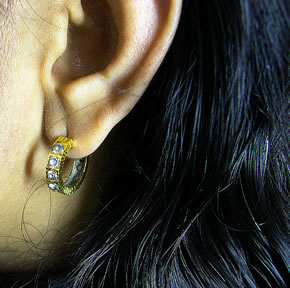
At a business mixer when someone asks you, “What do you do?”, tell them and then immediately ask them a question. “What did you hear?” And listen to their response.

We spend a lot of time creating our elevator speeches, memory hooks, taglines, headlines, and copy but we don’t spend enough time finding out if what we say is what’s being heard.

Start by asking interested strangers to tell you how they perceive your marketing message. Begin by asking them to repeat the message verbatim. Can they? If not, what words to they remember?

If you message includes either “technobabble” or vague “business-speak” it’s highly likely it sounds impressive when you say it, but no one outside your company will have a clue why specifically they should hire you.

Speaking simply might sound unsophisticated, but your message will be heard and understood short-term.

If you’re fanatical about ensuring your message is retained, re-contact people you meet and ask them, “What does my company do?”. You are trying to measure if your message stuck. If it didn’t, you have a second problem: your message isn’t remarkable enough to be kept in your prospect’s mental filing cabinet.

Crafting a message that is both clearly understood and memorable is an skill you need to develop in your business. Otherwise, you are wasting your time and money trying to attract new clients.

How Not To Construct An Advertisement

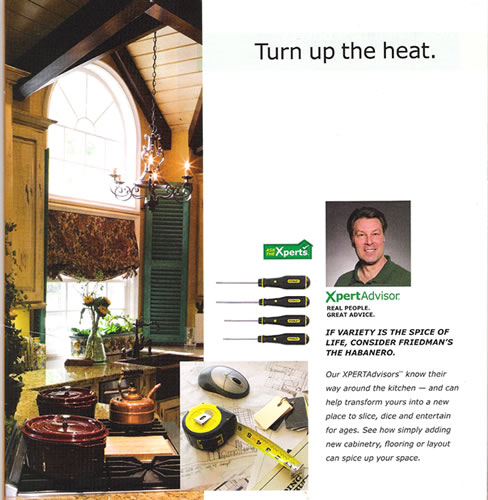
Xpert Advisor ad

When I read this ad, I was confused what exactly was being offered. I didn’t notice the headline (“Turn up the heat.”) because it was graphically weak (compared to the image on the left). The first text I read was, “IF VARIETY IS THE SPICE OF LIFE, CONSIDER FRIEDMAN’S THE HABANERO.” But what does this mean?

Spending more time with the ad made is clearer that Friedman’s has staff who can help give you ideas for kitchen remodels. The creative idea was to somehow connect hot peppers (“habanero”) with a “hot” kitchen.

It appears that the basic marketing strategy for this business:

For local homeowners
who need a kitchen remodel
we have friendly advisors
to give you up-to-date information
unlike other big-box retailers
our offering makes it easy to get great results

Okay, so how to change the ad? Use the strong image of a fancy kitchen and change the ad’s copy to read, “Let us help design your dream kitchen” (focus on results/service).

Alternatively, integrate the kitchen’s “before shot”. The copy could read, “Go from old to Oh-My easily” or “Make Remodeling Your Kitchen A Dream”.

Generate Your Own Business Name

Someone contacted me recently looking for a name for a new high tech business. They specifically didn’t want a name that conveyed any details about what the company actually did. They simply wanted a name that sounded cool. So I referred them to Dot-a-mator. For example, here are some of names it generated for me:

  • Linkjam
  • Rifftube
  • Tambee
  • Yotz
  • Kicero
  • Ore
  • Aitz
  • Cogivee
  • Jetware
  • Chatblab
  • Zoonder

If you want to narrow down the list further, you can ask it to mix/match prefixes/suffices using its built-in groups of words: boats, bugs, cash, charts, color, critters, etc.

What’s particularly clever is that the generated names can be checked (in bulk) for domain name availability (by Dotster, presumably the company that produced the tools).

Another simple option is Wordlab’s name generator.

As a rule, I don’t recommend meaningless names for your business. Because the name doesn’t immediately mean anything, then people seeing your name won’t connect who you are with what you do. You’ll instead need to spend time/money educating people of your offering (“LinkJam specializes in repairing sewers using robot inspection”). The generated names might instead be ideal for “code names” for internal projects.

After creating your own business name, you might also want to create your own logo (for free). Take a look at LogoYes. The logos are generic, might might be just what you need if you don’t have the funds to hire a graphic artist to design something custom. Alternatively, you could use eLogoContest, where graphic designers compete to create a custom logo that you like. You can get a logo for $25 and up, and only pay if you’re satisfied.

Does Your Website Jingle?

Jingle Generator Logo

Because people are being saturated with marketing messages, your message needs to be on-target but also worth remembering.

To keep your website’s content memorable, incorporate more than text to your site: photos, videos, audio, surveys, widgets, etc. The goal is the different components should “fit” into a larger picture for your marketing strategy’s success.

For example, the free Jingle Generator is an attempt to use interactive media to build extra interest in the company’s offerings. The core idea is to attract small business owners to create a canned jingle (for a radio spot). The experience is fun. Here’s a jingle it generated for Many Good Ideas:

The marketing campaign attracts the target market (small business), but it doesn’t connect the jingle (the piece) with how the company can help improve your business (the big strategy picture).

You don’t just want website traffic. You want traffic that wants to pay for your products or services.

Do You See What Everyone Else Sees On Your Website?

Your website is up and running. It looks great, and you get an email from a website visitor: “I wanted to let you know that your graphics on your site look strange…you might check it out.” How is it possible that your site looks fine to you but wrong to someone else?

You would think that each web browser program (Safari, Internet Explorer, Firefox, etc.) take the same web page information and display it identically. Sadly, you’d be mistaken. Web pages are generally written in (a combination of) HTML, PHP, Flash, or CSS. These are different programming languages that web site designers can use to create a site. While there are standards for how these languages display information, in some cases, the interpretation is open-ended. And there’s the problem.

As a minimum, when you create (or have one created) make sure that the site looks “correct” in the major web browsers. But since each of the web browsers have multiple versions and can run on multiple operating systems, it’s non-trivial to test everything.

Browsershots logo

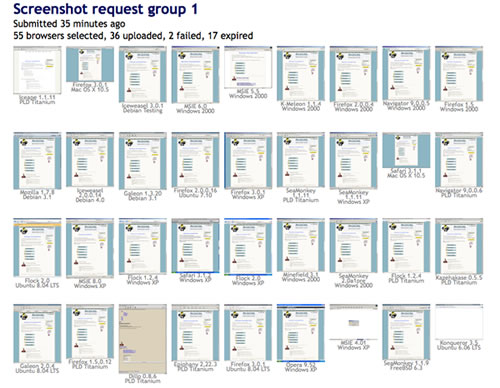
Browsershots is a free service that takes your web page code and displays it in a wide variety of web browsers in a simple format. Here’s a snippet from using my home page as an example:

Browsershots for Many Good Ideas Home Page

You can click on each of the screen snapshots (and save them to your computer) to see them in detail. However, at a glance you can tell what sites look “off”.

If you have unlimited resources, then make sure your site displays correctly in all the browsers. However, if you have to pick-and-choose, focus on those browsers that are used by the majority of users. These statistics can be found on Wikipedia.

Also, don’t forget to look at your site through the eyes of a search engine “spider”. You want to make sure that in addition to people being able to use your website, that the site is examined by search engines correctly. One such tool is Search Engine Spider Simulator.

Unpeeling Your Marketing Onion

Onion
Photo by Darwin Bell

One metaphor I use to describe what a marketing strategy is (and how I work) is a small business onion.

Strategy is focused on the very core of your business: “What makes your offering of interest to your prospective customers?”

The core of your business is the answer to the question: WHO are your prospects and WHY they should care about you. Simply saying, “I want everyone who wants to buy my product/services to know about me” isn’t good enough. You have to be very specific to create the core of your marketing effort.

You build your marketing onion through words (copy) and images (graphics) that both appeal to your targeted market and reinforce your core marketing message. You highlight what makes your business unique, and how you compare with your competition. At all layers in the onion your contact information is prominently featured, to make it easy for people to stop peeling and starting dialoging with you.

The outermost layer of your marketing onion is your business name and tagline. That’s the first thing that people see about your business. If you craft it well, then they want to find out more, peeling away layers of your marketing onion until either they realize they need your offering or deciding that it’s not for them.

A great marketing onion looks great, is juicy, and is easily understood. Extraneous information isn’t added (but is available when people want more details).

If you need to develop your marketing onion (or evaluate what you have), contact me. I’d love to help you develop a strong business model for long-term success.

How To Wear Your Sales Message

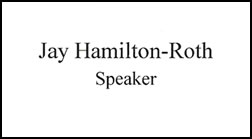
Jay Hamilton-Roth Badge (before)

At a recent conference session I spoke at, an exhibitor came up to me after my presentation and asked a great question: “How can I start a sales conversation with people without being obnoxious?”.

While the conference had an exhibitor hall, the exhibitor was also planning to attend various sessions and wanted some ideas for how to “break the ice”.

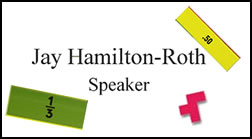
My suggestion was to turn their badge into conversation piece. Most conference badges simply have the attendees name, and some brief biographical information (title, company, location). What I suggested was to take some actual colorful parts to their product, and attach them to their badge.

Since everyone else’s badge was “plain”, their badge stood out. And indeed, people started asking about the colorful things on their badge. The ice was broken, naturally.

Jay Hamilton-Roth Badge (after)Notice I didn’t suggest creating a billboard out of the badge (“Have Questions About XYZ? Talk To Me!”). That sort of message doesn’t create a dialog. It creates a response to the message itself (and a potential lost opportunity to dialog). Instead, my suggestion provides people a way to approach you with their curiosity piqued, and for you to begin a sales dialog. You can pre-qualify your potential client based on their needs, and not on your specific product or service.
Insure Yourself Against Bad Advertising

Caveman Insurance Advertisement

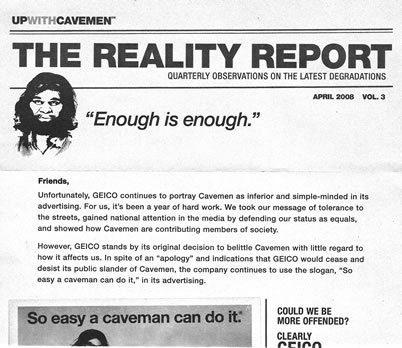
I received this advertisement in the mail. It begins:

Friends,

Unfortunately GEICO continues to portray Cavemen as inferior and simple-minded in its advertising. For us, it’s been a year of hard work. We took our message of tolerance to the streets, gained national attention in the media by defending our status as equals, and showed how Cavemen are contributing members of society.

However, GEICO stands by its original decision to belittle Cavemen with little regard to how it affects us. In spite of an “apology” and indications that GEICO would cease and desist its public slander of Cavemen, the company continues to use the slogan, “So easy a caveman can do it,” in its advertising…

It was unclear who sent the letter. On the surface, the sender was writing a “political” letter, complaining about the values espoused by the company. Only after reading the small print it became obvious that the letter was in fact sent by the company itself.

The goal of this letter is to build upon the insurance company’s latest advertising imagery and tagline. It’s certainly clever, but misses the goal: getting prospective clients to contact them because they offer best price/service mix.

Here are some suggestions I’d recommend making to this ad:

  • Contact information . As a minimum, create a URL for this campaign, which would redirect to the real company.
  • Focus on benefit . The direct mail piece was intended to be humorous, but it missed the chance to mention the benefits of this company’s products. This is especially important for people who haven’t seen the advertisements before and are only seeing references to other ads.
  • Make it transparent . At the end of the direct mail, show the “punch line”: Who really made this ad? Why they did it. How to contact them. Why the reader should contact them.