Category Archives: Creative Business Ideas

Chunky Marketing

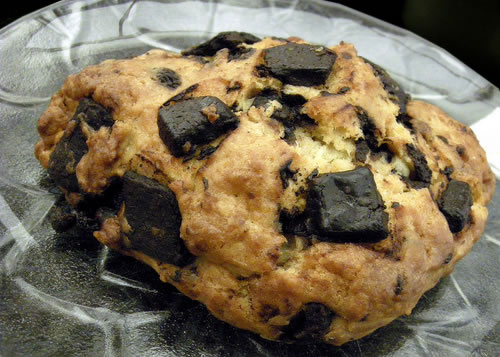
Great Marketing Is In Chunks

(Photo by Cillian Storm)

“Chunks” are blocks of things that go together. A chunk could be a list of parts, or a chunk could be a list of problems (or their solutions). So how does this relate to your marketing?

When communicating with your audience, you need to use the proper chunk size.

If your audience are experts, then use bigger chunks of information (more details, larger scope, etc.) to respect their knowledge and make your points stand out. With experts communication, feel free to incorporate jargon, acronyms, and reference common bodies of research. Without saying “I’m an expert too” you immediately establish yourself, since you treat your expert audience as peers.

If your audience are beginners, use small chunks to make it easier for people to follow your points, and learn what you’re offering. Beginners may not (yet) know that what you’re marketing would be a big value to them. So, mentor your audience. Respect that they are intelligent, but not necessarily in what you’re marketing. Tell them a story about another beginner you recently worked with to convey “I love working with startups”.

If your audience is a wide range of expertise, sprinkle a little expertise and a little down-home common sense into your marketing. The beginners won’t necessarily understand the expert references, but figure you must be an expert to throw these terms around. The experts won’t mind hearing a little about beginner-mindset issues, since they too were beginners. Remembering the effort it took to become an expert and honoring the achievement is more than flattery – it’s basic professional respect.

Be very attuned to your audience’s hunger for information and feed them just what they need to nourish them.

Carrot And Stick List Building

Carrots And Sticks Marketing

(Photo by Neil McIntosh)

Imagine you have a brick-and-mortar store and you know you need to build your customer list. What are your options?

You could require people to register (or become a member) before being able to shop. Members-only stores (such as Costco) are created to produce a regular second income stream (membership fees) or are used to ensure that shoppers are prequalified (to improve the type of shopper).

You could ask people for their contact information to get notified of “special offers”. This is permission-based marketing. You encourage people to sign up (with an appropriate benefit), but it’s not a prerequisite for doing business with you.

You could offer a two-tiered pricing model: a higher price for the general public and a lower price for those that provide their contact info. This is also permission-based marketing (since you don’t require the contact information) but it places a value on your contact information. You see this ever-increasingly in supermarkets, department stores, and pharmacies, which can collect your purchases history and either better target offers to you or provide co-marketing opportunities to third parties. How well two the two-tiered model works psychologically is based on how clear the pricing is articulated. Imagine seeing one price on the shelf, going to the checkout stand, and finding that the price is 10% higher (because you haven’t provided your contact information). Contrast this with seeing one price on the shelf, and being offered 10% off that price if you provide your contact information. The former would create distrust (no truth in advertising) while the latter would create an opportunity (you already selected the item for a price, now you’d pay even less).

As a business owner, you know that a customer list is the real value of your business. How you build the list will determine the quality of your list and the quality of your customer relationship.

The Right Way To Brand Yourself

Branding Yourself The Right Way

(Photo by Phillie Casablanca)

Whether you’re just starting out or growing your business, you recognize that it’s important to brand yourself. Your goal is create an underlying core value experience that people have working with you – in a word, “trust”. So, how can you create your own brand?

Branding begins by proving that you are worth knowing. The common way people create proof is to list their claims to fame in a professional bio (showcasing their educational training and special internships). It’s like a posting your diploma on the wall behind your office desk – everyone that comes to see you can be reassured that some trusted organization has “approved you”.

But your clients ultimately don’t care about your (lack of) diploma. What they care about is, “Will working with you produce a significantly better outcome for me?” Unless you already have the guaranteed solution for your prospective client, your best branding opportunity is to focus on the emotion underneath their question.

Instead of using a biography (or “About Me/Us” website page) to talk about yourself, use the bio to focus on the emotional experience people have working with you. This isn’t a testimonial per se, it’s showing how your past experiences combined with your raw talent has helped others (who were equally unsure of working with you in the past).

Your branding should explain why your marketing promise will be kept. Be clear about what problems you generally encounter (and how you’ve worked through them). Be clear about lessons learned. Be clear that it’s not really about you – it’s about them.

Since branding is a long-term business strategy, regularly ask your current (and past) clients why they love working with you. Together, these stories will help you to not only craft a strong branding message but also it will help you to fine-tune your marketing to attract more people who will love the chance to hire you.

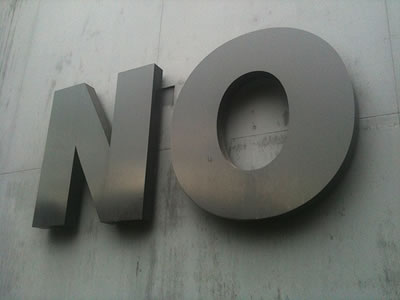
Learn From No

Learn From No Marketing

(Photo by Steve Boneham)

Congratulations! You got the courage to pitch a new proposal that you arranged with a prospective client that you cold-called. You give a strong pitch. You watch your client smiling and nodding along with you. And when it comes time to ask for the deal, you hear a “no”.

Quick Quiz: What do you do next?

A) Quickly leave. After all time is money, and trying to convince someone who’s not interested won’t make a whit of difference.

B) Repeat yourself. You know that you have the best value in the market, and the person sitting across from you likely doesn’t “get it”. So, repeat your key points and try to convince them that their “no” is wrong.

C) Ask why. You can’t satisfy someone’s needs if you don’t know what they are.

You should ask “Why did you say ‘No’?”. You’ve already invested your time and your prospect’s. If you leave without understanding what you missed, you’ve truly wasted your time. Learning from no’s will improve your presentation (even if you can’t satisfy their need) and fine-tune your marketing effort. When we hear a “yes”, we seldom think to dig deeper – we just think that we should repeat our actions and we’ll get another “yes”.

By asking for an explanation for a no, you create a dialogue. Up until now, you’ve probably been in selling-mode – a straightforward presentation when you tell what you have and wait for the yes. But by creating a dialogue you can better gauge your prospect’s true needs, timing, and budget. You might not win the sale today, but you’ll leave the door open for the possibility of re-connecting, and re-presenting a more appropriate offer to your client.

It’s not easy to keep going after your hear “no”. We’re trained to think that a “no” reflects badly upon us personally. Remember that someone else’s “no” may become a “yes” after we learned from our interaction.

(Aside: If you’re having problems getting to hear a “no”, read my previous article: Go For No.)

Pure Marketing

Marketing Pure vs. Hybrid

(Photo by Tyler Howarth)

Let’s say you’re selling a product (or service) that you’ve branded as 100% pure (based on ingredients or functionality). Sales are down. Is now the right time to introduce a new “hybrid” product (or service)?

Whenever you introduce something new, you’ll get fresh eyes – people who are looking for something new/interesting/tasty. These new eyes may convert into new customers (and perhaps new rabid fans) as well. But your gain of new customers means that you’ll likely lose some of your old/familiar/trusted customers.

Whenever you sell a product that’s “pure” you attract a couple of different groups of people: idealists – those that are looking for the minimum product that they need (no extra fluff or risk) and people susceptible to allergic reactions (the extra ingredient actually causes problems for them). Both of these groups of people can become staunch fans – since they know how rare it is to find “pure”. As a manufacturer, it’s so tempting to add additional ingredients to: save money, increase flavor, or differentiate it from the competition.

When you hybridize a pure product, you’re likely to damage your brand promise. Before you guaranteed that things were simple, pure, minimal, and efficient. Now, you’re backtracking on your promise. Maybe you hedge your bet, and offer both a pure and hybrid product. But now your hardcore fans may not trust you – maybe your organic and pesticide-treated fruit will get mixed up. Maybe your all-beef products will become tainted with pork. Or your pure chocolate bars will be exposed to peanuts. Suddenly your “guaranteed pure” brand is less “safe”, and your trustworthiness (whether rightly or wrongly) is at stake.

There’s nothing wrong about evolving your offering to grow your business or better target prospective customers. But your offering must fit with your “brand umbrella” – people need to know what you stand for (and why). If you need to experiment with new offerings, consider starting a new brand (with a new brand promise). You won’t have the benefit of leaning on an existing well-known name but you also won’t be sacrificing your “old” for something “new”.

Is Your Business Ready For an Emergency?

Emergency Business Readiness

(Photo by Jenny Starley)

It’s late Friday afternoon. A friend calls you to let you know your website is down. You scramble to check, and realize they’re right. You call your webmaster, only to find out they’re on vacation (and checking their emails sporadically). What do you do now?

If you’ve thought ahead, you might call another webmaster to pinch in. They’ll likely need access to your various usernames and passwords to investigate. If you don’t have this information at-hand, then you’re truly stuck.

Therefore, I suggest that as a minimum you maintain the following to help you WHEN you have a problem (not IF):

  • List of user names and passwords for your business (web hosting, email, CMS accounts, PayPal, DropBox, FTP, banking, telephone, contact manager, internet provider, etc.). Print out a copy and put it a safety deposit box (in case of fire). Give an electronic copy to a trusted friend (if worried about privacy, perhaps encrypt the file – but make absolutely sure you remember the password).
  • Backups of your databases (email, website, CRM). Ideally keep copies offsite. If you’re unsure how often to backup, determine your comfort level of having to recreate your business files at different time frames (1 day, 1 week, or 1 month).
  • Backups of your computer disks. Again, offsite is important.
  • A contact list for your support team (webmaster, accountant, lawyer, distributor, employees, and family).
  • A contact list for your “back-up” support team (if your first tier aren’t available).

In some cases, you might consider backing up your data to “the cloud” – if you’re comfortable with the speed/security trade-off. Whatever backup solution you use, occasionally test restoring from the backup. We assume that the backup will work without fail, but it’s vital to ensure that your backup works.

Emergency planning isn’t sexy or fun. But it’s vital to ensure you business viability.


Avoid a Race to the Bottom

Race to the Bottom for Business

(Photo by easylocum)

If you’re like most service providers, you’ve been feeling ever-increasing competition: from overseas, from virtual assistants, from under-employed people, and from online service competitions (for logos, design work, software development, website creation, animation, etc.). So how can you compete – both short-term and long-term?

Your first reaction might be to drop your pricing. If they are charging $500, and you are currently charging $1000, shouldn’t you likewise cut your pricing to measure up favorably? If you do, you’re in a race to the bottom – where the only person who wins is your customer. Dropping your price sends the wrong signals: your offering is a commodity (anyone can do it), your previous pricing wasn’t fair (you gouged your previous customers), and you’re not in touch with the needs of your prospective customers. Short-term, it may ward off losing a few customers, but long-term you’re risking your business viability. You’re making less income, so either you need more clients to keep profitable – or you’ll need to cut corners in your offering (and risk losing your highly prized top-quality perception).

Instead, compete on value. Focus your marketing message on what significant benefit you provide that others can’t (or won’t). Perhaps it’s deeper knowledge of subject. Extra training you’ve had that gets results. Additional formats of your work (at no additional charge). Comfort in knowing that you speak “their language” and understand “their needs”. You may even choose to further distance yourself from the “low-cost” competition and raise your rates. If you position yourself as an expert, with a clear benefit to your clients (that they’re willing to pay for), you create more value for your business (and your customer).

Short-term, you may lose some of your bargain-hunting prospects to the low-cost leaders, but these people weren’t your long-term customers anyway. If you’re in business long enough, you’ll continue to have competition. Just make sure that you have a strategy to stand out from them.

Blogging To Get Business

Blogging For Business

(Photo by Abigail Elder)

The common low-cost marketing suggestions for business owners are: create a blog, create a Facebook page, and Tweet. But are your efforts working?

As a blogger, your likely goal is to attract new readers (and eventually clients). With over 42 million blogs and 329 million people reading blogs, your blog is a drop in the web surf. So how do your prospective clients find your blog?

It’s likely that the source of your readership is either from an online search or a mention by someone else (a link, a like, or a “shout out”). For an online search, do you know what your readers searched on to find your site? Do you know what your potential readers are searching for but wasn’t on your site? If not, you’re blogging in a vacuum, and hoping that somehow one of your blog articles will get a BIG mention by someone else.

To find what your prospects are searching for, you need web analytics on your website. If your needs are basic, then install (for free) Google Analytics on your website/blog. On a regular basis, visit your analytics account to better understand the volume of traffic you’re getting and what they’re searching for. If your top searches are in alignment with your business goals, continue blogging on the same topics, using the keywords that attracted your existing visitors.

If you’re not getting the traffic you’re looking for, then take a look at Google’s (free) Keyword Tool. You can use this tool to analyze your competitions’ websites, popular search terms, and even similar category searches. As a minimum, you want to ensure that your blog articles naturally include the phrases that people are searching for (if you include the phrases artificially, you’ll get more traffic, but fewer visitors will explore your site since they will realize you’re site is for search engines, and not people). If you include the “popular” search terms, then you’ll be in the same situation as your competition. What you really want is to stand out. Focus on long-tail terms – things that few people are searching for, but has little competition. This will be your niche – and where you’ll be able to distinguish yourself from the millions of other bloggers.

If you’re going to make the effort to increase your business, why not work smarter?

Bonus: Here’s an infographic that summarizes the state of blogging. Do you see yourself in the chart?

2012 State of Blogging

Thank You

Thank You For Business

(Photo by Italian voice)

Of course you thank your clients after they’ve paid for your product or services. That’s business manners 101. But what other opportunities do you have to thank people in your business dealings?

Do you thank your clients months later (and not simply to drum up more business or referrals)?

Do you thank prospective clients for contacting you at the first “touch”?

Do you thank your employees for showing up, and trying, even if they don’t succeed initially?

Do you thank you banker and accountant for be trusted advisers?

Do you thank the phone company for providing you a reliable dial tone (even though you pay for the service)?

There are many religious traditions where you thank your god (or “the universe”) for providing what you need to live (and even, for providing challenges in your life). Being appreciative means simply that you don’t take things/people for granted, and realize that everyone has a choice who to associate with. The fact that people want to connect with you is a reason for thanks, no matter how obvious or simple this sounds.

So, consider also:

  • Thanking people for not choosing to work with you (but still for reaching out).
  • Thanking people who make you work harder (you have a chance to learn more about yourself and miscommunications).
  • Thanking your competitors for making you stay focused.
  • Thanking your detractors for caring enough about you to express their displeasure.
  • Thanking your family for supporting you (even though “they’re family”).
  • Thanking yourself for having the courage/strength/desire to continue to follow your passion.

The good life comes from appreciating the regular details, not the rare “wows”.

Thank you for reading my article.

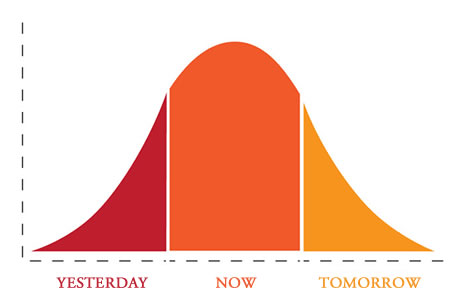
The Power of Now (or Yesterday)(or Tomorrow)

Marketing Now Yesterday Tomorrow

In your business marketing, what time frame are you targeting? You’re likely thinking that the right answer is “now” (you want your audience to see the message now and take action immediately), but not all offerings have the same time frame.

Is your audience facing a burning problem now? Perhaps they’re facing a medical or financial crisis that’s taking all of their attention. Of they just woke up and suddenly realized that they have a problem that absolutely positively must be solved by the end of the day. The audience of now is the most ripe to take action immediately, since your solution removes the pain or worry from their life. It’s the quick-fix they desperately need.

But what if the problem is coming up, perhaps tomorrow or next year? Your audience isn’t nearly in the same rush to solve the problem. They have time to weigh their options, do lots of research, and in some cases simply hope the problem resolves itself without taking action. Your marketing message for an upcoming crisis is best framed by contrasting the picture of the world with and without the problem, so people can understand what the future may hold for them. You want people to proactively solve their problems sooner.

And what if the problem already happened, and people are still feeling the ramifications of it today (and perhaps into the future)? You need to instead give them a reason to fix the problem. But you must first realize that the unresolved problem may not be critical to their life. If it was, they’d likely have fixed it by now. You need to focus your message on the cost for continuing to delay the fix: nagging worry, upcoming fear, distraction, or missed opportunities.

While we all want our prospective customers to want what we’re selling now, for the most effective results, we need to work with their time frame.