Archive for February, 2007

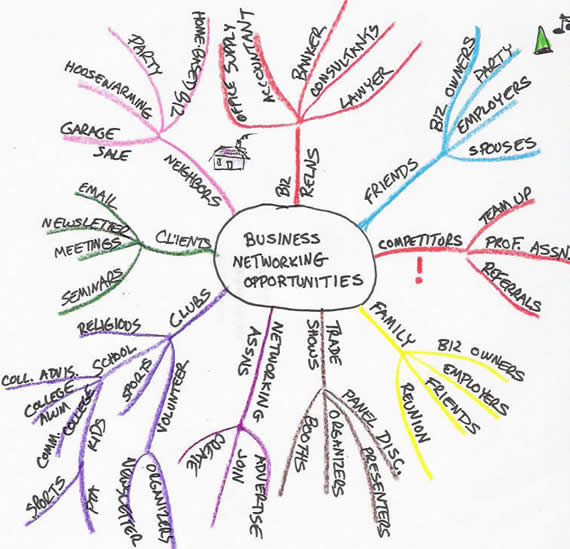
If you don’t have the luxury of others to brainstorm with, one technique you can use is mind mapping. Mind mapping, used for centuries, is a graphical way of recording, organizing, and displaying your thought process. It is a simple and fun tool for doing solo creative problem solving.

How To Make Your Own Mind Map

  1. Gather a bunch of (colored) pens and paper. Alternatively, you can use one of a myriad of mind mapping software packages. For me, pen and paper is more portable and directly tactile. Others may prefer using software to record their thoughts. The software packages’ resulting mind maps can be much more legible.
  2. Identify the core word (or phrase) you want to mind map.
  3. Write the core idea in the center of the paper (you can write ideas in the mind map using words, icons, or small pictures – whatever is most natural).
  4. What immediate ideas spring from this core idea? For each idea, draw a (colored) line radiating from the core idea and label the line with the idea. The colored pens can be used to color code each of these branches.
  5. Looking at each of these newly written ideas, what ideas spring from these? Continue branching organically, allowing yourself to bounce from one idea to another, remembering to maintain the color-coding of the core branches. Key ideas/milestones may be further indicated with small pictures.

Example Core Idea: “Business Networking Opportunities”
Further Reading

An overview of mind mapping

A brief introduction to mind-mapping, written by a college guidance counselor, with emphasis on using mind mapping to help you find a job.

A free online mini-course on making mind maps


Let me first answer the common questions:

I’m not a computer whiz. Creating a website isn’t much harder than creating a document in your word processor.

I don’t have a lot of time. Spend more time selling your products (services) and less time setting up your business using the detailed steps.

Is this really free? Yes.

Why? By giving you a free website, companies build your loyalty.

Why do professionals charge $1000s? Anyone can create an online business. Making the website look “sharp” is a job for the pros. If you don’t have thousands of dollars to spend, create something functional now and improve it later.


The “catch” is that for free you won’t get your own domain name (www.MyBusiness.com) . Instead, you’ll have to have a name like: MyBusiness.googlepages.com. From a professional marketing perspective, this isn’t ideal. However, if you have no budget but want a website, then this will work wonderfully. There are a number of companies that will provide you a free website. I’ve found that that “Google Pages Creator” is the best - they don’t insert advertisements onto your website.


  1. Go to: pages.google.com
  2. Create a free Gmail account (if you don’t already have one)
  3. Websites are all about visual appeal. Gather images that highlight your product (or service). Make sure that the images are yours to use (either something you created, is in the public domain, or have licensed).
  4. Design your “Home” page. This page should answer the question, “What problem does your product (or service) solve?” Don’t clutter it with lots of details. The home page is all about getting someone interested enough to read further. Make sure that the home page has your contact information (name, address, phone, email) on it (note: you want contact info on all your webpages).
  5. Design your “Contact Me” page. Make it easy for someone to find you.
  6. Design your “About Me” page. Add a picture of you. This page should answer the question, “Why are you the best person to sell this product (or service)?” or “Why should I trust you?”.
  7. Design your “Store” page. This page should answer the question, “How much does it cost? What are the details? What proof do you have? How can I buy it?”
  8. Go to: www.paypal.com
  9. If you don’t already have a (business) checking account, go to your local bank to get one. Link the account to Pay Pal.
  10. Choose for your Paypal “payment solution” Website Payments Standard. Create Buy Now buttons and/or PayPal Shopping Cart for each product you’re selling. Insert the buttons at the proper locations on your “store” webpage.
  11. Get feedback from your business associates. Does the site look acceptable? Is the information on the site accurate?

The site that you create will be a full-fledged online business. People can find more information about you and your products. They can order from you online. You can gradually improve the look and feel of the website over time.


✓ You know how wonderful your product is.
✓ You know how great a value it is.
✓ If people could only hear about it, you think, the product would sell itself.

Communicating your offering to potential customers is marketing. The mistake people make is by simply showing the product (in a flyer, spec sheet, web site, etc.) that it will convince people to purchase it. Theodore Levitt (Harvard Business School) said: “People don’t want to buy a quarter-inch drill. They want a quarter-inch hole!”

It’s hard to change your perspective (from selling drills) to focus on the dis-interested potential customer (who wants a hole). How do you get their attention?

Here are three key questions your marketing materials need to address:

  1. What problem does your product solve?
  2. Why should they believe you?
  3. Why should they care?

Let’s take an example of Janet, who makes earrings. The earrings are beautiful. Her friends love them. People ask about them when she wears them around town. How does she market them?

  1. What problem does her product solve? Janet’s earrings allow the wearer to express their individuality, since each pair of earrings are unique. They are affordably priced.
  2. Why should they believe her? Besides showing a gallery of people wearing her creations, she should seek out testimonials of how people feel when they wear them.
  3. Why should they care? People primarily care about 3 things: money, relationship, or health. Janet’s earrings are relatively inexpensive ($19.95/pair) [money]. Janet’s earrings are made of hypo-allergenic materials, avoiding ear infections [health]. People that wear her earrings feel more attractive and if you feel more attractive, you are more attractive to others [relationship].

What could be some of her simple marketing messages?

  • Unique earrings affordably priced. [money]
  • Feel more attractive for $19.95 [relationship& money]
  • Earrings that people notice. [relationship]
  • You’re unique. Are your earrings? [relationship]
  • What does your earrings say about you? [relationship]
  • Earrings that are good for your body [health]

The right message is the one that works in the niche she’s focusing on, since each niche has different priorities of money, relationship, and health.