I love seeing creative signs that underscore a business’s message. Here are a few to get your creative juices flowing:
LinenLadies.com caught my eye with a great moving billboard. The car is an 1973 Fiat 500 R shrink-wrapped with catchy graphics. The ladybug connects with the business name and immediately starts conversations.
Dr. Rabin’s mailbox does double duty. One glance is all it takes to get a sense of his business. It also is a great landmark.
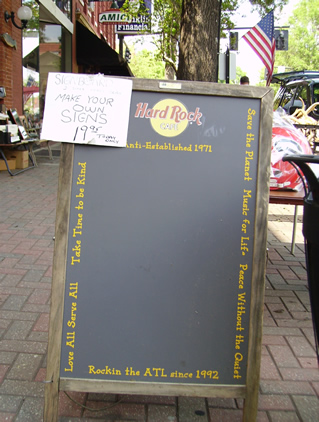
What catches my eye with this sandwich board sign is the clean retro look. The blackboard is also quite functional.
Curtis Carlson (president/CEO of SRI International) and William Wilmot (director of the Collaboration Institute) share their system for innovating in business. While the book is written for larger corporations, their message translates to all types of businesses.
The book details their five disciplines and provides supporting stories. The authors claim that the chance that you’ll succeed is directly proportional to using all five disciplines simultaneously. Failing to address one of them will doom you to failure.
1. Important Needs. Your product or service must target a customer value (as opposed to a company, shareholder, employee, or public value). A customer’s value = benefits – cost. You can optimize either the benefit or the cost to achieve high value. Likewise, you can compare values using the formula: Value Factor = benefits / cost.
2. Value Creation. You need a value proposition. The value proposition is the core of your “elevator speech”. (NABC = needs + approach + benefits + competition) that addresses:
What is the important customer and market need?
What is the unique approach for addressing this need?
What are the specific benefits per costs that result from this approach?
How are these benefits per costs superior to the competition’s and the alternatives?
3. Innovation Champions. You need people who are passionate and committed. In a small business, this responsibility falls to the owner. One of the challenges in growing your company is finding employees (or partners) who share your “champion-attitude”.
4. Innovation Teams. To innovate, you need collective intelligence. In a corporation, you would have the team all in-house. As a smaller business owner, you’ll need to create your own ad-hoc innovation team in networking, mastermind, or friendship groups.
5. Organizational Alignment. Upper management needs to remove barriers and provide organizational support. This is the advantage of smaller businesses; the organization has a flat hierarchy and people are aware of their fellow team members.
When I meet a professional for the first time, I want to know if they practice what they preach. It’s too easy to tell others to do something. I’m looking for a disconnect between someone’s image and actions.
If there is a discrepancy, I question them to find out more. People will either respond sheepishly “Yeah, I know” or be stunned to think that their image matters. Perhaps I’m more sensitive to this than others, but I want to work with people who are self-aware. I’m not expecting people to be perfect – I just want to ensure they personally know of what they speak.
Marketing is all about a consistent message. How do you answer the phone? How do you respond to emails? What does your website look like? Your brochures? How do you introduce yourself?
When you meet a website designer for the first time… check out their website.
When you meet a search engine optimizer… see how easily you can find their website.
When you meet a graphics designer… inspect their business card.
When you meet a business coach… see how well they listen.
When you meet a marketing person… see how they explain what they do.
When you meet a body worker… see how relaxed they are in their body.
When you meet a realtor… see if they own their own home.
When you meet a teacher… see if they regularly take classes.
When you meet a investor… see if they are personally successful.
When you meet a photographer… see what their picture looks like.
When you meet a customer service professional… see if they use their own products.
When you meet a publisher… see if they wrote a book.
When you meet a gardener… see what their garden looks like.
Next month, I’ll discuss how consistency is important to build your company’s “branding”.