Archive for May, 2010

We are a financial services company that sponsors investment seminars to gain new clients. We would like to develop an attention grabbing seminar title.

Our target market are High Net Worth investors aged 55 – 70, both retired and nearing retirement.

The goal of the seminar is to teach the average investor what it is that the wealthy do differently than most others. Our investment program mimics the investment tactics of the Harvard and Yale endowment funds and is utilized by more sophisticated investors.

###

Jay’s Answer: Why not, “How Wealthy People Invest Differently Than You!” or “What The Wealthy Know About Investing” or simply, “Invest Like The Wealthy Do”.

I’m a manufacturer of modular kitchen accessories, I want to name my new modular kitchen products, so suggest me a good tag line and a eye catching name for the same.

###

Jay’s Answer:

A name needs to appeal to your target audience….who are they? Where are they located?
The name needs to explain what’s unique about your business…what makes it different/better?
The name needs to fit your business style…are you looking for a name that’s made up? Technical? Traditional?

The tagline needs to complement your business name. If your business name doesn’t say what you do, then the tagline needs to clarify what business you’re in and a primary benefit you offer. For example, my business name “Many Good Ideas” hints at originality, but doesn’t say who/how it helps. That’s the job for my tagline: “Architecting Business Success”. In 3 words I convey: you hire me when your goal is success (specifically business success) and want someone to planning/building your business success (“architecting”).

First focus on your marketing strategy ( for example, see my answer to someone else looking for a business name). Without this, you’ll waste your time & money trying to attract business to your ineffective business name.

I do marketing for a Baby Boomer support website/blog called Vaboomer (www.Vaboomer.com)
Is this site looking good? Is it clear? What are critiques? Do you get a good feeling from it?

###

Jay’s Answer: My key question about the blog is:

What’s the goal of the blog? For author PR? To sell something? To build traffic/authority status?

If it’s not about the author, then remove the author’s name from the banner.

If it’s to sell something, make the featured books more prominent (and make the books have links into the Amazon associates program).

If it’s to build traffic, write less and ask questions of the readership more.

If it’s to build authority, state opinions, quote other authorities, and react to their opinions.

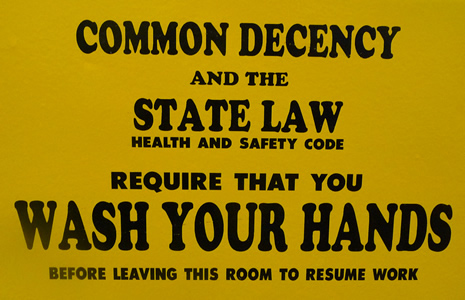
Decency sign
Photo by Bev Sykes

I got a cold-call message on my answering machine the other day. The person was selling me the opportunity to buy booth space at a local business show. Their phone message ended with the statement, “…please have the courtesy to call me back at (800) 555-1212…”. I didn’t call them back. Would you have?

The problem with the phone call was they knew nothing about my business, my target market, my demographic, my skills, or me. They were likely given a list of business names and phone numbers in the region and proceeded to cold-call everyone. They were banking on the message that “there will be lots of very motivated business owners attending” to hint that simply by being at the show I’ll make money (or at worst, be seen by many prospective clients). They were playing a numbers game. And like any casino, the only one who wins these games is the “house”.

Instead, if the caller first called me to find out more about me, and my business, they would’ve impressed me and then be better able to sell to me in the future. They might create a leads database that knows what opportunities I’m looking for and only pitch me when they have something close. Of course, doing this involves work and skill. You can’t simply hand someone a script and ask them to interview people over the phone to get to their core business needs.

So the next time you try to market your offering to someone, please have the courtesy to find out about them first. Otherwise, you’re simply being rude. And rude people don’t get noticed for the right reasons.

Busy street scene
Photo by Dar’ya Sipyeykina

One of the easiest ways to market something is to make it easier to join the “club”. You want to be cool? Dress like we do. You want to look like us? Exercise like we do. But is there a risk to using this technique?

First, by putting the “in club” on a pedestal you’re making them a worthy goal. But what happens when “they” start doing dangerous, illegal, or stupid things?

Secondly, the “in club” knows there are lots of wannabes. They actively root them out, and know that many people are “posers”. Looking like you lead the lifestyle and living the lifestyle are two totally different things (unless you’re simply looking at the club’s veneer, and not at its soul).

Imagine you’re selling a magic pill to people who are looking for an easy way to lose weight. It’s made of natural herbs. People who take it lose weight. So you build a marketing campaign to tie the pill with happy, healthy, thin people. All’s fine until the ingredient in your pill causes some major side-effects. While your customers may have lost weight, they may not be facing serious health consequences. This creates three major problems that’s liable to send your company into a downward spiral: (1) fewer people buy what you’re selling, (2) those that bought it, now want retribution, and (3) you’ve lost people’s trust in their ability to lose weight.

(Un)fortunately, there is no magic pill to marketing success. Selling the sizzle is easy. Selling the steak is harder. Selling steaks to people who appreciate your steaks is the ultimate goal.

Burlesque
Photo by Steven Depolo

The goal of your marketing is to have people stop to pay attention to it, listen to your message, and then take immediate action. But these days, with lots of competition for attention, how can you be successful?

Follow the examples of professional burlesque dancers. They know that their goal is to create interest and hopefully desire in the audience. They first position them self as something worthy of desire, then sloooowly share that connection with the audience. If the pacing is wrong, then the audience loses interest. If the pacing is right, and the energy is focused, then the performer can do no wrong; it has the audience’s full attention.

In your marketing copy, you need to first grab the audience’s attention with a promise that they can’t ignore. You need to confidently state that you’re worthy of attention, and slowly share your worthiness with your audience. If your copy is a menu list of features, then your conversation is over – they look at the menu and either it “clicks” or it doesn’t. But in any event, it’s not memorable.

So start with something enticing – an “image” that the reader can “see” (the image can be carefully written prose, photographs, video, etc.). The only goal of the start is to get their attention. Next, slowly get the reader to see them self in the picture. Is that image even more enticing?

Now, show a little of what you’re describing in detail. Not too much, but just enough to show that you can deliver on your promise. Still reading? Good. Show a little bit more of what you can do. Now what? Ask them to take action – email you, call, complete a form, whatever is appropriate. And so you don’t throw cold water on your prospect – make sure that however you continue the conversation one-on-one, you maintain the same level of seduction.