Category Archives: Creative Business Ideas

X-Prize Marketing?

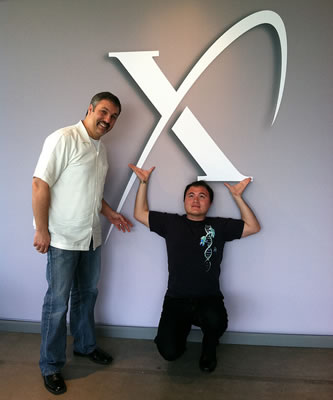
X-Prize Marketing

(Photo by Mark Krynsky)

You’ve likely heard about some of the contests that the X Prize Foundation has sponsored: Ansari (build and launch a spacecraft capable of carrying three people to 100 kilometers above the earth’s surface, twice within two weeks), Progressive (build cars that achieved at least 100 MPGe in real world driving), and Wendy Schmidt Oil Cleanup (removal of test oil in a test environment with salt water). How can your business benefit from offering its own X Prize-like contest?

The key of the contest is that the winner get a sum of money to those that successfully complete an audacious challenge. No winner, no pay. Instead of paying people to solve these challenges, you invite public competition.  The goal is to remove your company’s risk – the risk is all in the hands of the competitors. The more the prize value, the more likely people will want to compete. The best part is if your stated goals aren’t met, then you keep your prize. But in any case, you’ll get a lot of free PR opportunities from both your competitors and the contest itself. You also get to learn from others what works (and doesn’t).

There’s a wealth of crowd-sourced online competitions for such things as graphics and logos. These likewise can provide you a similar experience to an X Prize.  However, the key difference is that these smaller competitions are based on appearance – not results. I don’t know of any competitions for logos where you pay only if the logo improves your business by a specific percentage. Therefore, be realistic in your goal-setting and be willing to toss the “prize” if it doesn’t truly pay off for your business.

If you’re thinking of creating your own contest, first determine the bottom-line value is to solving the problem. If you’d likely see a yearly increase of net income of $100,000, then offer a similarly large prize purse. What do you have to lose?


Marketing: Lipstick On a Pig?

No More Marketing Lipstick on a Pig

(Photo by Brent Moore)

Marketing is often viewed as (a sometimes necessary) evil: fear promotion + gullible customers = money. So, you want to be doubly-sure that your company’s marketing is truly making a bottom-line difference.

First: Make sure you have a great offering. It’s all-too-easy to craft a clever marketing campaign that makes what you’re selling sound incredible. But if it isn’t, people will quickly discover  your deception. Your short-term sales will turn into a long-term revolt against your business. If you’re not sure what you’re offering is great, test it. Give it away. Have extended free trials. Hire independent auditors to evaluate your product against your competition. Hire secret shoppers to audit the shopping experience. Post your home phone number for people to call you in case they’re unhappy. Ensure what you’ve selling is truly remarkable.

Second: Make sure you develop a fan club. It’s not sufficient to sell one thing to one person. You want to create a domino effect – one sale begets another. When someone purchases from you, ask the question, “How will this purchase fit into your (business) life?” You want to understand that if your software is part of a CRM system they’re developing, how it’s being used (and why). Or, the custom jewelry they’re buying is for a special movie gala they’re attending in the city. The more you know about your client’s needs, the more you can help them succeed. And nothing breeds fans like success.

Third: Share success. Remember, your offering isn’t about you. It’s about them. So, when one of your customers succeeds, get permission to tell their story. You’re not the star – they are. You’re in the supporting cast for their win.

If what you’re offering is poor, don’t waste your time (and your prospective customers’) trying to dress up the “pig”.

Speak With Passion: Slowing it Down

Slow Your Speech Down

(Photo by LaserGuided)

After spending a lot of time memorizing your speech, the last thing you’ll probably think about is your speech’s pacing.

It’ll be hard for to remember that just because you know what you’re saying, your audience won’t likewise quickly understand your message and fall in love with you. When you start talking, you’ll likely get a big spike of adrenalin, which will naturally cause you to talk faster than you intended, and faster than your audience can process your words.

Your audience is also likely to perceive that a speaker whose words are racing as nervous, afraid, and insecure. They may try to keep up with the too-fast speech, and realize that it’s simply too hard. And then they’ll tune out your speech. Your hope for success has effectively landed on deaf ears.

When you start your speech, pretend the audience isn’t full of native English (or whatever language you’re speaking in) speakers. Speak slowly so they can understand what you’re saying, using words that are familiar to them. If you’re unsure if you have the right pacing, keep track of how many words per minute (wpm) you speak. If you speak consistently too slowly (under 120 wpm), your audience may think you’re stupid or are talking “down” to them.  So, use as your starting point 130 wpm.

Tip: Use your pacing to infuse your speech with passion.

Lemons & Lemonade Marketing

Making Lemonade With Lemons Marketing

(Photo by Christine Kirk)

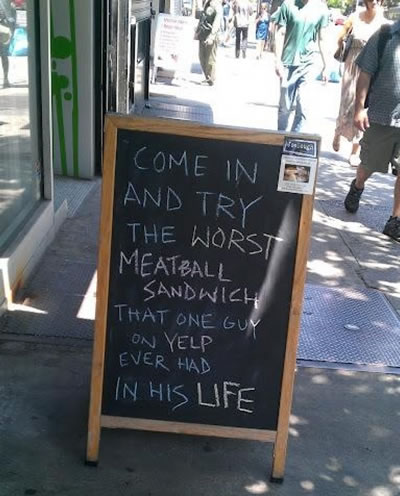
Imagine…You just graduated from culinary school, poured your lifetime of savings into a new restaurant in your home town, and people start regularly coming in to enjoy a fantastic meal. But one day someone asks if you’ve seen a new review on Yelp that gives you a strongly negative review. How do you handle the negative publicity?

You’re probably curious to find out more about the negative experience someone had in hopes of solving a small problem before it turns bigger. Maybe your pride has been hurt. You might want to find out if “that guy” has a personal grudge (or is a competitor of yours’). You might even worry that others will read the review, and start crossing off your restaurant before they even give it a try for themselves.

If your offering is indeed “awful”, no amount of marketing will help change the perception (see Marketing: Lipstick On a Pig?). Fix the awful problem first, then attempt to change the perception.

But if you’re confident in your value and creative, you’d take the negative and turn it into a positive marketing opportunity. By highlighting your offering as “the worst” that one guy had cast this reviewer in the minority and tells your whole story simply (“It’s not us. It’s them.”).

If you don’t do something well, then state that upfront in your marketing. While conventional wisdom is to not showcase a weakness, by stating yours makes the rest of your marketing more believable. If you’re honest enough to say “don’t come to us for this“, then when you say, “We’re the best in that” makes your claim much stronger.

So if you’re lucky enough to be in business long enough to get negative reviews, focus on their value. Nothing spreads like bad news. Therefore, piggyback your positive message onto their negativity to achieve a memorable message for your own benefit.

Is Your Marketing Agile?

Make Your Marketing Agile

(Photo by Dustin Ginetz)

Experts always advise that you need to create a long-term plan for your business and marketing. Clearly identify the big goal. Develop measurable milestones. Use appropriate tactics. This long-term plan becomes your bible. But is this approach likely to miss something BIG?

Developing long-term plans is a great exercise. It will help you understand what’s important for you and what isn’t. It’ll help highlight the resources you’re likely to need to achieve your goals. But the mistake people make is thinking that the long-term plan is then written in stone. These grand plans cannot account for changing market conditions, new technology, efficiencies in production, and fads.

This problem was first identified in software development, where teams often spend years developing complex software only to find out problems too late. In 2001, a group of people gathered to create the Manifesto for Agile Software Development (which has been since adopted by software testers, marketers, etc.):

“We are uncovering better ways of developing software by doing it and helping others do it. Through this work we have come to value:

  • Individuals and interactions over processes and tools
  • Working software over comprehensive documentation
  • Customer collaboration over contract negotiation
  • Responding to change over following a plan

That is, while there is value in the items on the right, we value the items on the left more.”

The Agile manifesto basically says that if you create grand plans and marching forward confidently (without measuring the results as-you-go), you’re likely to become a dinosaur.

For your own marketing efforts, be willing to clearly state and then test your assumptions in smaller chunks. Your plan may be perfect, but you won’t be able to convince anyone else unless you have the data to show why you’re right. For example, before launching a new offering, test market it quickly/cheaply using pay-per-click ads for a short time period. If enough people click-through to find out more (and then request more information), then you know you have interest. Before you spend a lot of money on a fancy website, (split) test the home page.

Don’t become the best buggy whip manufacturer.

See Yourself On The Radio!

Marketing yourself with radio?

(Photo by Andréanne Germain)

Have you been contacted by an organization who is pitching a seemingly great offer: they’ll produce your own radio show and/or invite you to be guest on someone else’s show? It sounds like fame has finally come knocking on you door, or has it?

It seems that all you have to do is simply talk, and people will listen (and your notoriety will grow). The radio station will handle the distribution, scheduling, and technology. You’ll simply need to find topics to talk about and/or guests to interview, and away you go. If it sounds too good to be true, it’s because it is.

Radio stations (whether online-only or broadcast) make money from advertising. For you to get on-air, the money needs to come from somewhere (hint: the radio stations are contacting you to help them make money). So, your first goal is sponsorship. If you already have great relationships with other companies that love your “brand”, then sponsorship may be relatively easy for you to achieve. However, for most of us, sponsors will care about a few things: the number/demographics of your listener base and how the sponsors will benefit. But if you’re just launching your radio show, you don’t have any listeners, so you’ll likely need to self-fund the radio show initially.

Your second goal is listeners. The radio stations will push your message to their existing subscriber base, but that’s likely not to help you much. So, you’ll have to market the show yourself (or hire someone to help you). And with increasingly more competition for listeners, getting sufficient listeners to interest sponsors is hard work (even for the seasoned professionals).

If you’re asked to be a guest on a radio show, ask if there’s a fee involved. A number of organizations offer the “opportunity” to interview you and broadcast your interview in a number of different channels. But it’s ultimately a pay-for-interview model, where the production values of interview isn’t being controlled by people who necessarily place your needs first.

Getting a show on the air may be a nice addition to your professional portfolio (and your ego), but these days it’s easy for people to produce and distribute their own podcast using desktop software. And because it’s easy, it’s not as unique as it once was. If you’re thinking of working with these radio stations, do your homework. Talk to hosts who have shows similar to yours, and carefully listen to their experiences and expenses.

Speak With Passion: Passionate & Scatter-Brained?

Passionate & Scatter-Brained?

(Photo by Rob DiCaterino)

One of the keys to giving a great speech is to share your passion. Your passion is infectious, and your audience gets to vicariously experience your story. But if your speech isn’t well thought out, your talk may become rambling, and make your audience very frustrated. They can feel your passion. They know you have something exciting to tell them, but they can’t “get it”. And they want to. Here are some tips to keep you on-target:

  • Start at the ending. What is the key one or two points you want to leave your audience with? What is your call-to-action (what you want them to do afterwards)?
  • Start at the beginning. Where in the landscape of your story do you want to start? Why there? How does this starting point related to both your ending and your audience?
  • Build a bridge. Scattered-brained people get distracted on their journeys – often going on a lot of side-trips that somehow turn into digressions. Stay on the highway of your talk’s focus. If you do take a side-trip, it must be informative, and come back to the highway for a good reason. Too many side trips and the audience loses the feel of the highway. There are great storytellers that can string together a number of side trips into a journey (Malcolm Gladwell, for example), but it’s a rare skill. Keep your message clear so your audience will remember your story.
  • Refer to your notes. If you get nervously distracted during your talk, have some notes to remind you of the key landmarks you want to visit. Don’t do any extemporaneous speaking. It’s likely to get you in trouble.

Give your audience the gift of a clear, well-understood speech. They’ll likely want to come back to you for more information later.

Speak With Passion: An Opportunity For Personal Growth

Affirmations

(Photo by Joanna Penn)

If you’re like most speakers, when you’re preparing to give a speech you’re focused on memorizing your speech and your delivery. You  know that a great speech is a gift to your audience. But there’s also a way to give yourself a huge gift as a side-effect of your speech.

Before you take the stage, think of a single word that conveys an personally important aspirational meaning to you, for example: confidence, joy, breathe, smile, or success. It’s important that it’s a single word, since you literally only have a second for this technique. Choose a word with a positive connotation that’s truly important – something that you want more of in your life, or a feeling that you want to convey to your audience. Got your word?

As you come onto the stage, remember your word fondly. Don’t force the word through mentally gritted teeth. Smile inwardly. Think of the experience of having more of this word in your life. Now begin your speech.

As your speech has natural breaks for you to breathe or for people to applaud to show slides, remember your word again.

As you end your speech (or even, after you give your speech and before you leave the stage), remember the word again. Don’t force this drill. Remember, it’s a gift you’re giving to yourself.

So, how can remembering a single word change your life? While you’re onstage, your audience has given you a huge gift – their attention. This attention is a sea of opportunity for you energetically. Everyone wants to hear a great speech, so they’re sending you positive hopeful thoughts. By using an affirmation, you’re using helping to ground their energy in your personal growth.

If you’re not a “new-agey” person, who thinks this is all silly mumbo-jumbo, I encourage you to suspend your disbelief. Consider this story:

An American scientist once visited the offices of the great Nobel prize-winning physicist, Niels Bohr, in Copenhagen. He was amazed to find that over Bohr’s desk was a horseshoe, securely nailed to the wall, with the open end up in the approved manner (so it would catch the good luck and not let it spill out). The American said with a nervous laugh, “Surely you don’t believe the horseshoe will bring you good luck, do you, Professor Bohr? After all, as a scientist –”

Bohr chuckled.

“I believe no such thing, my good friend. Not at all. I am scarcely likely to believe in such foolish nonsense. However, I am told that a horseshoe will bring you good luck whether you believe in it or not.”


“They Say”

The Voice of Marketing

(Photo by Tyler Hoff)

They say that the next must-have smartphone app is…” “They say that the best style for next season is…” Who are they and what voice should you use in your marketing?

If you’re a well-respected brand leader, than your voice is “I” or “we” (“I’m predicting that…” or “We will be focusing our next product line on…”). People want to hear from the leader what’s next straight from the source. It makes them feel part of the conversation. That’s why Facebook business pages for brand leaders are generally well-liked by large numbers – people want to be in the know.

If you’re just starting out then your voice is “they” (“They say that the best widgets are made by…”). Your voice doesn’t have authority, but you want to leverage well respected “names” to support your own voice. So you point to others for validation, and include your offering as part of the conversation (“…so that’s why we’re proud to offer you…”).

If you’re trying to create a social movement, your voice is “us” (“If you care about …. join us …”). You’re not establishing yourself as a leader, but you’re a part of the leading edge people who are already committing to take action.

If you’re trying to appeal to the leading edge influencers, use the “you” voice (“You are wise to notice that our new offering…”). Influencers want to see things first, so use a voice that recognizes their specialness.

If you’re trying to appeal to a mass market, use the “they” voice (“They know value when they see it”). Point to the leaders who already have validated it to have the “followers” feel like they’re not risking anything to purchase your product or service.

If you’re appealing to the laggers (slow-to-change), use the “us” voice (“Join us and see how much better…”). The late-to-change group want no risk, and easy adoption. Make your offering the obvious best-of-class choice.

They say that great marketing begins with a great offer. I say that great marketing begins from the right point of view.

Avoid Marketing Blind

Avoiding Marketing Blindness

(Photo by Polina Sergeeva)

If you’re just starting a new business, the biggest mistake you’re likely to make in your marketing is to be blind to the business landscape. You know what you’re offering, you know why it’s valuable, and you know why people need to buy it now. Or do you?

Odds are you’re too close to your business and too far from your client’s mindset. While you may think what you’re offering is the best thing (by far) on the market, your prospective customer knows nothing about you and doesn’t trust in what you’re saying. Being too much in your own world is a symptom of not actively being in a dialogue with prospective customers. For example, how often do you meet people face-to-face who may be interested in what you’re selling? When you do, are you focused on selling them, or are you asking them questions about their needs and their decision-making process? Are you listening to the words they use? Are you looking not just at what they say but also what they do (or have done)?

Before you launch your offering, have you tested your marketing on a wide range of prospective customers? Is your message blindingly obvious or do you need to help explain it so people “get it”? Are you testing not just with your inner (supportive) circle but also with complete strangers (who are more like your target market)? Are you not just getting nods of recognition but also immediate confirmation that you’ve hit the bullseye?

Are you having your peers compare your marketing efforts to those of your competition? Is your message more focused, better written, and graphically easier to understand? Is your call-to-action compelling? Is your value proposition crystal-clear? Is the next step you want your prospect to take clearly articulated?

If you find yourself getting frustrated that others “just aren’t getting it” – consider that you’re either ahead of your time or woefully mistaken. In both cases, you’re wrong. The market is right. If someone won’t buy what you’re selling, you’re better off finding out about it sooner rather than later. Don’t be blind to your own ignorance.