We all think that our ideas are the best ones. Our way is the right way. Our views are the right worldview. But in business, it doesn’t truly matter what you think about your offering – it’s what your customers think about it that matters.
If you spend thousands of dollars developing a new amazing cutting-edge product and it doesn’t sell – is it because your product was bad or because it’s not the right offering at the right price at the right time? If you create a beautifully scripted television show, but no one tunes in, is your audience stupid? If you use organic healthy ingredients that taste delicious to you, but everyone else spits out the food, who’s right?
There’s a fine line between being on the cusp of the next new thing and being insanely wrong. You can do all the focus testing you want. You can hire all the best consultants. But until people vote with their wallets, you really don’t know if you’re about to be famous or infamous.
“Do you want to be right or do you want to be happy?” could be rewritten for business as, “Do you want to be right or do you want more customers?” Lead your customers to your better offer. Unless you have a huge budget, you’re better off focusing your efforts meeting your customers’ needs today rather than trying to teach them why they’re wrong.
Bottom line: Spend your time testing your offerings frequently to best understand the pulse of your customers.
It seems that everyone is telling you that you need to upgrade to the latest and greatest. A new hosting server. New contact manager software. New business cards. New flyers. An updated website. Tweeting around the clock. If you don’t keep moving (your business) forward, you’re likely dying. But is it true?
Since I don’t believe in giving advice without first-hand knowledge, I recently decided to change how I send out my monthly newsletter. I looked at a number of options, and decided to try MailChimp. It looks great and priced right. Since I’ve helped some clients tweak their MailChimp newsletters, I thought it would be a good experiment to try out. I copied over my text, my graphics, created new newsletter templates, imported contact lists, etc. After many hours, I was pleased with my results. And just before I was about to send out latest newsletter, I remembered to test it. I emailed it to a number of different email accounts and was surprised to see that the newsletter was labelled “spam” by my main email account! I dug deeper and figured out the links in the newsletter that MailChimp creates look spam-ish. So I tossed all my work away. A failed experiment? Hardly – I deeply learned the abilities of some new software and can speak in-depth about its abilities and even figured a way to use some of the features to my benefit.
The latest “thing” is simply that – the newest version. Jumping to use the new thing has a higher risk/reward. The “leading edge” is often called the “bleeding edge”, since you’re blazing new trails and learning new solutions and problems.
Definitely continue to innovate your business and marketing. But measure the results of the actions before you fully commit to ensure your steps are taking to your desired outcome.
Whether you use Keynote, PowerPoint, Prezi, or your own favorite presentation tool, it’s vital that you think about the effect your slides will likely have on your audience.
When a new slide is flashed on the screen, people’s eyes will naturally gravitate to it. That means for a split second they’re likely not to be listening to you – they’ll be looking at the slide. In your presentation, give them time to absorb the new image/text, otherwise your words are likely to missed.
If your slide contains text, you need to give your audience time extra time to read the words. You can draw their attention to some key points (hint: don’t read the slide to them!), but realize that if they’re reading it’s hard for them to simultaneously listen to you. So, plan out how you wish to make your point – visually or aurally.
If you’re trying to make an emotional point, use few or no words on your slides – use emotional images instead. The images are easily “absorbed” by your audience and your speech will become more like a movie narration (an intimate experience) rather than a professional speech. In fact the movie analogy is quite appropriate – you want to script what you want your audience to see/do at each step in your presentation. When you move your hands or body, people follow your motions. If you’re looking away from the audience, they’ll follow your gaze. If you’re handing out paper, they’re looking for the handout.
Imagine if people tuned out your voice when talking and only looked at your slides (which naturally does happen when people shift their attention) – what would they remember about your message? To give a speech with passion, guide your audience on a journey, rather than tell them information.
Imagine you’re looking to purchase a bottle of wine as a gift for the host of a party. You’ve narrowed it down to two bottles in your budget that look good. Both of them are well-recommended by the wine store owner. But then she tells you that one of the bottles comes from a small family vineyard, continuously owned for four generations. The wine is produced in small batches, the wine labels designed by an artist in their family, and the bottles are made from recycled glass. The other bottle contains equally delicious and affordable wine, produced by a winery you’re heard of. Which would you buy?
If you’re like most people, you’d chose the wine from the small family vineyard. And you’d feel good about doing so – knowing that you’re supporting a small family operation, and feeling a part of that tradition through your purchase. You’ll probably also share the story of the bottle with the party’s host – showing that you spent time thinking about what to purchase, and including their interest in the story as well.
When you’re marketing your product or service, realize that your competition’s quality may be as good as yours. The price may be as good. Ditto the reputation. So, how can you distinguish your offering from others? With a good great marketing story that lets people know what story they are also buying as part of the purchase. Consider that most people, after visiting your website’s home page, next visit your “About” page. Why? Because they want to know your story, and to somehow see if they “connect” to you. That’s why you should include details not only about your offering, but relevant details about you, your values, your aesthetics, etc.
First, focus on producing a great product or service. But to sell it competitively, develop a story that explains what people are buying into. This will help you to satisfy people’s analytic and emotional needs.
New year, new business idea? Before you start leasing an office space, hiring a web designer, ordering business cards, designing a logo, filing for a fictitious business name, ordering checks, or even registering your new domain name, start by talking to people.
The #1 way to start your new business is through networking. Even after you’ve done all the “checklist” items to start your business, your business success comes down to your customers. So instead of spending time and money setting up shop, first start spreading the word about your ideas and listening to people’s responses.
The #1 indicator for professional success is the size and quality of your professional network. While having having 10,000 Facebook “friends” might be nice, these aren’t the people who are likely to regularly interact with you, respond to your emails, or be willing to meet with you face-to-face. Business success is about relationships – so you need to have a plan to continually build relationships: volunteer your services (or simply your time), formal networking events, informal parties, or simply striking up conversations with strangers (waiting in line, for example). The goal isn’t to sell your (proposed) services – the goal is to establish yourself as a person that’s worth further conversation. Don’t simply collect names to build your network – invest in your time to keep your network “active”. Throw a party. Email them articles that they might enjoy reading. Introduce people in your network to each other. Ask for their input on professional questions. If you’re an introvert, either team up with someone who is an extrovert, invest in learning good social skills, or look for a job in an established corporation.
Once you’re a member of a vibrant network, launch your business. Now you have a community of people who will already know and trust you, and you can focus your energies on the internals of your business, rather than trying to find customers.
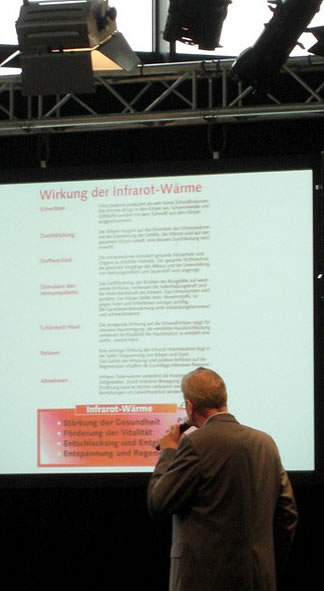
Before you start spending lots of time creating slides or shipping your props across the country for your speech, you need to do your technology homework first and know what the audience will be seeing when you’re on stage.
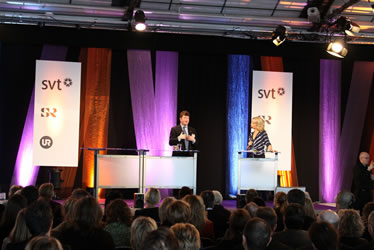
What does the backdrop look like? A simple black curtain with perhaps a slash of color, elaborate colored curtains, or perhaps even a built-up “set”? Your beautiful piece of artwork (or even choice of clothing) that you want to showcase on stage might simply disappear if the colors are too similar. Will there be a screen that images can be projected onto? Where is it located relative to where you’ll be talking?
How will the stage be lit? You might be squinting through bright lights (and unable to see your audience), or staring into a spotlight (that follows you around the stage), or perhaps the house lights will be up and little or no additional dramatic lighting will be added. The lighting affects not only how you look, but also how visible your slides and/or props will be. If you’re depending upon some dramatic lighting during your presentation, you need to give your show’s producer ample notice to see if your vision and their lighting abilities are a match.
How many people are likely to be in the audience? If there are hundreds (or thousands) of people, will the cute prop you’re bringing onstage be visible by more than the people in the first few rows? If not, will a camera be able to zoom in on what you’re holding and show it to your audience or recorded for later playback? If your personal goal is to have a great presentation for video for example, then it doesn’t matter if the audience can see your prop.
Slides or not? For many presenters, it’s not a question – it’s an assumption that they’ll show their latest PowerPoint deck. From your audience’s perspective, why do they need to see the slide? Is it to show proof of what you’re talking about? Is it visual “eye candy” – something to break up the talk? Is it a requirement that they read along with what you’re saying?
If you do decide to use slides (and/or video), ensure that either: 1) you can bring your laptop (and associated cables) to connect to the projection system or 2) that your show producer has a version of the software that you used to create the slides on-site. If you’re going to use the producer’s software, then ensure that you have version compatibility (their software can read your files). Next, use slides that fit your audience size. The bigger the audience, the simpler the slides should be – since not everyone will be able to read the slide – just get a “gist” of what you’re trying to point out. But just because smaller audiences can read words on your slide, doesn’t give you permission to write down more than a few key thoughts. Be sure that if you use slides, you leave ample time to practice running your slides in the venue with show-like lighting. You might find that your slides don’t stand out nearly as well they did on your computer’s screen.
The microphone. Will your presentation be amplified? Will your presentation be recorded? If there is a microphone – will it be a handheld, on a stand, a lapel mic clipped to your shirt, or a headset mic that hooks on to your ear. Whatever the system, get comfortable with it so you’re not adjusting it during your talk. Also – if there is a microphone, don’t choose to ignore it. The audio might be vital for a video recording, and if you’ve wandered out of range, the video will suffer dramatically.
Remember that your speech is ultimately a live performance. You don’t want to add unnecessary complexity to your performance (that might be a distraction). But if you do choose to make things more complex, practice your presentation as much as your speech.
Let’s say you’re about to sell a new eco-fabulous product. It saves 50% energy, lasts 25% longer, and is made by Fairtrade workers. Who are you going to target your marketing message to: the people who say they’re ecologically aware (“green”) or to people who aren’t?
If you’re targeting your “green” prospects, you’d share all the details of your “eco-fabulosity”. These people “get it” – they understand the key ecologically-friendly points. These people would care about the details, and compare these details with products they are already considering. They would feel good about buying a better choice. You wouldn’t have to educate them to your green-related differentiators – these people are already educated. They are your choir.
If instead you’re marketing to people who either aren’t ecologically aware or don’t care, your message would need to be different. You could spend you message educating them first why they should care about the “green” benefits and then explain why your product is the right choice. Or, you could simply show why your product is the better choice, with an ecological secondary benefit.
The problem is that there’s likely a smaller group of people who “get” your message (the choir). Your new product would simply compete in a small segment, and you’d fight for market share. Your marketing message would be easier to figure out – you’d share your company’s values and show how they align with your customers’.
If you want to grow your business, you’re better off focusing on a niche of people who are under-served and then showing how your product solves their needs better than anything else. The problem is these people might not care about your company’s values, your ecological footprint, etc. They only care about how well your product takes care of them.
Sometimes we forget that by taking the easy road of marketing to the choir, we’re actually hurting our company’s long-term success. Instead of assuming that everyone likes our product for what it stands for, we’re better off focusing on things that matter to our prospective customers.
Now here’s an idea worth replicating (from Marin IJ). It lets people choose to donate to a local charity in a way that everyone wins:
Quarters gobbled up by Sausalito parking meters in December go a long way to helping those in need.
During the rest of the year, a quarter will buy you 15 minutes of time for your car in the city. But in December, it will buy you a bit of good karma.
During the Christmas month the city waives all meter fees for the public with the hope people will come to shop in Sausalito.
But to each meter is affixed a sign letting people know that if they drop money in anyway, it will go to a good cause. And despite the recent tough financial years, the quarters drop.
“Surprisingly enough, people do,” said Adam Politzer, Sausalito’s city manager. “It can be anywhere up to $14,000 in donations collected from the public.”
It’s an annual city tradition that goes back a decade.
“What that allows the City Council to do every year is to look for service providers and nonprofits that help the less fortunate and the underserved during the holidays,” Politzer said. “It helps folks here in the city and in the county that need help.”
Last December, roughly 24,000 quarters were deposited into the meters. That means the city had $6,000 to distribute to good causes this year. Quarters being dropped right now will be distributed next December.
Three programs benefited from the city’s and public’s good cheer as they were each awarded $2,000 at last week’s City Council meeting.
Homeward Bound of Marin, which addresses homelessness in the county, was one of the recipients.
The Ritter Center, which serves low-income people in the county, also received money along with MarinLink’s Project Warm Wishes, which once a year distributes “street packs” stuffed with new gloves, hats, scarves, socks and rain ponchos to homeless men and women.
Mary Kay Sweeney, executive director of Homeward Bound, applauded the city’s program.
“This has to get the award for creativity in fundraising,” she said. “This is a wonderful way, a painless way, to raise money for very important causes.”
When you consider how to tell your story, you’d do well to follow some of the more popular storytelling formats. Using these age-old formats helps to shape expectations and therefore easily have people know how to receive your speech.
The sales speech is basically a long advertisement for a product or service. It’s goal is to have the listener take a specific action. Sales speeches generally showcase the risks of not buying and the rewards for buying your offering. These may combine elements of biographical speeches, but instead of simply connecting with the listener’s emotion, you want to connect with the listener’s wallet.
A lecture demonstrates how to solve a problem. A college lecture, for example, will start with a question, and offer best practices for solving the question. A cooking demonstration shows how to make something delicious. The format of the lecture is a “cookbook” for solving the problem so that you can go home and reliably reproduce their results.
The inspirational speech is best exemplified by Martin Luther King’, Jr.’s “I Have A Dream” speech. Inspirational speeches are ideal for when you want your audience to share your vision. The format is a series of short contrasts: this is what life is like today, but this is what life can be like. The contrasts showcase the divide, and your speech can focus on the steps the listener can take to obtain your vision. These speeches need to be kept relatively short, otherwise they become sermons that people will tire of (too many contrasts become repetitive and few speakers can enthrall their audience for a long time).
The biographical speech shares your personal history with the audience, using specific anecdotes to highlight key points you wish to make. Biographical speeches are great for showcasing how a series of events contributed to the learning you’re imparting, and the stories help the audience remember your “teachable moments”. These speeches can be much longer, but can suffer from the “Yeah, that was your experience – and it doesn’t relate to me at all” feeling. It’s important to somehow take your specific story and generalize it for others to learn from.
The fairy tale is the most ingrained form of storytelling, since these are the stories we heard when we were young. Fairy tales have both a specific format (every day…until…and because of that…and because of that…and ever since then…) and an underlying moral. A fairy tale is a powerful storytelling structure since it allows you to combine fantasy and reality in a simple package with a powerful punch. Crafting a fairy tale is hard – since you really need to distill the characters, their actions, and reactions to their essence to make it truly fairy tale-like. Otherwise, you story becomes a biographical speech, which doesn’t pack the childhood innocence-like feeling you’re trying to evoke.
While it might be tempting to mix-and-match the structures (a fairy tale that’s also a sales speech), be very careful doing so. Your audience won’t know what you’re trying to convey, and are likely to internally have resistance to enjoying your story. Instead, if you want two structures, put them back-to-back, creating a separate “chapter” of your speech.
By matching your speech goals with the right storytelling structure, you make it easier for your audience to “get” your message.
For some great examples of some of the speech structures, I suggest watching Nancy Duarte’s TEDxEast talk:
When you are marketing a product or service, how do compare it to the competition? Is your product 5% better? Are your prices 10% less? Is your offer 100% guaranteed?
Unless your offering is already the market leader, people will naturally be comparing what you’re selling with what others are offering. If your product is slightly better or slightly cheaper, it’s unlikely that people will pay you much notice. Why should they risk a mistake of not choosing the market leader for small win?
To get noticed, your offer needs to be significant. How much is significant? For large ticket purchases, a few percentage points may tip the scales in your favor. Otherwise, 5-10% will likely be ignored. You want to shock people awake to your offer, so if you truthfully do so, make the claim that your offering is dramatically better – 25%, 50%, even 100% better. Prove it not just with your words, but with testimonials and comparison charts (where appropriate). Groupon typically features 50-90% off discounts – that gets attention.
Once you have your prospect’s attention, you need to convince them that your offer isn’t just hype. Explain how your service can be 33% better than the competition. Support the claims with white papers and/or testimonials from your happy customers. You don’t want your prospects to feel that there’s any risk from buying from you – that’s why you want social proof to show that you’re the smarter choice, and that others have found you as well. Make them feel that they’re on the “next great thing”, and you’ve made them feel smarter and safer for risking doing business with you.
People are deluged with messages daily. Have your marketing message stand out by making bold claims that are clearly supported.