Category Archives: Creative Business Ideas

Optimize Your Website’s Search Engine Results: Rap Videos

Tired of reading articles and books on how to improve your website? Spend a few minutes with these videos. The key point is that not everyone learns the same way. Try different approaches to sharing your information and measure what works best for your target market.

(Note: Poetic Prophet is making great use of his rapping skills to share his knowledge. What’s missing is a link from the video to his website and also a PDF tip sheet reviewing his suggestions.)

Are You Wedded To Your Marketing?

Scott & Liz Market Their WeddingThe other day I received a most curious email from someone I’ve never met.

“My name is Liz Flowers and my fiance’s name is Scott Bland. We are a “not your average couple,” looking for a “not so average, ‘think out of the box’ type company” who would like to obtain some great exposure while truly showing pure generosity.

We were online securing vendors for our event and ran across a term known at “wedding sponsorship.” We read that a MAJOR Cola company granted a bride to be, $10,000 as long as she would give them publicity and serve their product at the reception!!

With that being said, we are seeking sponsorship gifts and or financial donations going towards both our wedding and honeymoon in exchange for media coverage and targeted publicity. Here’s how this would work…”

For the sake of argument, I’m going to assume that the couple is really going to get married and that they feel that they are entitled to having strangers underwrite their wedding. From a creative marketing perspective, is what they did good?

Certainly it was creative, since I hadn’t heard much about this before (although, as part of my research, I’ve found many other resources: ABC News and even a business specializing in this). However, is this an effective marketing campaign?

In a word, “no”. To be effective, it needs to clearly target me (or my business) and let me know how this opportunity will help me (other than being on their website, in their wedding program, and maybe incidental PR opportunities). First, why me/my business? The letter wasn’t tailored to me at all – it was a bulk emailing (“a spray and pray”). It puts the burden on me to read the email and figure out if there’s a tie-in worth my time/money.

What the couple should’ve done is identify specifically what services and products they wanted, and focus on vendors that could provide them. Instead of contacting everyone, contact only those that can clearly help them directly and create a win-win proposition. Furthermore, each contact should be directed to the right person in the organization. No doubt if another couple received a major sponsorship, they had a very specific request to the right person with a clear benefit to the sponsor.

Advertising That Drives People Away

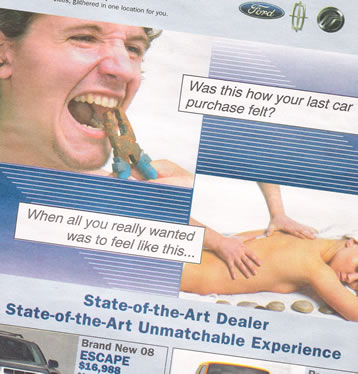
Ford Dealership Advertisement This advertisement got my attention, but not in a good way. The image of pliers grabbing a tooth made me immediately turn away. It didn’t get me curious what the ad was about, what was being sold, or who was selling. All I could think about was, “uggh!”.

The point of the ad is that every 3 years (or so), when people are shopping for a car, they inwardly groan.The #1 least trusted profession is used car salesman. A new car salesman is not much more trusted. This advertisement is focused on reducing pain (a good thing), but misses its mark.

First, let’s figure out the basic marketing strategy for this car dealership:

For local legal drivers

who need a new car

we have a system

to prevent the hassle of dealerships

unlike other non-trustworthy dealers/salespeople

our offering as transparent and easy as can be

Okay, so how to change the ad? Since the underlying pain is un-trustworthiness, try to make the association to professions that are trustworthy (according to a Harris Poll ): doctors, dentists, or nurses.

Here are some ideas:

  • Your Prescription For Pain-Free Car Shopping [key words are: car shopping (who), pain-free, and prescription (association to medical professionals)]
  • The New Way To Shop For Your Next Car [key words are: shop/car (who), new way (instead of the old/yucky way)]
  • We Feel Your Car Shopping Pain [key words are: car shopping (who), pain, and we feel (emotional connection)]

Also, I would change the graphic from pliers/massage to a salesperson wearing a white coat (embroidered with the logo of the dealership) to further the association.

Self Test: Small Business Marketing IQ

Test Book
How much do you know about marketing your small business? Spend a few minutes with this quiz and see how much you know.

1. Does your business need a website?

a. Yes, definitely . A website is needed so people can find you around the world.
b. No . My business is tactile, and doesn’t translate well to an impersonal online experience.
c. Maybe . All my friends tell me I should be online.

2. You should hire an expert to help your business:

a. Write a marketing strategy / business plan
b. Design your marketing materials
c. Create your website
d. Write your advertisement
e. Create your logo

3. Compelling marketing copy is all about “selling the sizzle”.

a. Sure. That’s what works, doesn’t it? Otherwise, it’s boring.
b. Only if you are a huckster. You tell people about the benefits of using your services/products, and people that need it will be interested.

4. Do you need to spend money to make money?

a. Yes, of course. That’s the way the world works.
b. No . A good idea will naturally attract the right people to my business.
c. Maybe . I should be able to bootstrap my business, spending as-I-go (but not all at once).

5. The best way to assure business success is to:

a. Get an MBA. If it works for corporations, it will work for my small business.
b. Hire a business coach. They know how to motivate me to get ahead.
c. Find a mentor. There’s nothing like learning from a wiser person.
d. Read. Business books are a great way to learn new skills.

6. The Small Business Administration (SBA ) / SCORE counselors are for:

a. Cheapskates. They don’t charge for their services.
b. New businesses. They have expertise for startups.
c. Old businesses. They have expertise in brick-and-mortar companies.

7. The best way to attract attention to my website is:

a. Use flashy graphics to grab attention.
b. Write compelling text to make the reader interested.
c. Use SEO techniques to grab the search engine’s attention.

8. The best way to become an expert is to:

a. Say you’re one. If you don’t shout it, who will?
b. Write lots of articles on your expertise. Let people judge for themselves.
c. Comment on others’ articles. Let people see how you give-and-take.
d. Write white papers sharing your strategies. Let people see your big-picture strategy.
e. Read articles, books, blogs. You need to build your wisdom on the shoulders of others.
f. Take classes from other experts. Learn from an expert and get a chance to interact with them.
g. Get an advanced degree. Let others teach you the best practices of the past.

9. Marketing and Advertising mean the same thing.

a. Of course. You’re just telling people to buy stuff from you.
b. Not quite. Advertising (telling people to buy stuff from you) is a type of marketing (focusing on what people want and fulfilling their needs).

10. It’s important that your website and other marketing materials are top-notch.

a. Obviously, yes. If your image isn’t polished, no one will believe you’re great.
b. Not me. Top-notch marketing materials look too “corporate”, and I’m selling something more intimate. Besides, if everyone else’s materials look “corporate”, mine will help me stand out.
c. Maybe yes, maybe no. It depends on what you’re selling. If you’re selling something very expensive, yes. If it’s cheaper, having marketing materials that you can afford to do is better than bankrupting yourself.

11. As a small business owner, I should be able to know how to do everything to run my business.

a. Of course . I can’t trust someone else to care as much as I do.
b. No, I’m not a jack-of-all-trades . It’s better to leave some things to the experts.
c. Yes, but I don’t have to be an expert . I need to know what the process is, but I can get help to complement what I don’t know.

— Answers —

As you will see, there’s no right answer for all businesses. What’s right for your business is what works. However, here’s how I approach these issues with my clients:

1. Does your business need a website? Most businesses do benefit, but they’re not necessarily where everyone looks first to find you. Look at it this way, can it hurt to have a one-page website?

2. You should hire an expert to help your business. If you’re just starting out, having expertise is a shortcut for saving you time, money, and aggravation. If you don’t have the funds for hiring an expert, then you’ll need to do-it-yourself until you can get others to help. Doing it initially yourself (and seeing the results) will also give you a better appreciation for the various specialists that can help you.

3. Compelling marketing copy is all about “selling the sizzle”. Traditionally, “male-oriented” copy is about sizzle while “female-oriented” copy is about emotional benefits. As sizzle has become overused, selling emotional benefits becomes more important.

4. Do you need to spend money to make money? If you have lots of time, then you can use your time to make money. If you have lots of money (but not a lot of time), then you’ll need to spend money to make money.

5. The best way to assure business success is to. .. There are no guarantees for business success. However, having someone who’s “been there, done that” can be a huge boost. However, if you’re trying to break the established rules, having a “voice of reason” can become a headache (that you may wish you listened to).

6. The Small Business Administration (SBA ) / SCORE counselors are for anyone who wants help 1 on 1 from experts. The US Government wisely invests in these organizations, since a successful business pays more taxes. If you need expertise, talk to them. If you don’t like their services, find other offerings.

7. The best way to attract attention to my website is (b & c). Flashy graphics are often used poorly by site designers. Keep it simple, clean, and compelling.

8. The best way to become an expert is to …be patient. Anyone can say they’re an expert, but the next question will be, “Oh yeah? Prove it!”. Have a volume of quality work speak for you.


9. Marketing and Advertising mean the same thing . (b = Not Quite)

10. It’s important that your website and other marketing materials are top-notch . (c = Maybe yes, maybe no). A top-notch first impression is wonderful, but isn’t always realistic. What is important is that your materials are improving, better targeting your prospects’ needs.

11. As a small business owner, I should be able to know how to do everything to run my business . (c = Yes, but I don’t have to be an expert). Ultimately, it’s your business, so you’re the decision maker. The more you understand about how a business operates, the better the business owner you’ll become.

The Little Touches That Matter

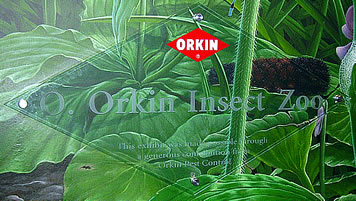
Orkin Insect Zoo Sign at Smithsonian Museum
Orkin Insect Zoo (!) Sign at Smithsonian Museum

I’ve been noticing a growing trend of restaurant dining inconsistencies. For example, the Station House Cafe makes a point to talk about how much it supports the local economy, uses the freshest organic ingredients, and is environmentally friendly:

“We subscribe to sustainable agricultural practices and use premium ingredients, including local fish and meats and organic vegetables from our own garden.

Our beef, pork and lamb are from Niman Ranch and raised on chemical-free pastures, without hormones or antibiotics. Our chicken is fresh, free-range “Rocky” birds raised in neighboring Petaluma, also without hormones or antibiotics…”

So, when I was sitting at my table at the restaurant waiting for my meal, I noticed the condiments: salt, pepper, ketchup, mustard, etc. They were all from a generic restaurant supplier. Why wasn’t the salt “sea salt”? Why wasn’t ketchup made from local organic tomatoes? Why was the packaging in plastic bottles? Given their concern for sustainability, why weren’t the napkins and to-go containers made with recycled paper or the plastic to-go utensils made from compostable/recycled usual plastic?

When your business takes the effort to stress certain values, you’re saying how important this value is to you and educating others why they should care about it. People who don’t know care about the values (they just want your product or service) might be open to learning something new. People who care about these values will be curious to see if you’re self-consistent: Are you walking your talk? If not, your message will be diminished. Make sure that your business values are carried through consistently.

Plumb-Wrong Advertising

Live Plumbing Advertisement What’s wrong with this advertisement? From my marketing strategy perspective, it’s focusing on their service and not the benefit to the prospective consumer.

How many property owners think about their sewer pipes? Why would they? Sewer pipes are something are “out of sight/out of mind” and seldom fail.

So, how should the plumber advertise this service?

First, let’s figure out the basic marketing strategy for this plumber:

For local property owners
who need problem-free plumbing
we inspect sewer lines
to prevent unpleasant surprises
unlike traditional plumbers that only fix the mess
our offering is a free consultation/estimate/second opinion/video inspection.

Now, let’s rewrite the headline, “Do you really know what’s in your sewer pipes…and if they leak? Do you want to know?” Here are some options:

  • Homeowners: Prevent A Sewer Catastrophe! [key words are: homeowners (who), prevent/catastrophe (pain), and sewer (what)]
  • Is Your Plumbing About To Explode? [key words: plumbing (what) and explode (pain)]
  • How’s The Health Your Older Home’s Plumbing? [key words: plumbing (what), health/older home (pain)]

The $100,000 Question

$100,000 bill “So, what do you think my web-based business worth?”, someone recently asked me. I questioned them about previous year’s income, expenses, traffic, page rank, and the amount of effort they put into the business.

After listening to their answer, I realized that fifty people when asked this same question, will probably provide fifty different answers, and that all of these answers are likely wrong.

What does matter is what someone is willing to pay for it.

When selling a house, for example, real estate appraisers start by looking at comparable sales in the neighborhood and adjusting the value based on the positives and negatives the home has. The number they arrive at is a historical value. Lenders require them. Real estate agents love them. Sellers try to optimize them. But the house is only worth what someone is willing to pay for it

Business brokers will likewise place a value on a business based on historical earnings (which don’t guarantee future earnings), potential for growth, market niche, etc. But again, the value of the business is in the eye of the purchaser. Of course, if there are tangible assets in the business, those can be liquidated for a known value.

For a web-based business, it all comes down to perception . Is the business making money or is it likely to do so? If there’s lots of unique traffic, then there is additional possibility to make money by selling ad space.

The problem in negotiating “worth” is when there’s a discrepancy between the perception of the buyer and the seller. The buyer is looking for flaws to justify a price reduction. The seller highlights the uniqueness to justify a top price. Both want to walk away from the deal feeling like they “won”.

Instead of getting caught in the perception game, consider the cost for not buying or not selling. If you’re exhausted running the business, then what’s it worth to you to reduce your stress? How about the late nights worrying about the new competition that’s threatening to overshadow your success? When was the last time you took a vacation?

You might regret the sale or purchase, but if you did your “homework” to verify the “numbers”, and you got wise counsel to help with the transition, then everything that happened is investment in your education.

Besides death, taxes, and change, there are no guarantees in life or business.

(Since people love hearing about online businesses that “hit the lottery”, read the story about pizza.com selling for $2.6M or a story about Fund.com and Harmony.com for $10M)

Boost Your Store’s Foot Traffic For Free

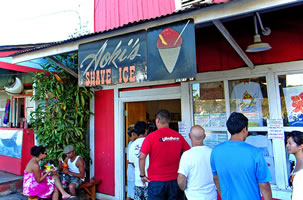
Store Queue
Photo by tata_aka_T

To get more customers into your store, make it easier for people to find your business online. Use Google’s Local Business Center to get your business listed in Google Maps, include a photo of your store, a description of your services, and even downloadable coupons for free. The entire process takes less than 15 minutes and you can easily change your store listing at any time.

  1. If you don’t already have a Google account, get one here . A Google account is also a necessity for using Google Analytics, Google Pages, etc.
  2. Create your Local Business Center Account
  3. Enter your business name, street address, phone number, website, and description. While you don’t need a website, Google requires a valid street address and phone number.
  4. Categorize your business (major categories include: retail stores, organizations, business to business, entertainment, transportation, travel, education, services, health & medical, restaurants, government offices, and real estate)
  5. (Optionally) Specify your hours and payment options.
  6. (Optionally) Upload pictures of your storefront or goods.
  7. (Optionally) Add details such as keywords, price ranges, and/or areas served.
  8. Confirm your listing (either by phone or postcard).

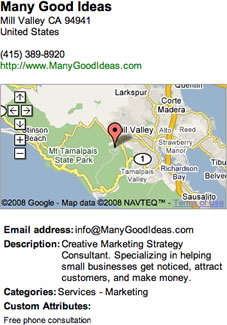
Many Good Ideas Google Maps Listing

The more information you provide, the easier it will be for people to find you: by location, by type of your business, by the hours of your business, and even what your store looks like. Think of Local Business Center as a free online Yellow Pages listing. Make sure you highlight the key benefits of your store to attract online attention.

Of course, adding a listing alone isn’t going to make your business an overnight success. It will make your business easier to find, and is a great addition to an old-fashioned brick-and-mortar store that doesn’t have a website but does want an online presence.

This tip will help increase awareness of your store online. Getting customers to tell their friends and return back to the store is vital strategy for creating an ongoing stream of clientele.

In addition to Google, many other search engines also allow you to submit your store (in many cases for free) to their business lists: Yahoo , Super Pages , Yellow Pages , MSN , Insider Pages , Local , and City Search .

Marketing Snake Oil

The Dark Side Of Marketing The Dark Side Of Marketing
For the longest time, I associated people who market and advertise with evil. I hated seeing advertisements telling me “if only I bought this, I would be cool also”. I couldn’t imagine what type of person became a marketer or advertiser. Now I am one.

Marketing that attempts to change our belief systems or undermine our values I consider evil . It lives by appealing to our insecurities, showing us a shortcut to happiness. It preaches fear, isolation, failure and shows salvation by living your life differently. A number of years ago advertisers made a fundamental switch in how they talked about their product. In the “old” days, a company would tell you all the wonderful things that their products did and problems they solved. You would chose your product on its own merits. Some consumers that tried those products and didn’t get the promised results wound up in court, claiming a breach of promise. After defending too many lawsuits, the companies wanted a safer way to promote their goods. The result is now companies show a lifestyle, and then show how their product fits into that lifestyle. There isn’t a claim that the product will help you achieve the lifestyle (or any other promise for that matter) – just an association between what product and lifestyle. This works wonderfully, since our brains are wired to fill in the gaps (“Gee, if I had that product, I would look/feel/act/love like that”).

The good side of marketing doesn’t attempt to sway. Instead it simply tries to help customers find the solution to their existing problem. In some cases, marketing attempts to educate you that you have a problem. The good side of marketing is actually helping people. You’re doing a genuine service (and making money doing it).

Good marketing is harder than evil marketing, since you really have to understand what problems people have and try to fix them. Good marketing can also focus on people’s fear, isolation, and failure, but it solves it authentically, not with a mirage.

Gaming the SEO System

I recently heard an interview of a web “guru” who’s showing people how to get their website noticed quickly. Their first steps were straightforward: create a blog, keyword optimize it, and publish it. So far, so good.

The next step involved generating backlinks (links to you site) and social bookmarks (a “thumbs-up” vote for something people find interesting). Instead of waiting for this to happen organically, the guru pays people to comment and bookmark their sites. Since people are interested in the “next hot thing”, the bookmarks beget other backlinks, and the traffic builds quickly. It works.

But, is this ethical right ? Not so long ago, movie studios got into trouble when reporters figured out that some reviews were written by the studio (or someone that the studio paid). Some interviews (of people coming out of the movie) that raved about the movie were also studio-generated. The studios got bad press, and the practice (supposedly) stopped.

The problem is, it’s not yet easy to figure out who has paid-for-posts/bookmarks, and who has authentic ones.

Be careful: it’s a slippery slope to trade off your ethics for dollars.

Optimize Your Website For Search In 3 Steps

Search Engine Logos Since the purpose of having a website is for people to find you online, I wanted to go over some basic strategies for ensuring that people searching for your types of services/products find your small business’s website.

The goal of optimization is to have your website listed before your competitors ("ranked highly") (ideally on the first page of search results, which most people don’t look beyond).

Most search engines report the result of searches in two groups: sponsored ads and normal ("organic ") searches. Sponsored ads appear because the company has agreed to pay the search engine (via a pay-per-click [PPC] ad campaign) money whenever people click on their ad for specific keywords. PPC is a great way to generate traffic quickly, but it’s often not cost effective long-term. Long-term you want your website to appear organically highly ranked.

When a person does a search, the goal of the search engine is to show the most relevant websites that likely match the person’s search terms . The goal of optimizing is to make your site highly relevant for specific search terms.

  1. Identify the search terms you want to rank highly for . As in all forms of marketing, you need to think like the person who’s looking, not as the business who’s selling. That means you need to know what keywords people use to search for businesses like yours. This information is easy to find from pay-per-click programs, such as Google Ad Words Keyword Tool . Don’t forget to also spot trends (using a tool such as Google Trends ) in keyword searches, since you want to catch "up-and-coming" searches that might be ranked low now.
  2. Use the keywords in relevant pages in your website . Keywords are seen in: the main body of the web page, meta tags (less important, but still worth having), and the alt-text in your images. Use keywords naturally – remember the point is to have more customers. If your website isn’t human-readable, then all your work will be for naught. Also, make sure that if you want to target customers in a region, you use your region in your keyword phrases.
  3. Get links to your website. Search engines rank websites by their "authority ". One way they measure authority is how many (and which) other websites link to them ("backlinks "). One backlink from an top-class website is worth hundreds of poor-quality links. You can get backlinks from a wide variety of sites: organizations that you’re a member of, blogs, and directories. One tool I recommend is Directory Submitter , a free tool to get backlinks. Be warned: Google is in the process of penalizing websites with paid backlinks. Also: submit your websites to the search engines (if you have not already) so they can explicitly add your site to their directories: Google , Yahoo , and MSN .

There is a lot more to search engine optimation (SEO) that these tips. Don’t forget there are professionals that can help you with your search engine optimization (I’d be happy to recommend some).