Monthly Archives: March 2009

How Can We Get Our Company Profiled By The Press?

Can you recommend best-practices for getting our company profiled or quoted in the press? We’ve already begun blogging, and are seeing some nice results. We also have a number of experts on staff who can speak intelligently on topics that should be of interest to potential clients. How can we position ourselves optimally for getting covered by the media?

###

Jay’s Answer: To get picked up by specific media, understand their demographics and the article trends. Spend time to sincerely develop relationships with the editors, so that when you do contact them, they’ll answer your call/email, Then, based on your company’s expertise, suggest story ideas to the proper editors. In addition to the story provide them with some possible sources for material (including your company, if appropriate).

Another approach to being picked up by the media is to do/say something outrageous. The media is looking for a “story”, not just another business ho-hum “piece”. Take a stand completely against the mainstream, and justify it with lots of data. Start an argument, dare someone publicly, or simply play “devil’s advocate”. Done right, you’ll be seen as a passionate expert on a topic and worth covering.
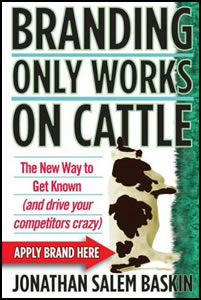

Branding Only Works On Cattle

Buy Branding Only Works On Cattle
In Jonathan Salem Baskin’s book, Branding Only Works On Cattle, he takes firm aim at the practice of the marketing practice of branding. He defines branding as building consumer awareness with the goal of influencing their future behavior. Simply put, he believes that branding is useless.

Traditional marketing is focused on behavior: identifying prospective customers, their needs, and communicating how your business solves their problems. Behavior is measurable. Either someone takes action or they don’t. Split testing on messages can give statistically valuable information to improve your marketing campaign. You can optimize your marketing based on the response you do (or don’t) get.

Traditional branding is intangible. How can you measure the influence of someone’s future behavior? When it comes time to make a purchase decision, people don’t decide in a vacuum. They ask their community for input, do research, and then purchase. Impulse purchases aren’t made based on brand either; impulse happens on the spur-of-the-moment, and is based on the offering targeting the immediate need at the right price.

In the past, branding was possible because customers had few choices (besides their immediate community) – television (with just a few channels) and magazines. Larger corporations could spend money to control the messages of these limited media. The Internet has allowed people to easily search for information. Search, the author contends, is the enemy of brand. Search allows people to find information anywhere (not just in company-controlled locations). The end result is that companies are simply trying to scream louder to get their message heard about the din.

The author also believes that social online “communities” are a poor way to brand/market your company. Most of these communities aren’t really communities – people can be anonymous, there’s no shared responsibility, no trust, and no informal conversations.

Instead he suggests paying attention to the basic strategies of guerrilla marketing, which are focused on changing near-term behavior:

  1. Support existing behaviors, don’t create them [piggyback on habit]
  2. Show, don’t tell [by example]
  3. Prompt behaviors, not ideas [cause action]
  4. Talk to many, every time you talk [involvement by dialog]

Taglines Passe? Try Six-Word Memoirs.

Six
Photo by Prabhu

I recently listened to an interview by Larry Smith and Rachel Fershleiser (who compiled Not Quite What I Was Planning: Six-Word Memoirs by Writers Famous and Obscure) on National Public Radio. The basis of their compilations was the legend that when asked to write a six-word novel, novelist Ernest Hemingway responded: “For Sale: baby shoes, never worn.”

That got me to thinking about taglines, those seven-or-so words that we use to encapsulate a key benefit of our business. Or headlines, short pithy words that get people to keep reading. And I realized that a six-word novel might even be more juicy material to build your marketing.

A tagline (or slogan) tries to be self-contained. Easily understood. Unambiguous. Maybe clever or memorable. But the end result is often dull. Yes, it’s clear but it’s not helping to inspire dialog between you and your prospective customers.

Perhaps it’s time to create your own business’ six-word memoir to pique some targeted interest in your message.

For example, instead of an insurer with a tagline:

  • Protecting Your Family And Your Future

(which has a clear emotional hook/benefit), imagine any of the following business memoirs:

  • Unplanned Future. I forgot. Our loss.
  • Should’ve saved. Could’ve relaxed. Too late.
  • Boring insurance. Sudden catastrophe. Lucky me.

These memoirs serve a slightly different purpose than a tagline. They don’t tell your whole business. They paint a quick emotional story, which could easily be filled in by supporting copy.

How hard could six words be?

How To Make Your Business Message Go Viral

Dandelion
Photo by Emiliano Ricci

I am often asked what tricks people can use to get their video or product announcement to go “viral” (spread online quickly). In almost all cases, people are trying to make an entertaining message get passed around like a funny joke. If the message does get passed around, all too often the business part of the message is forgotten. People get traffic to their website, but no one is paying attention to the business – only the entertainment. It’s a lost opportunity.

The late Dr. Everett Rogers described in his book Diffusion of Innovations (first published in 1962!) the five key ways innovations spread (or in modern lingo, go viral):

  1. What benefit do the consumers notice: price, prestige, appearance, convenience, and/or satisfaction? The clearer the emotional benefit, the faster the innovation spreads.
  2. How easy is it to use your innovation (from what your consumers are already using)? Habits are hard to break. Bigger changes require bigger benefits. Smaller changes only require smaller benefits.
  3. How steep is the learning curve? The more education, the lower the likelihood for spreading the word.
  4. How easy is it to sample? A free experience reduces the fear of a bad choice.
  5. How easy is it to see the results? The more obvious the benefit, the higher the likelihood for spreading the word.

None of these are magical incantations to get your idea/product/service to spread like wildfire. However, if you do incorporate Dr. Roger’s messages into your next viral marketing campaign, you dramatically increase both the speed of the message and the retention of it.

A Tagline For My Consulting Business?

I’m trying to come up with a tag line for my Consulting Business. This came up during the design of my new business cards. The company name is Pierce Consulting, Inc., which communicates nothing about the type of consulting I do. On the back of the card (and for uses elsewhere) I want a tag line to accompany what I already use, which is “Federal Contract Services” – (I might mention I’m not tied to that either.) There’s two of us in the company so we’re small, and we do no outbound marketing. All our business comes from referrals – and it’s plenty for now, and has been for the last 7 years. We work with commercial industry companies of any size, from the giants in telecommunications, document production, and express shipping to the smallest resellers and integrators that want to sell their wares and services to the federal government. Our specialty is securing these companies what’s called a GSA (General Services Administration) Schedule Contract, which is a contract vehicle that limits competition, and generally simplifies the government purchase process. The GSA has a Schedules program for just about anything you can imagine, for everything the Government buys, from granola bars and tunafish, to Information Technology, Office supplies to Air Craft Carriers to Neurosurgical Navigation equipment. We prepare a proposal for the company (in accordance with the incredibly confusing, ridiculously long – 100-300 pages of strict instructions and requirements of the GSA’s solicitations), and negotiate terms, conditions, and pricing on behalf of our clients. It’s about a six month process when you know what you’re doing, and we do, and a year or more, or never because your offer is rejected for non-compliance, if you don’t. Companies don’t have the luxury of time to work through the administrivia and red tape, or deal with the varied personalities of GSA’s personnel, they just want the contract quickly so they can go forth and sell. Not glamorous consulting, but in high demand. There are lots of large consulting firms and legal entities that do this, especially here in the Nation’s Capital. We’re not the biggest, not the cheapest, but we are personally
committed to each client, de-mystifying the process from proposal prep to contract award – and we do the majority of the work required throughout the process. What six or seven words convey all that?

###

Jay’s Answer: Thanks for a very thorough background to your problem!

You’re right that your business name does nothing to help clarify what you do.

“Federal Contract Services” is vague but does describes what area you operate in. A tagline needs to focus on the benefit to what you do. Here are some ideas to get you started:

  • Cutting Through Federal Contract Services’ Red Tape (note: “cutting through” can be a play on “pierce”)
  • Simplifying GSA proposals
  • Improving B2G (Business-To-Government) Sales

A Better Pricing Model?

I run a strategic firm and I’m putting together a proposal for a company who is doing well and needs a plan and execution of all marketing functions except sales (strategy, PR, AD, positioning, management of campaigns, etc.)

This is slightly different than what I’m used to, however I believe that the best pricing module for them is a combination of a contracted monthly retainer and a modicum of funding that goes into a capital account.

My question is: can you give a sound reason for another pricing model (to the client) and if not then what are some of the pitfalls that I should consider as I proceed in pitching it to the client.

###

Jay’s Answer: To your knowledge, has your client already used this pricing model previously? If so, they’ll know the pros/cons.

If you’d present this to me, I’d ask for a breakout of how much it’d cost for each of the planning/functions you propose. To achieve the agreed-upon goals, I’d want to have a “to not exceed” number (or a fixed price) to ensure no budgeting problems and to allow me to compare your costs with those of your competitors. Depending on the value of the goals, I might even have a performance bonus (if ROI is over X%, I’d pay more, and if less than Y%, I’d pay less).

A Catchy Name For An Interior Decorating Business?

We are located in Northville Michigan. Most clients are near-by not more than an hour away from us. What makes us different or better I would say is that we shop very good quality items with little money, we also use a lot of items that the clients have, and we have reasonable hourly pricing. We really have only done a hand full of business’ and are looking to target that area a little more. We are working with mostly homeowners in family houses. We try to make their house into homes and try to help them have better space planning (rearranging furniture and such). We work with middle class to high end it just depends. We are looking for a name that would apply to the business and residential owners.

###

Jay’s Answer: A business client would have very different goals from a homeowner – so one name that works for both will get a bit generic.

Here are some names to get you thinking:

  • Interior Design For A Song (emphasize price)
  • Home Inner Beauty (like a person)
  • Rooms That Reflect You (emphasize uniqueness)
  • Gorgeous Rooms (emphasize beauty)

10th Company Anniversary Ideas?

Our company is turning 10 in August 2009. I want to make a story out of our anniversary, from our company promotions, to events etc that will mark our countdown for our 10th.

I’m thinking of a remarkable theme for this milestone event of ours.

What can be the best theme for us? We are into direct selling and multilevel marketing. We value partnership and business relationship to all our dealers, of course with great customer service. We want to highlight on the business partnership, one family supports all.

Believe. Achieve. Succeed. Is this nice?

###

Jay’s Answer: The best tagline is one that appeals to your target market.

“Believe. Achieve. Succeed.” is vague and doesn’t mention a benefit to your target market. For example, “Taking Your Income To The Next Level” plays off both the MLM and the benefit ($).

Creative and Yet Practical Sales Plans?

We provide Engineering Design Services since 9 years in the domains of Automotive, Utilities and Industrial Designs. The slow down in our target market has hit us which is evident from our last two quarter results.

I am looking for you offer us more creative and yet practical approach plans, sales plans so that we would move close to our numbers next two quarters.

Our services normally comprises of Product Design, Tool Design, BIW Design and Detailing, Machine Tool Designs, etc.

###

Jay’s Answer: Instead of focusing on selling your services, ask your clients what services they currently need. It may be that they’re not in an innovation cycle, but rather trying to figure out how to to better sell their existing inventory. Once you’ve identified their need, if you can help them directly, you’re in good shape. If not, find vendors that can help them directly, and subcontract them out to your clients.

Consider looking in different regions or niches for prospective clients.

Business With Passion: Jeff Raz

Trailer:

For the last 30 years, Jeff Raz has performed nationally and internationally with circuses and theaters including Cirque du Soleil, The Pickle Circus, Song Circus, Lincoln Center Theater, Vaudeville Nouveau, Dell’Arte Players, Berkeley Repertory Theatre, Marin and S.F. Shakespeare Festivals, TheatreWorks and Marin Theater Company. He has written 11 plays, directed many others and is the founder and director of the Clown Conservatory, a program that has trained some of the top young clowns who are currently performing around the world.

Website: www.JeffRaz.com
Email: jeffraz@aol.com

Business With Passion TV Show Logo