
Category Archives: Creative Business Ideas

What Do People See In Your Marketing?

Ink Blot Test

The great unspoken truth about Marketing is that while marketers create names, taglines, websites, social media campaigns, etc. – they are unlikely to know WHY people reacted positively to their work. They may think they understand, but odds are they’ve simply been lucky.

When we talk with someone else one-to-one, we think we’re having a heart-to-heart connection. We’re listening, thinking, and reacting. But the reality is, the other person has an entirely different world experience than we do. The better you know the person, the more you’ve heard their “stories”, struggles, and motivations. That gives you a glimmer of their true self. But you don’t truly know how they think, since you’re not them.

So imagine the difficulty trying to create a marketing strategy that will produce a desired outcome to a large number of people. If you’re starting afresh with a campaign – you start by understanding the logical/common/emotional motivations for your target audience. You spend a lot of time crafting the offer, the headline, and timing of your message.

Is that enough to cause people to understand and react to your marketing? Probably not. So, to be safe you add visuals (colors, pictures, typefaces, layout) and perhaps audio (background music). Can you confidently predict what % of the people seeing the campaign will act on your offer?

Let’s say that your marketing was a success. What was the magic that unlocked your prospects into action (copy, visuals, audio)? If you don’t know, then the next message that you send may or may not work.

That’s why smart marketing people are continually testing their marketing cause-and-effect using A/B split testing and/or multivariate testing. They know that they don’t know WHY until they understand WHAT. Our ability to rapidly draw conclusions (read: Malcolm Gladwell’s Blink for discussions on intuition) is a double-edge sword. The smart money’s in not assuming – but uncovering – motivation.
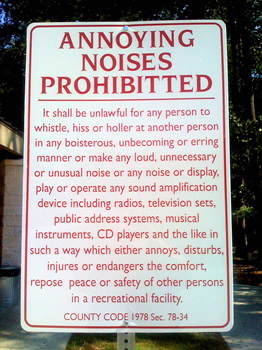

Top 5 Ways To Annoy Your Prospective Customers

Annoying sign
Photo by Patrick Fitzgerald

Do you know if your marketing efforts are backfiring on you? Look through the list to ensure that your well meaning work is actually causing you professional harm:

Talk LOUDER. If someone isn’t paying attention to you, you might be tempted to raise your voice. The first time you do it, it seems to work. But eventually people learn to tune you out, since you’re not saying anything new – just LOUDER. This is true not only for face-to-face conversations, but also in print (bigger font size, flashier graphics, etc.). Make sure your communications are worth listening to.

Talk Non-Stop. If you’re monologue-ing your conversation, you’re not listening to your prospect. First, ask questions to qualify them. Find out what types of problems they have and then craft a message that shows you listened.

Talk Repetitively. Don’t find 10 ways to say the same thing. While repetition is important to ensure that your key points aren’t missed, respect your audience’s intelligence. If the first way you say something isn’t interesting, neither will the tenth repetition.

Talk More Often. If you email someone once a month, then emailing them once a week is unlikely to endear yourself to them. If you have something new to say, say it. If you don’t, respect your prospect’s time.

Talk Nonsense. We get caught up in the latest buzzwords and keywords. Pretty soon no one can quickly make sense of what you’re saying. The goal is to talk simply to be understood. Once you’re sure your prospect likes to use buzzwords, by all means shower them with words. Until then, speak naturally in all your communication.

Marketing The Invisible

Marketing The Invisible
Photo by Sarah G

Most people have no idea how much effort it takes you to do your work. Whether you’re a gourmet chef, a house painter, a web designer, or a graphic designer – the work you do is invisible. People judge its worthiness not on your effort, but on the result. Can you (and should you) market your invisible work?

When people are judging your business offering, they are actually reacting to the tangible and the intangible. The tangible is how well it works, how much it costs, how customizable it is, etc. The intangible is how it makes them feel. Marketing the invisible is all about describing the intangible.

If you’re selling a used bicycle on Craigslist, you would likely describe its: size, color, style, features, condition (and maybe include a picture of it). But supposing you also told the story of the bicycle: when you bought it, where you rode it, the fondest memory of riding it, the attention to paid to its regular upkeep, etc. A person buying the bicycle is buying more than just your bicycle – they’re buying your story of your bicycle – and that commands a much higher level of interest. That’s why antiques that have a documented story sell for higher amounts.

If you own a restaurant, don’t just describe the meal based on its appearance and taste. Explain how much time it took to find the ingredients, prepare them lovingly, and slow-cook them to perfection. People are fascinated by details – let them feel a part of the work you do.

When you are marketing your business, make sure that you are appealing to the logical and emotional sides of the prospect’s brain. You want them to feel fortunate to have purchased from you. Give them the opportunity to feel good.

What’s Your Marketing Number?

Targeting A Number
Photo by Peter Solness

If you run your own company, you know how easy it is to get overwhelmed by all the day-to-day tasks to keep your business on target. But what about the employees in your company? How do they know what to focus on?

Author Bill McKibben had a similar problem. He had written a number of books on the environment, but he was having a hard time trying to tell people how the planet was doing. He was looking for a single message to share. After interviewing a number of scientists, he realized that the key message is “350” (as in 350 parts per million of CO2(ppm) – the safe upper limit scientists have identified). With this single number, he was able to spread his message around the world quickly – since it’s easy to say, easy to quantify, and easy to see how we’re doing.

In your organization, do you have a single clear target for everyone to see (and regularly get updated on)? It may be revenue, failures, returns, clients, web visits, click-thrus, or phone calls. But whatever you choose, make sure it’s clear to everyone what you’re measuring, how you’re measuring it, and what the importance of hitting this target is to everyone. You’re trying to create a feedback loop – a way of reacting to how well you’re achieving your goal.

The trick is to focus on the target while keeping your company’s values intact. It’s too easy to create a short-term win to hit the numbers and cause long-term havoc. Stock market investors focus on the share price and return, and often neglect the long-term goals for the company.

So, pick a measurable goal. Tell everyone its importance. Regularly update how you’re doing.

Marketing Rx

Marketing Prescription
Photo by Robert S. Donovan

The last time you were feeling lousy, what did you do? Did you wait it out, hoping that it would run its course naturally? Did you go to the pharmacy and try some over-the-counter remedy (hoping one will work)? Or, did you visit your doctor to get an accurate diagnosis and a treatment plan?

The biggest marketing mistake small businesses make is using hunches to improve their business without first diagnosing their problems. Business owners will call a website developer and want to freshen their website (making it look more modern or polished). The problem is, most website developers aren’t skilled marketers. They are experts in making the website graphically enticing and functional, but they’re often not as skilled at creating a website that attract more traffic (and more importantly, more clients for you).

The first four questions I ask my new clients are the same:

  1. Where is your business now?
  2. What do you want your business to become?
  3. When?
  4. What have you tried?

The answers to these questions will start you on a diagnosis and a treatment plan for improving your business. Stop wasting time guessing what’s wrong (or only treating your symptoms).

Found Your True Calling (To Action)?

Hypnotizing
Photo by Hidde de Vries

You already know that every time you market your business, you need to include a call to action. A reason for someone to contact you now. Where should you place it? How should you phrase the call?

Think of your marketing copy as a conversation you’re having with a prospect.

You’re at a business event, and meet someone new. You shake hands, and introduce yourself by name. You mention why you’re at the event, who you work for, and perhaps an observation or two to build a connection with your new friend. If you’re savvy, you’ll ask more questions about your friend’s business than you’ll tell about yours. You’re listening so you can share relevant information with them. If you have some knowledge of solutions to your new friend’s business challenges, here’s the time to mention it. You might ask for their business card and offer to follow up with them later about your information (giving your business card in exchange).

In this conversation, your ended your conversation with a call to action (“give me your card so I can give you the information you need to solve your problems”).

Your first call to action would be after you’ve clearly identified your prospect’s problem, validated your expertise, and put a value on solving the problem (not necessarily what you charge, but rather what it’s worth to them in monetary or emotional terms). If you have extended marketing copy, then you’d place calls to action following each detailed explanation of another problem/solution you handle effectively. And you’d end your extended copy with yet another call to action (in case the prospects skimmed over the content).

The phrasing of the call should be natural: “Call TODAY to solve your problem. Guaranteed.” The call to action must have a mention of time, otherwise it’s not compelling (“Call when you’re ready to find out more”). The call is actually worded as a subtle command: you’re telling your prospect exactly what to do, after you’ve sold them on why they should care about your offering.

Don’t make your prospects “read between the lines” too much. Make it blindingly obvious what you’re offering, why they need it, and how they can get it.

4 Steps To Hypnotize Your Business Prospects

Hypnotizing
Photo by Mattia Belletti

As business owners, our fantasy is to be able to cause our prospective customers to do exactly what we tell them, when we tell them: buy our products, refer more business to us, increase the frequency of orders, blog about their experience with our company, etc. Many people are constantly searching for the magic system that will easily bring piles of riches to your door easily, regularly, and automatically. We love hearing about the latest get-rich-quick guru success stories and dream that maybe this guru has our missing piece of knowledge. We are ready, willing, and able to be hypnotized by their promises. Why not use this same skill to improve your own business?

Key point: People that are searching for solutions to their problems are willing to be hypnotized by your offering. Here’s how to make your marketing hypnotic:

  1. Identify them. First, make sure you’re talking to the right audience. Focus where (and to who) you send your marketing message.
  2. Relax them. Tell them that their problems can be solved, and that you’ve been solving these problems for people like themselves. Let them experience the feeling of having their problem solved. Let them see that it’s not impossible and that they can start solving their problem today. Let them believe that there is “light at the end of their tunnel.”
  3. Overwhelm them. Start to hypnotize them by giving them more information than they can process (but not all at once): testimonials, case studies, graphics showcasing the winning solutions, graphs of increased results, etc. The key is to honestly present the information, but to deluge them with information, so that everywhere they look they see the answer they’ve been searching for. This is why extremely long landing pages are so effective – they get you hooked for information, and then you realize that there’s too much information to read all at one sitting, and start scrolling, and scrolling and see the buy now button over, and over again.
  4. Guide them. Tell them what specifically they need to do to make hypnotic suggestion a reality. If you’ve identified their pain, talked about it, and let them experience the reality of having their pain erased – they’re ready, willing, and able to take action NOW.

How To Branch Your Business

Branching Your Business..
Photo by Marina Castillo

If you’re thinking of growing your business (or increasing its revenue), focus on your business structure first. I’m not referring to your internal business organization (e.g., marketing, sales, administration, development, customer service, etc.) – I’m referring to your external business conversations.

Businesses converse with (at most) five different target groups, each of whom have different needs:

  • customers (people who give you money in exchange for your offering)
  • investors (people who give you money in exchange for ownership)
  • the public (teaching people about your offering – but not with the primary goal of turning them into customers – perhaps to share information to make their lives better)
  • advocates (try to affect rules and regulations in society)
  • prospective employees (are people who want to give you their time and knowledge in exchange for a salary)

You need to market your company to each of these groups differently, because each group has different needs/concerns.

  • customers want to know why they should buy from you. What specific problems do they have that you can solve?
  • investors (or donors, for non-profit businesses) want to know how their money will help your business and how will they benefit.
  • the public want to know why they should trust your information and how it will make their lives better.
  • advocates want to know what in society should change, why, and who will benefit (and who won’t).
  • prospective employees want to know that your business is healthy, their contributions will be valued, and that your company values are in alignment with their personal values.

Before trying to grow your business, make sure you send the right message, to the right group of people, at the right time.

Remember My Company?

Scene from a party.
Photo by disco | modjo

We’ve all been to a party where we remember someone’s face, but not their name. Or their name, but not their “story”. Or their “story” but not what they look like. We even have language for it (“good with faces”, etc.)

So why is it that when we launch a business we’re so focused on the perfect business name? Or the perfect tagline? The goal of any name, phrase, or image is to be remembered (when the time is right by the prospect). We forget that not everyone remembers what we tell them. To usual way to help them remember (in business) is with emails, advertisements, direct mail, etc. That’s somewhat useful, since people are barraged with information daily, and reminding people keeps you “top of mind”.

Consider that a business’ image is much like a person’s image. Both have names. Both live somewhere. Both have stories about themselves. Instead of a face, a business has a logo. Therefore, the next time you create a marketing effort, ensure that you are tickling all your prospects’ brain cells: visual (logo), logical (name), and context (stories). If you want to tickle more brain cells, engage more senses: smell (like Abercrombie’s stores), hearing (a jingle), or even touch/taste (something tangible). That’s why the best marketing engages the brain’s ability to recall not just facts but sensory memory (“The sound of a light rain on an autumn night” or “The first bite of an imported dark chocolate bar” or “The new car smell”).

Is New+Improved Better?

New & Improved ImageYou’ve probably been taught that the phrase “new and improved” are strong words to place in your marketing copy. People are supposedly always looking for an edge, so getting the newest thing will help them better. From the customer’s perspective however, does newer = better?

Newer might be a restyled product, additional features, fixed bugs, or brand new technology. But what are your customers looking for? Your past clients are looking for a reason to upgrade: what did they purchase from you in the past that’s now obsolete and would necessitate them to buy from you TODAY? (Aside: the goal is to convince someone that the new widget that they recently purchased is now old, and they need to toss it and get the newest best thing is well described in the new documentary film Objectified). Your prospects appreciated that you’re evolving your offering to make it cutting edge.

But is newer better? Only your customers can judge better. From your perspective, it might be cheaper to produce your new offering or newer makes you more competitive with your competition. From your customers’ perspective, does the new offering save them money? Does it really improve their quality of life? Does it remove pain from their body or psyche?

Most marketing focused on “new and improved” tries to keep the customers on the endless treadmill of buy new, discard old, and give them a psychological boost with something “new and shiny”. But to be a truly world-class marketer, your “new and improved” should sell itself with concrete reasons to own it. Do your business (and customers a favor): truly understand what they need, why they need it, how they use your offering, and how you can help make their lives better (even if they don’t know it yet).