Category Archives: Creative Business Ideas

Are You Selling or Consulting?

Consulting for Christmas...
Photo by makelessnoise

You’ve studied your target market (in general) and know the typical problems your prospective customers are facing. You assume that each prospect that’s looking at your marketing message fits that profile (on average) and talk to them appropriately. It’s the keystone of a marketing strategy. In your sales pitch you’re telling people: what your business is offering, why the offering is great, why your company is great, why the price is great, why the competition isn’t, why you should buy it today, what happens if you don’t buy it today, how to beat your competition, the ROI of using it, testimonials of people raving about your business, guarantees of performance, etc. Selling requires you to already understand what your prospect needs.

But what if you don’t know exactly what your prospect needs? You could continue your sales monologue, or you could ask them what they need (and why). You’re now in the process of consulting, not selling. You need to understand each of your potential customers individually to customize your offer to them. You may very well also send them your sales information (later), but first you need to listen to them and show that you’ve listened. Once you’ve engaged your potential customers in a dialogue, you’re much more likely to create a sale. And if not, you have more information about why your consulting strategy did not translate into a sales strategy.

If you don’t have the resources to consult with every prospect don’t assume that you truly understand why someone does (or does not) buy from you.


How To Drive Your Business

Driving Your business...
Photo by Kyle May

When you first learned to drive a car (or bicycle), you probably looked at the road immediately in front of you. You were looking for potholes, the edges of the road, and other obstacles/hazards that you were heading for. You were focused 10% on the distant road and 90% on the near road. Your driving was probably a bit overreactive – jerking the wheel or quickly hitting the brakes to avoid something. As your confidence and skills improved, you no doubt learned to scan the road (not just ahead, but surrounding you) and to anticipate problems. You focus shifted to 80% of the distant road and 20% to the near road.

The difference in your driving perspective applies to your business perspective as well. The difference between a small/startup business and a big/established business is planning strategy (and yes, resources as well). A new business is mostly focusing on their near-term issues (because the fear is: “if you don’t focus on near-term, you won’t have a long-term”). Long-term issues is a luxury they can’t imagine. As a result, small business mentality involves a lot of sudden stops and starts. Surprised consequences. And white-knuckled driving.

An established (big) business understands the need to be aware of the current market situation, but trusts that they can safely navigate through short-term problems. The bigger success is achieved by focusing on the long-term goals. Anticipating problems. Creating opportunities.

If you want to keep driving yourself crazy, keep focusing on short-term issues. If you want to drive like a professional, devote more resources on your long-term goals.

Is Your Advertising Amoral?

The moral is...
Photo by Hamed Saber

You already know that a strong headline gets people to start reading your (advertising or marketing) copy. You also know that the purpose of every paragraph is to get people to continue to read the rest of the copy. But what happens when people get to the end of your copy?

Each of Aesop’s Fables end with a brief moral (“One bad turn deserves another” or “Appearances are deceptive”) that summarizes the point of the story. Does your copy end with a moral-like statement? I think of this phrase as a “toeline” (the opposite of a headline). While a headline focuses on the benefit to the reader, the toeline focuses on your offering with a reminder about the benefit.

For example, if you’re selling raw, organic cat food (called Purely Cat Food), your headline might read: “Keep Your Cat Healthier Naturally“. Your copy would describe why most commercially available cat food is bad for cats, and by feeding your cats this food they’ll live longer and be sick less. Most people end the copy with “Now available at your local store”.

Instead, create a toeline that echoes the headline. For example, “Purely Cat Food Ensures Your Pet’s Health”. Notice it starts with the offering, then mentions the benefit.

Hyperconnectivity Stress

Phone stress

Are you on Twitter? Facebook? MySpace? LinkedIn? Other social networks? Posting regularly? Checking your email every 15 minutes (and immediately responding)? Check your RSS reader daily? Is it helping your business? Cellphone on all the time? Is it helping your quality of life?

We get caught up trying to keep up with the latest ways to boost our business. In some cases, a small effort has a major benefit (for example, a website allows people to find your online 24/7). But when we spend too much time focusing on trying to keep up with “the world”, we lose sight of our intimate network (people who truly know and care about us). Hyperconnectivity is giving us the feeling of doing something (having thousands of Twitter followers) but at the expense of meaningful relationships (both in our personal and business life). It’s also decreasing the amount of creative “unstructured” time that we need to think deeply about issues. If we’re always reacting to a stimulus, we have no opportunity to actually do something novel.

Before you jump into the latest business “fad”, find out the true cost (time/money) and the real world results (profit, goodwill). You’ll always hear stories about the person who made $100,000 overnight from a Twitter feed, but remember that these stories are passed around because they’re not typical. Focus on what works for you, experiment on new things, but balance your return on investment (ROI) of your time/energy.

The Adjective Of Your Marketing

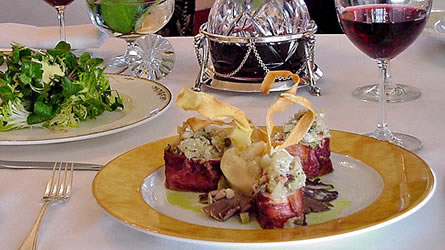
Madrona Manor Dinner

Once you have identified your customer’s needs, you need to communicate your offering in language that inspires them to take action.

Both the restaurant and consumer paint industries know this very well.

Here’s some of the offerings from the restaurant at Madrona Manor:

Seared Hokkaido Scallops
Eggplant pur?©e, compressed zucchini, lardo, spicy basil

Liberty Farms Duck
Roasted breast and crisped confit, hazelnuts, summer beans, quinoa

Cart “a Glace”
Ice Cream Sundae, hand-churned tableside with minus 324 degree nitrogen, chocolate sauce, almonds, whipped cream, cherries on top

The key to their mouthwatering copy (for me, at least) is in their choice of adjectives: seared, Liberty Farms, compressed, roasted, crisped, and hand churned.

Studies have likewise shown that people prefer exotic names of colors, rather than the tried-and-true simple names (blue, light blue, sky blue, navy blue, etc.). For example, here are names from Dulux Paints: Japanese Maze, Caymen Lagoon, Sultan Spice, Mexican Mosaic, Peppermint Beach, Fragrant Cloud, Shangrila Silk, and African Adventure. It doesn’t matter that the names don’t convey the color group (red/blue/yellow). They are the names you see when you look at the can of paint or the color swatch and they sound so…exotic. And if you use an exotic named paint, you hope your life is now a little more exotic. (Do you think you know what names match the color? Play the Paint Game.)

So in your next marketing copy, take out the thesaurus to find juicy, emotional, and exotic adjectives that will inspire your prospects to take action (and separate yourself from your hum-drum competitors).

Make Your Marketing Personal

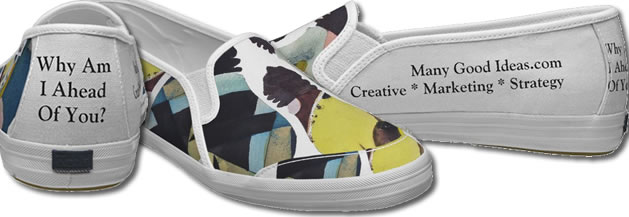
Many Good Ideas Sneakers

It used to be that only big companies could afford to create a marketing message that was highly visible: newspaper ads, direct mail, television, radio, skywriting, sponsorships, etc. But modern technology allows people to create one-offs inexpensively: email blasts, your own ink-jet printer, local digital printing, or even personal 3D fabricators.

These modern fabrications allow you to more easily create guerrilla marketing messages – putting your message in places people would not have previously considered. Initially, this will be fun and innovative. And as more businesses copy the idea, it’ll become annoying unless the message is well-targeted to the proper audience.

If no one else is doing this in your business niche, lead. If others are doing it, do not simply copy their idea. Do something remarkable. For example, donate to a sponsored charity for everyone that comments on your marketing message. Or, if everyone else is filling banners with lots of words, put up a blank banner with a small message (“Talk is cheap. Watch my actions.”).

Asides:

  • Neil Gershenfeld described this phenomenon in a 2006 TED Talk.
  • Zazzle.com has a wide variety of products you can customize for do-it-yourself-ers.
  • If you need a recommendation for professionals who can help create high-quality custom products at an affordable price, contact me.

Marketing With Adrenalin?

Woman Afraid
Photo by Rosie Hardy

Someone recently asked me if the only way to cause people to react emotionally to your marketing message is by using fear (fear of the unknown, loss, death, family, job, etc.).

As humans, we are wired to respond to fear by producing adrenalin. Fight or flight. Protect yourself at all costs. However, once the adrenalin tank is empty, the reaction is over.

Many television news shows focus on bad news. As people get used to bad news, the “thrill” is gone, and people need stronger stimulation to create a reaction. This is true for scary movies, MTV videos, etc. You need to keep upping the adrenalin trigger. Eventually people get tired of the fear/adrenalin reaction, and start tuning out. You’ve lost them.

Fear is a great short-term motivator. But it’s not a good long-term motivation. Researchers have studied what message would motivate people who had heart attacks to make healthy changes in their lifestyle (to live longer). Fear of another heart attack/death produced short-term behavioral changes, but once people got used to the fear, they reverted to their older (bad) habits. Only by having people focus on keeping/growing the love in their life, they were able to make long-lasting behavioral changes.

Remember that fear is only one of the basic human emotions that you can use in your marketing. The others include: love/sex, anger/hate, wealth, freedom for mind & body, desire for life after death, self-preservation, recognition/self-expression. Make sure you choose your emotional “hooks” well, both for short-term and long-term results.

Is Your Elevator Pitch a Monologue or a Dialogue?

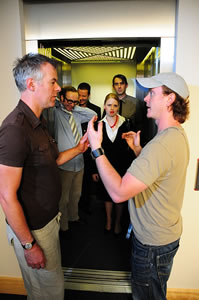
Elevator Pitch
Photo by Frank Busch

When most people think “elevator pitch”, they think of a paragraph that they can utter in about 15 seconds that tells people what they do. I’ve written previous articles on how to craft a pitch and how to judge your pitch’s effectiveness. But what most people forget is the goal of the elevator pitch – to start a dialogue.

Let’s say I’m at a mixer, and I ask the person standing next to me what they do for a living. They respond with their elevator pitch. And unless it’s a great pitch, it’s likely that I’ve tuned them out. Why? Because they didn’t tailor their pitch to me.

In all your marketing communication, you need to ensure the message matches your target’s needs. If you don’t know their needs, all you can do is talk at them, and hope that the message somehow “sticks”.

How can you create an elevator pitch that’s memorable? Start slowly. Describe who you target clearly and a single benefit you provide. For example, I’d say: “I help small businesses around the world make more money.” In this simple sentence, I’ve identified my target audience (small businesses), where they are located (around the world), and a single benefit (make more money). Notice I also put in clear clues to help the listener to see if their problems fit my business offerings (this helps the listener frame the dialogue better). Instead of adding any more to the pitch, I now wait for the inevitable question, “How do you make more money?” (I could loan money, steal money, print money, or provide services).

My next sentence is a bit more specific: “I plan and implement creative marketing strategies.” Perhaps they’ll hear the word marketing or creative or strategies. It doesn’t matter much, because I immediately follow up my answer with a question, “What’s your #1 business problem?”

I’ve just created a dialogue around a prospect’s business. The more I find out, the better I can now talk about how my offerings can help their business (or not). The result is a memorable message that’s tailored to my prospect’s needs.

What Comes First? Ready..Aim..Fire?

Ready..Aim..Fire
Photo by Mark Walz

No doubt the phrase “ready..aim..fire” has been drummed into your head as the right way to do things:

  • Ready means prepare for action.
  • Aim means to choose your target.
  • Fire means to spring into action.

If each time you “fire”, it takes a lot of time or money, then investing time/money preparing and aiming makes good sense. For example, if you are thinking of building a custom home (which costs a lot of money and takes a while to construct), you’d be prudent to study what types of homes people are buying, design a home that fits the market you’re going after, and perhaps even test market the design before you even break ground.

But what if you are a one-person business, and you’re thinking of doing a email blast to your mailing list? The cost for an email blast is basically zero, so why spend a lot of time preparing it? This is one of the principles of guerrilla marketing – try something, see the effect, try something else, continue. It keeps you away from analysis paralysis.

In Timothy Gallwey’s Inner Game Of Tennis (and other “Inner Game…” books), he found a key way to quickly improve your tennis game is to have someone else tell you what the result of your action was. For example, if you’re practicing serving, hearing “the ball was 2 feet outside the baseline” creates a feedback loop. You hear the result, and your system naturally (and quickly) adjusts to achieve the desired result.

The key point is: After you “fire”, make sure you pay attention to your results. Learn what works better, and continue to hone your actions.

What Are You Really Buying?

The moral is...
Photo by Sherman

I read with great interest the article “Burt’s Bees, Tom’s of Maine, Naked Juice: Your Favorite Brands? Take Another Look — They May Not Be What They Seem“. Andrea Whitfil does a great job unearthing how many natural and organic brands that we perceive as being produced by small companies are in reality now owned by large multinational corporations. And she’s very bothered by the deception.

When you offer a product or service, you’re actually making two separate promises: a primary logical offering and a secondary branding promise. The logical offering addresses the reason someone would choose your offering: price, speed, cost, efficiency, resources, quality of life, etc. These benefits are easily measured: how much faster/cheaper/better/bigger is your business or life.

The branding promise is much more subtle. Purchasing the offering will create a feeling in the buyer. They’ll feel like they’re now part of a specific community. They’ll feel better about them self. It will create an emotional reaction to making the purchase. The emotion may not make logical sense, but the feeling it produces is real enough.

What Andrea is complaining about is that many products have broken the branding promise. Andreas felt that she was supporting small businesses that were working hard to make a difference to the planet. Purchasing those small business products made her feel better about herself (and a belief she was helping others continue this worthy mission), so she embraced the product and the mission of the business.

Let’s say that you’re selling a successful product with a primary (logical) benefit and also have a great branding message that goes along with the product. And something happens that changes the story (it’s now made offshore, etc.). The product is made with the same exacting standards. Should you now change the branding message and risk sacrificing your success?

The large corporations that Andrea mentions decided to keep the branding message and hide their affiliation. Andrea would probably not be as upset with the duplicity if the products had updated their story to say something like, “Making a well-intentioned product is only good if it also produces a good livelihood. We didn’t have the resources to share the product with the whole world, so we sold our company. We make sure that they are also putting the same quality into their product as we did (even at a larger scale). If enough people buy these high-quality products, increasing profitability, then companies will see the bottom-line and change their values as well.”

Remember that some buyers look for stories when considering products. Some buyers look for products when considering communities.When all things are equal with a product, people look for differentiators. Your well-crafted branding story can be a key differentiator to attract buyers.