Category Archives: Starting Out

Marketing 202: Networking Skills

(Prerequisite: Marketing 201: Networking Goals)

You now know your goal for attending an event. If you’re naturally outgoing, then you’re well on your way. But what if you’re shy? Nervous? Insecure? Not a “people-person”?

I never considered myself good at social events until I realized that socializing is a skill that can be authentically learned. You don’t have to fake a personality to succeed, and in fact the only way you can get good at socializing is to develop your strengths. There are some people who are naturally magnetic. If you don’t know your social strengths, ask your friends for their honest evaluation.

Here are some of my networking skill tips:

1. Count Quality, Not Quantity. Some people I know go to events to collect other people’s business cards. They judge their success by how thick their card stack is. How often have you had someone come up to you, hand you their card and say, “Use my services!”, then they repeat this with everyone they see? Rather than playing the “numbers game”, spend time getting to know people in-depth.

2. Be More Interested In Them. People love talking about themselves. Ask people what they do. Why do they do this job? What’s in it for them? Where’s their passion for their job? I personally love hearing about people’s passion – whatever it is.

3. Avoid The Common Questions. “What do you do?” is the common first question people www. People need to get their elevator speech off their chest. Let them. Pay attention. Then ask a question that you ARE interested in. Why? How long? What did you do before?

4. Talk in Specifics. Don’t talk about the weather.

5. Reveal Something About Yourself. You build trust by sharing something about yourself.

6. Find Commonality. If nothing else, you’re both at the same event. Why? Anything you both witnessed?

7. Thank You. A single interaction doesn’t build relationship. Send a “nice meeting you” email. Even better, a hand-written note.

8. Reconnect. When you see someone you met before (even if you don’t remember their name), say, “Hi”. People like to be recognized.

9. Remember Why Are People At The Event. People go to networking events to network. That means that you can potentially go up to anyone at an event and say, “Hi”. Introduce yourself.

10. Look For Other People Not Talking To Anyone. Inserting yourself in someone else’s conversation can be awkward. People are often relieved to have someone talk to them.

11. It’s Networking, Not Dating. Don’t take it personally.

12. It’s Networking, Not Dating. Keep your goals professional. If you’re at an event to get a date, it’ll confuse the person you’re talking with. Are you interested in them or their business?

13. Dress Nicer Than You Normally Do. You’ll feel better about yourself. When you feel better, it’s easier to be friendly.

14. Play The Host. Even if it’s the first time at this sort of event, welcome people. Look them in the eye. Ask them how you can they help. Pass along some tip (the bathrooms are around the corner). Introduce people to each other.

15. Help The Host. Introduce yourself to the host. Tell them why you’re at the event, tell them that who you’d like to meet and why. By being open to introductions, you make the host’s job easier.

15. Pay Attention To Your Energy. You don’t have to be networking all the time. Allow yourself some quiet time. Look around the room. Grab something (small) to eat.

16. Be Careful About Alcohol. You only get one chance to make a first impression. Alcohol may cloud your professional judgment or cause your tongue to slip.

17. Make Eye Contact. Make sure to give the person you’re talking with your complete attention. Besides being polite, it’ll relax the both of you – since they know you’re “there”.

18. Smile. Happy looking people are more approachable.

19. Don’t Take It Personally. Social events can be stressful. Some events are better for you than others.

20. Practice. Think of networking like dating. When you first started dating, you might have been quite awkward. Instead of trying to make the event be a huge success for you, simply try to improve your technique.

The key thing is to be authentic. People can spot fakes easily. Find (or develop) some social skills and get really good at them. You might even find yourself looking forward to attending more networking events.

How do you keep track of your network? One free software solution is Highrise.

Networking Magic

Networking MagicWhen I started networking, I did it the way most people do: I showed up and hoped to meet people and convince them that they should use my services. It became quickly evident that this doesn’t work (at least not for me).

Networking Magic (by Rick Frishman and Jill Lublin) helped me reframe what networking is, and how to succeed at it. They define networking as the “building and maintaining of relationships”. Therefore to be good at networking, you need to generously give to receive. People who have benefited from your assistance are more likely to reciprocate when you www.

The book describes how to build your own network: both to get information from others as well as to sell your product or services. It describes how to ask for referrals, present yourself, and “work your network”. It’s based around the simple premise that the more you give the more you get (without expectation of getting).

When I now go to networking events and meet someone, I get to know them and find out what business problems they have. My primary goal is to help connect them with someone who might be a great resource for solving their problem. Ideally, the connection would be a person in the same room, so I can make a personal introduction. I’ll often take notes on the back of their business card (or use a spare one of mine if they don’t have a card handy) and follow up with them within a day (with names and contact information). Again, my sincere goal is to help them with their problem.

My secondary goal is to get people to think of me as someone who can help them (building trust). I’ll often follow up with people to ensure that a referral I provided was useful to both sides. If not, I’ll offer other resources. Trust is something that is earned over time. This sort of networking is a long-term process, unlike the vision I initially had of a short-term, “Hi, nice to meet you, here’s my card, want to buy from me?” sales speech.

I personally enjoy connecting people who need something with a person who can provide it (a business “matchmaker”). I love hearing a “thank you” for an introduction that did work.

Marketing 201: Networking Goals

(Prerequisite: Marketing 101)

Have you dreaded going to a business event? While at the event, found yourself wishing that the event would end soon so you could go home? Once at home, you then wished you were more outgoing and could connect with people at the events?

First, determine your motivation(s) for going to the event:

  1. To be “seen”
  2. To meet new people
  3. To get information from others
  4. To share ideas with others
  5. To get known
  6. To sell others your product / services

Different goals require different approaches:

  1. To be “seen” – This is the easiest goal to achieve. Basically walk around, smile at people, and talk to people that you know or who approach you first. You’re passively attending the event.
  2. To meet new people – Here’s a secret: everyone who goes to networking events wants people to talk to them. Go up to people who are by themselves. Ask them about their business and non-business interests. Share something of interest about yourself. You’re trying to find people who you “connect” with. Smile. When you’ve met someone of interest, get their contact information and follow up.
  3. To get information from others – Think of the event as a big informational interview. Introduce yourself to the host, and tell them that you’re looking to talk to people who might have answers to your questions. The host’s introduction will smooth the opening, and the “experts” will be flattered to be sought out. Make sure to thank the experts after the event with an email or (even better) a hand-written note.
  4. To share ideas with others – This is basically the other side of the previous goal. When you first arrive, introduce yourself to the host. Tell them of your expertise and give them permission to introduce others to you. You’ll be helping the host provide a useful service (other than simply greeting) and also establish yourself.
  5. To get known – There’s an advertising axiom that says you need to see the same ad 7+ times before it’s in your consciousness. It’s also true at business events. While you only have one chance to make a first impression, consistent following-up with people will result in being recognized. To get known, you need to repeatedly show up to events. You don’t have to talk to the same people each time (simply being “seen” is often enough), but do make it a point to remember something about your last conversation with them. People like to be remembered. Follow up with people you’ve met (for the first time) with an email or note.
  6. To sell others your product / services – Many people go to events to find a new customer. Think back to all the events you’ve gone to. How many times have you talked with someone and thought “I need to buy that NOW”? Instead of hard-selling yourself, tell stories about people who’ve used your products or services. Highlight the benefits. Tell how you solve their problem. Offer to send them marketing materials. You might introduce yourself to the host, and ask them for an introduction to someone who might benefit from your product / service. A “warm” introduction is much better than a “cold” one.

Next month, I’ll share some networking tips. Until then, I’d suggest reviewing one of my previous articles for tips for talking about your product or services (“So, What Do You Do For a Living?“).

The Luck Factor: Changing Your Luck, Changing Your Life

The Luck FactorI recently read “The Luck Factor” (Dr. Richard Wiseman), a scientific study of luck. After three years of study, Dr. Wiseman determined that “Luck is something that can be learned”. His research boiled down to four principles:

  • Principle One: Maximize Chance OpportunitiesIn business, do you spend more time trying to sell your product than paying attention? Increase the number of people you interact with (not just the obvious business networking groups). Increase your relaxation. Listen more. Pay attention to what people are saying and doing.
  • Principle Two: Listening to Lucky HunchesIf you know what the return on investment (ROI) is, the decision-making is easy (“black and white”). Unfortunately, many business decisions have incomplete information (“gray”). To be lucky in business, increase your “centered-ness” to build (and trust) your intuition.
  • Principle Three: Expect Good FortuneWe create our own realities. If your expectation is an increase of sales, you’ll be less affected by problems and focus on things that can produce good fortune. Others will sense your focus on the positive, and will react accordingly.
  • Principle Four: Turn Bad Luck to GoodBig business opportunities come from fixing what’s broken or missing, not from improving the status quo a little bit. When something breaks, remember it could always be worse, and find the gift in the problem. Then fix it.

It’s all about changing our (business) attitude. Focus on the positive. Smile. Be thankful. Help others. Trust. Breathe deeply.

Marketing 102: Co-Marketing And Cross-Marketing

(Prerequisite: Marketing 101)

You’ve crafted your marketing message (customer benefit, customer trust, and customer emotional connection). What now?

If you already have a customer base, tell them (email, postal mail, phone calls, etc.).

If you want more customers, try co-marketing or cross-marketing.

Co-marketing is working together with another company to market your products. Generally co-marketed products have a “fit”.

Cross-marketing is a type of co-marketing where the products are loosely related. The relationship can be a simple, “Now that you bought a hamburger, would you like fries with that?”. Sometimes it’ll take a bit of sleuthing to find out what your group has in common – A club affiliation? A love of art? Restaurant? Hobby? A type of car?

Let’s continue (from Marketing 101) our example of Janet, who makes earrings.

Janet could join together with some of her fellow jewelry makers and offer a jewelry show. In addition to advertising the show publicly, each jewelry maker would invite their customers. [co-marketing]

Janet realizes that a number of her customers do yoga. She approaches the local yoga studio, offering to make a beautiful display of her earrings. With the display is her contact information (on flyers for people to take home). In exchange, Janet offers to display the studio’s yoga brochures at her events (or on her website). [cross-marketing]

Both of these techniques require cooperation from other companies. When approaching others, highlight the mutual benefits. Later on, ensure follow-through. Proactively tell your co-marketing partners what you’ve done.

How To Brainstorm By Yourself

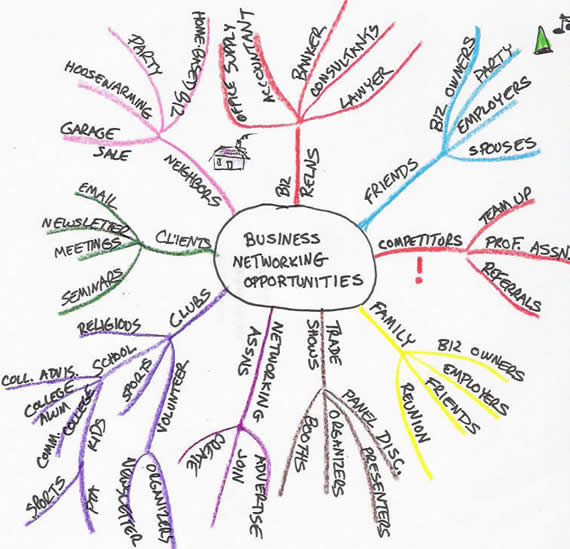
If you don’t have the luxury of others to brainstorm with, one technique you can use is mind mapping. Mind mapping, used for centuries, is a graphical way of recording, organizing, and displaying your thought process. It is a simple and fun tool for doing solo creative problem solving.

How To Make Your Own Mind Map

  1. Gather a bunch of (colored) pens and paper. Alternatively, you can use one of a myriad of mind mapping software packages. For me, pen and paper is more portable and directly tactile. Others may prefer using software to record their thoughts. The software packages’ resulting mind maps can be much more legible.
  2. Identify the core word (or phrase) you want to mind map.
  3. Write the core idea in the center of the paper (you can write ideas in the mind map using words, icons, or small pictures – whatever is most natural).
  4. What immediate ideas spring from this core idea? For each idea, draw a (colored) line radiating from the core idea and label the line with the idea. The colored pens can be used to color code each of these branches.
  5. Looking at each of these newly written ideas, what ideas spring from these? Continue branching organically, allowing yourself to bounce from one idea to another, remembering to maintain the color-coding of the core branches. Key ideas/milestones may be further indicated with small pictures.

Example Core Idea: “Business Networking Opportunities”

Further Reading

An overview of mind mapping

A brief introduction to mind-mapping, written by a college guidance counselor, with emphasis on using mind mapping to help you find a job.

A free online mini-course on making mind maps

How To Start Your Online Business For Free

Let me first answer the common questions:

I’m not a computer whiz. Creating a website isn’t much harder than creating a document in your word processor.

I don’t have a lot of time. Spend more time selling your products (services) and less time setting up your business using the detailed steps.

Is this really free? Yes.

Why? By giving you a free website, companies build your loyalty.

Why do professionals charge $1000s? Anyone can create an online business. Making the website look “sharp” is a job for the pros. If you don’t have thousands of dollars to spend, create something functional now and improve it later.

The “catch” is that for free you won’t get your own domain name (www.MyBusiness.com) . Instead, you’ll have to have a name like: MyBusiness.googlepages.com. From a professional marketing perspective, this isn’t ideal. However, if you have no budget but want a website, then this will work wonderfully. There are a number of companies that will provide you a free website. I’ve found that that “Google Pages Creator” is the best – they don’t insert advertisements onto your website.

  1. Go to: pages.google.com
  2. Create a free Gmail account (if you don’t already have one)
  3. Websites are all about visual appeal. Gather images that highlight your product (or service). Make sure that the images are yours to use (either something you created, is in the public domain, or have licensed).
  4. Design your “Home” page. This page should answer the question, “What problem does your product (or service) solve?” Don’t clutter it with lots of details. The home page is all about getting someone interested enough to read further. Make sure that the home page has your contact information (name, address, phone, email) on it (note: you want contact info on all your webpages).
  5. Design your “Contact Me” page. Make it easy for someone to find you.
  6. Design your “About Me” page. Add a picture of you. This page should answer the question, “Why are you the best person to sell this product (or service)?” or “Why should I trust you?”.
  7. Design your “Store” page. This page should answer the question, “How much does it cost? What are the details? What proof do you have? How can I buy it?”
  8. Go to: www.paypal.com
  9. If you don’t already have a (business) checking account, go to your local bank to get one. Link the account to Pay Pal.
  10. Choose for your Paypal “payment solution” Website Payments Standard. Create Buy Now buttons and/or PayPal Shopping Cart for each product you’re selling. Insert the buttons at the proper locations on your “store” webpage.
  11. Get feedback from your business associates. Does the site look acceptable? Is the information on the site accurate?

The site that you create will be a full-fledged online business. People can find more information about you and your products. They can order from you online. You can gradually improve the look and feel of the website over time.

Marketing 101


? You know how wonderful your product is.
? You know how great a value it is.
? If people could only hear about it, you think, the product would sell itself.

Communicating your offering to potential customers is marketing. The mistake people make is by simply showing the product (in a flyer, spec sheet, web site, etc.) that it will convince people to purchase it. Theodore Levitt (Harvard Business School) said: “People don’t want to buy a quarter-inch drill. They want a quarter-inch hole!”

It’s hard to change your perspective (from selling drills) to focus on the dis-interested potential customer (who wants a hole). How do you get their attention?

Here are three key questions your marketing materials need to address:

  1. What problem does your product solve?
  2. Why should they believe you?
  3. Why should they care?

Let’s take an example of Janet, who makes earrings. The earrings are beautiful. Her friends love them. People ask about them when she wears them around town. How does she market them?

  1. What problem does her product solve? Janet’s earrings allow the wearer to express their individuality, since each pair of earrings are unique. They are affordably priced.
  2. Why should they believe her? Besides showing a gallery of people wearing her creations, she should seek out testimonials of how people feel when they wear them.
  3. Why should they care? People primarily care about 3 things: money, relationship, or health. Janet’s earrings are relatively inexpensive ($19.95/pair) [money]. Janet’s earrings are made of hypo-allergenic materials, avoiding ear infections [health]. People that wear her earrings feel more attractive and if you feel more attractive, you are more attractive to others [relationship].

What could be some of her simple marketing messages?

  • Unique earrings affordably priced. [money]
  • Feel more attractive for $19.95 [relationship& money]
  • Earrings that people notice. [relationship]
  • You’re unique. Are your earrings? [relationship]
  • What does your earrings say about you? [relationship]
  • Earrings that are good for your body [health]

The right message is the one that works in the niche she’s focusing on, since each niche has different priorities of money, relationship, and health.

Tips For Brainstorming

“A group problem-solving technique that involves the spontaneous
contribution of ideas from all members of the group”
— Merriam-Webster Dictionary

Brainstorming is one of many creative problem solving techniques. While you can use any size group, we believe it works best when done in a facilitated group of 5-10 people. The more diverse the group the more diverse the input. The group members don’t need to be experts in your field. In fact, they don’t need to know anything about the problem topic at all!

Step 1: Define Your Problem

You need to get really clear on what your problem truly is (and is not). Keep asking “why?” until you feel that you’ve identified the root of your problem. For example, if your problem is “I need more money?” Ask “Why? To do what? And then what?”. Once you have the problem, state the brainstorming topic as:

“I would like to _________ but it’s difficult because ________”

The more time you spend in defining your problem the better the results will be.

Step 2: Uncover Solutions

Now is when the group starts contributing ideas. The group should some pre-agreed rules. Here are some:

  • I will listen to others’ ideas.
  • I will not be attached to my idea.
  • I will attempt to find the good in someone else’s ideas.
  • I will give myself permission to be wrong, insane, and stupid.
  • I will respect that the person with a problem is best judge as to quality of the idea.
  • I will not tell someone else what to do, I will only offer suggestions.

Make sure you have someone responsible for recording the meeting (that person should definitely not be the person who’s presenting their problem).

Brainstorm for a set time. Initially, a lot of obvious ideas will be suggested. After this initial flurry, things will quiet down. Be patient. Risk saying something that makes no sense to you. The better ideas usually arrive after people have relaxed and listened to others.

Step 3: Evaluate Solutions

Here is where the solutions that were suggested can be evaluated. What ideas are the most exciting? If any of the ideas seem incomplete, go back to step 1 and re-brainstorm.

Remember that brainstorming can be an intensely intimate encounter. Thank everyone for their contribution.

What’s Your Niche?

Do you want to make it easier to find people who want your product or services? Instead of saying, “This is great for everyone”, you want to say, “This is great for you.” This article details how to simply and clearly define your narrow offering.

Definition. A niche is a group of people with a narrow common problem. While you could have a niche of people who want money, a better niche might be “people who want money to pay off credit card charges” (and perhaps, “people who want money to pay off credit card charges incurred by purchasing clothing”).

Benefits. From your client’s perspective, a niche means that you understand their common problems. From your perspective, niche prospects are easier to find and you can charge them more for your specialized offerings.

Danger. Some people think choosing a niche means that you’ll miss potential clients (who would benefit from your offering but aren’t in your niche). You can’t be all things to all potential clients. If you must, pick more than one niche.

Classify. What’s common about your existing clients? What group of people would you like to work with?

Brainstorm. Niches are adjectives. Look through lists. What are people searching for online?

Let’s take the example of Peter, who’s a life coach. While he can help anyone working on their problems, he likes working with men. Men with what problem? Having recently been divorced, he understands the process and wants to help men who also have recently been divorced. He could even specialize further (men who have been divorced because their wives fell in love with someone else, etc.). He’s now a specialist, and his marketing materials would target his demographic.