Tag Archives: strategy

Restaurant Marketing: What Would You Do?

Let’s say that you opened a new restaurant in town. The restaurant gets some “buzz” and some positive reviews in the local media. It’s packed every night. People call days ahead to reserve a table. Your restaurant is clearly the “next hot thing”. How do (or should) you market your success?

Right now, it’s hard to imagine that there will be a time that you’ll wish for customers to sit at your unused tables. You need to recognize that you’re the current fad, and that unless you take action now, you’ll simply be “that new place that people used to eat at.”

It’s possible that people that eat at your restaurant will simply feel at home in your ambiance and love the ever-increasing quality of food. They’ll come back regularly and share their latest “find” with their friends (and so on).

With a little effort now, you can greatly increase your chances for long-term success by asking everyone that calls for the first time: “Where are you from?” and “How did you hear about us?” Record their answers. After they visit, offer them a chance to be on your VIP customer list (for free); get their contact information (including email) to tell them about upcoming special events.

Without this information, you’re in a vacuum. Fast-forward six months. The phone isn’t ringing as much. Tables are going unused. How can you find people who would enjoy your restaurant?

How did you hear about us? If the answer was a mention in a specific media (magazine, newspaper, radio, television), then you know what your target market pays attention to.

Where are you from? If people are coming from specific geographic areas, then you can target that location in your marketing / advertising.

Where have you been? If you’re keeping track of frequent guests and notice a drop-off, send a “missing you” message. You want to find out if there is something that you can do to re-attract them.

Ironically, the best time to market yourself is when you’re “hot” – you’re repeating the “buzz” that people are already hearing. You’re investing in your future by creating a clear message of who you are now. You’re not guessing where to market yourself initially – your existing clients have already told you what matters to them.

To create long-term staying power, you need to leverage your short-term success into long-term smart planning.


Getting Everything You Can Out Of All You’ve Got

Getting Everything You Can Out of All You've Got

Jay Abraham calls himself “America’s Number One Marketing Wizard”. His client list is impressive and in his 25 years he has amassed a lot of knowledge about what works – why – and when.

In this dense book (published in 2000), Jay focuses on using marketing to increase your business revenue. His book starts with a simple formula:

Number of clients * Average Client Sale * Sale Frequency = Total Income

His book then proceeds to show ways to increase the number of clients, increase the average client sale, and/or increase the sale frequency.

The book contains a very useful 50 question list to help you focus your marketing (“Where do my clients come from specifically (demographics)? When I create a new client for my business or profession, who else have I directly created a new client for? Who are my biggest competitors and what do they offer that I do not?”).

While some of Jay’s suggestions require larger budgets to achieve, some of his ideas are quite provocative:

  • Calculate the lifetime value of a client and spend appropriately to capture new ones.

  • Better than risk-free guarantees

  • Create better add-ons – what does your client need before using your product? After? Make it easier to purchase automatically.

  • Always test your marketing pieces (split-testing, telephone, email, sample, price, etc.) Measure your ROI. Consider split testing.

  • Creating host-beneficiary relationships

  • Creating a (detailed) referral system

  • Regaining inactive clients

  • Direct mail piece suggestions

  • Pre-qualifying leads

  • Telemarketing scripts

  • Bartering

Each of the chapters is full of case studies and examples that help to explain his principles. Any one of these ideas could produce a wealth of results for your business.

Marketing 103: Branding

(Prerequisite: Marketing 102: Co-marketing and Cross-marketing)

“Branding” is providing a consistent message to your customers. It’s rooted in the combination of your core values and your strategic plan for your company (think of it as your “business persona”). Every time you have an interaction with your (prospective) customers you want to reinforce your brand (by phone, in person, via email, on website, or print). You’re sending a consistent message of why someone would choose to do business with you.

Here are key points I focus on when I create (or review) marketing materials. Each of the points has implications in crafting the branding message.

  1. What are your core values? Your core values identify you to the world, and include: collaboration, cost-sensitivity, diversity, education, efficiency, excellence, flexibility, fun, holistic, innovative, preventive, service, social responsibility, sustainability, and teamwork). There are no right or wrong values – but they must “fit” your business.
  2. What makes you different? Knowing your competition is important to make sure you don’t fall into a “me-too” message. Your materials need to make you stand out.
  3. What’s your plan for 2+ years? Are you planning to focus on one aspect of your business? Planning to change direction or grow? Your marketing materials can help you make the transition smoothly.
  4. Who will be getting this document? Different audiences have different informational needs. The benefit to your services would be different for a potential customer than an investor.
  5. How will the document be delivered? If you’re mailing the material, besides optimizing its size / weight (to save mailing costs), you’ll want to design it so it will be read (and not deemed “junk mail”). If you’re emailing it, you’ll want to likewise ensure it’s not labelled “spam” as well as making it easy for people to read it (plain text, a downloadable PDF, a link to a web page, etc.).
  6. What’s the purpose of the document? Besides Marketing 101 information, you need a “call to action” – a reason for someone to contact you NOW. How you convey your benefits depends on the main purpose of the document: educating (about a problem they didn’t know about), convincing (why you’re the best), enumerating (all the different things you can do), or swaying (from a preconceived notion). Often people try to make one marketing piece “do it all” (very tempting, especially when you’re spending a lot of money on a project).
  7. What other materials do you provide? Your materials should have a consistent look (except during a business makeover) and tone (that reflect your core values).
  8. What are the demographics of your customers? Older people have an easier time reading bigger fonts. Younger people might prefer something “hip”. Men and women process text differently. Different cultures have certain color / graphic taboos.
  9. Will you be excerpting any of this material for use in another format? If so, you’ll want to ensure that your graphics and fonts can work across the formats (for example, you want high-quality graphics for print, but lower-quality graphics for quick-loading web pages).
  10. Have you “tested” the material (or previous materials)? Remember you’re trying to create a dialogue with your customers – you need to listen to what people think to make sure what you’re saying is what they are hearing. You want to attract the right customers.
  11. How will you measure the effectiveness? You need to determine your “ROI” (return on investment).
  12. How often will the same people be receiving it? Will you be rotating a message / offer or sending the same message?

Innovation: The Five Disciplines For Creating What Customers Want

Innovation: The Five Disciplines for Creating What Customers WantCurtis Carlson (president/CEO of SRI International) and William Wilmot (director of the Collaboration Institute) share their system for innovating in business. While the book is written for larger corporations, their message translates to all types of businesses.

The book details their five disciplines and provides supporting stories. The authors claim that the chance that you’ll succeed is directly proportional to using all five disciplines simultaneously. Failing to address one of them will doom you to failure.

1. Important Needs. Your product or service must target a customer value (as opposed to a company, shareholder, employee, or public value). A customer’s value = benefits – cost. You can optimize either the benefit or the cost to achieve high value. Likewise, you can compare values using the formula: Value Factor = benefits / cost.

2. Value Creation. You need a value proposition. The value proposition is the core of your “elevator speech”. (NABC = needs + approach + benefits + competition) that addresses:

  1. What is the important customer and market need?
  2. What is the unique approach for addressing this need?
  3. What are the specific benefits per costs that result from this approach?
  4. How are these benefits per costs superior to the competition’s and the alternatives?

3. Innovation Champions. You need people who are passionate and committed. In a small business, this responsibility falls to the owner. One of the challenges in growing your company is finding employees (or partners) who share your “champion-attitude”.

4. Innovation Teams. To innovate, you need collective intelligence. In a corporation, you would have the team all in-house. As a smaller business owner, you’ll need to create your own ad-hoc innovation team in networking, mastermind, or friendship groups.

5. Organizational Alignment. Upper management needs to remove barriers and provide organizational support. This is the advantage of smaller businesses; the organization has a flat hierarchy and people are aware of their fellow team members.

Marketing 102: Co-Marketing And Cross-Marketing

(Prerequisite: Marketing 101)

You’ve crafted your marketing message (customer benefit, customer trust, and customer emotional connection). What now?

If you already have a customer base, tell them (email, postal mail, phone calls, etc.).

If you want more customers, try co-marketing or cross-marketing.

Co-marketing is working together with another company to market your products. Generally co-marketed products have a “fit”.

Cross-marketing is a type of co-marketing where the products are loosely related. The relationship can be a simple, “Now that you bought a hamburger, would you like fries with that?”. Sometimes it’ll take a bit of sleuthing to find out what your group has in common – A club affiliation? A love of art? Restaurant? Hobby? A type of car?

Let’s continue (from Marketing 101) our example of Janet, who makes earrings.

Janet could join together with some of her fellow jewelry makers and offer a jewelry show. In addition to advertising the show publicly, each jewelry maker would invite their customers. [co-marketing]

Janet realizes that a number of her customers do yoga. She approaches the local yoga studio, offering to make a beautiful display of her earrings. With the display is her contact information (on flyers for people to take home). In exchange, Janet offers to display the studio’s yoga brochures at her events (or on her website). [cross-marketing]

Both of these techniques require cooperation from other companies. When approaching others, highlight the mutual benefits. Later on, ensure follow-through. Proactively tell your co-marketing partners what you’ve done.

Marketing 101


? You know how wonderful your product is.
? You know how great a value it is.
? If people could only hear about it, you think, the product would sell itself.

Communicating your offering to potential customers is marketing. The mistake people make is by simply showing the product (in a flyer, spec sheet, web site, etc.) that it will convince people to purchase it. Theodore Levitt (Harvard Business School) said: “People don’t want to buy a quarter-inch drill. They want a quarter-inch hole!”

It’s hard to change your perspective (from selling drills) to focus on the dis-interested potential customer (who wants a hole). How do you get their attention?

Here are three key questions your marketing materials need to address:

  1. What problem does your product solve?
  2. Why should they believe you?
  3. Why should they care?

Let’s take an example of Janet, who makes earrings. The earrings are beautiful. Her friends love them. People ask about them when she wears them around town. How does she market them?

  1. What problem does her product solve? Janet’s earrings allow the wearer to express their individuality, since each pair of earrings are unique. They are affordably priced.
  2. Why should they believe her? Besides showing a gallery of people wearing her creations, she should seek out testimonials of how people feel when they wear them.
  3. Why should they care? People primarily care about 3 things: money, relationship, or health. Janet’s earrings are relatively inexpensive ($19.95/pair) [money]. Janet’s earrings are made of hypo-allergenic materials, avoiding ear infections [health]. People that wear her earrings feel more attractive and if you feel more attractive, you are more attractive to others [relationship].

What could be some of her simple marketing messages?

  • Unique earrings affordably priced. [money]
  • Feel more attractive for $19.95 [relationship& money]
  • Earrings that people notice. [relationship]
  • You’re unique. Are your earrings? [relationship]
  • What does your earrings say about you? [relationship]
  • Earrings that are good for your body [health]

The right message is the one that works in the niche she’s focusing on, since each niche has different priorities of money, relationship, and health.

What’s Your Niche?

Do you want to make it easier to find people who want your product or services? Instead of saying, “This is great for everyone”, you want to say, “This is great for you.” This article details how to simply and clearly define your narrow offering.

Definition. A niche is a group of people with a narrow common problem. While you could have a niche of people who want money, a better niche might be “people who want money to pay off credit card charges” (and perhaps, “people who want money to pay off credit card charges incurred by purchasing clothing”).

Benefits. From your client’s perspective, a niche means that you understand their common problems. From your perspective, niche prospects are easier to find and you can charge them more for your specialized offerings.

Danger. Some people think choosing a niche means that you’ll miss potential clients (who would benefit from your offering but aren’t in your niche). You can’t be all things to all potential clients. If you must, pick more than one niche.

Classify. What’s common about your existing clients? What group of people would you like to work with?

Brainstorm. Niches are adjectives. Look through lists. What are people searching for online?

Let’s take the example of Peter, who’s a life coach. While he can help anyone working on their problems, he likes working with men. Men with what problem? Having recently been divorced, he understands the process and wants to help men who also have recently been divorced. He could even specialize further (men who have been divorced because their wives fell in love with someone else, etc.). He’s now a specialist, and his marketing materials would target his demographic.

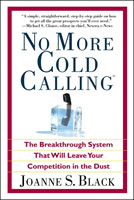
No More Cold Calling

No More Cold CallingI recently read a book that made me rethink how I market myself to others and wanted to share it with you: “No More Cold Calling” by Joanne Black. The essence of the book is that the odds of selling something to people you don’t know (“cold leads”) (either by email, phone, ads, or US Mail) is extremely small and therefore expensive. Ms. Black recommends spending time working on your referral networks.

Identify your ideal customer. Ask people you know if they can give you a referral to one or two people that meets your ideal. You don’t just want the names of the people – you want them to contact your referral and have them tell about you themselves. If you’re thinking, “This seems like I’m asking a favor for my business” – you’re right. It’s a favor you’re asking because people really want to help and be helped. Another approach is to join one of a number of referral-based organizations.

By spending time pro-actively building your referral network it’ll result in a higher “close rate” and better clients as well. You can still do your “cold lead” development to keep your branding going, but referrals, she claims, is where it’s at.

Here’s who I’m looking for: a business owner who is ready to change their day-to-day business practice to leap in front of their competition.

Who are you looking for?

Talk Little, Ask Lots


I recently attended a conference where Alfie Kohn (“Punished By Rewards”, “Unconditional Parenting”, etc.) spoke about parenting a child. As he described healthy ways of parenting, I was struck by the commonalities of a parent/child and a business/client relationship.

One of his speeches was summarized by “Talk Little, Ask Lots” – stop talking and be curious about the other person’s needs and feelings. As I mentioned in last month’s newsletter (“So, What Do You Do For a Living?”), as a business person you want to engage in a dialog to understand the potential client’s needs and build trust. After you’ve introduced yourself, shift the conversation back to the client. What’s their problem? When does it need to be solved? What have they tried? What’s their budget?

Only after you’ve asked these questions can you begin to figure out if you can help them. Are they are trying to solve a symptom or a problem? Is this problem a match for your business (sometimes the best service you can provide is a referral to an expert)?

Remember, the goal of the conversation/meeting is to develop a long-term relationship. If you can communicate with passion, honesty, and wisdom you’re well on your way to bridging the divide between prospect and client.