
Category Archives: Starting Out

How Can I Brand Myself?

My niche is self-development / law of attraction and the best I’ve come up with so far is “The Self-Dev Junkie” and “Your Universal Healer”)

I consider my unique talents to be: excellent customer service, creates products that make a difference, strong passion to help others achieve, and friendly, willing to help.

###

Are you a coach? Seminar leader? Spiritual Leader?

Before you focus on the branding, tagline, etc. you need to focus on your strategy.

Answer the following questions to start on your strategic plan:

Who is your ideal client? What problem do you solve for them? How do you solve their problem? Why are you the best for solving it?

The rest will flow from your strategy.

How To Tell Your Marketing Story

Tell Me A StoryWe are wired to tell, read, and listen to stories. A great story gets you to feel as if you were in the story: your senses are engaged, your curiosity is piqued, and your adrenalin is flowing.

Marketing is basically the art of telling a story. Simple stories include:

  • I had no money. I did this. Now I’m rich.
  • I was a loser. This product changed me into the winner I am today.
  • I had no clients. I figured out a great technique. My phone hasn’t stopped ringing.
  • Boy meets girl. They live happily ever after.

A compelling business story causes the listener to contact the business owner for more information or to make a purchase.

You must deliver the story convincingly. When you tell the story in person, make sure that your voice, tone, tempo, eyes, and body are enhancing your story. If you’re telling the story in print, online, or on television, use images to reinforce the words and reduce the length of the story.

You have different stories for different people. Since one goal of a story is to make the listener feel part of the story, the story needs to “fit”. Carefully consider who you’re telling the story to.

Your story has an arc. Think of a classic fable. It no doubt fits the standard framework: every day… until one day … and then … and then … and ever since then …. For example, in Watty Piper’s The Little Engine that Could:

A little railroad engine was employed about a station yard for such work as it was built for, pulling a few cars on and off the switches. One morning it was waiting for the next call when a long train of freight-cars asked a large engine in the roundhouse to take it over the hill “I can’t; that is too much a pull for me,” said the great engine built for hard work. Then the train asked another engine, and another, only to hear excuses and be refused. At last in desperation the train asked the little switch engine to draw it up the grade and down on the other side. “I think I can,” puffed the little locomotive, and put itself in front of the great heavy train. As it went on the little engine kept bravely puffing faster and faster, “I think I can, I think I can, I think I can”.

Your story includes concrete details. Details allow the listener to visualize the story and engage the senses. Instead of a refrigerator, say “a white, side-by-side ‘fridge, with an ice dispenser in the left door and a wheeze that you can hear when the compressor is working”. Add appropriate details.

Your story is personal. Instead of retelling someone else’s story, it’s better to tell something that happened to you (or that you personally witnessed). A personal story builds trust in the teller.

Your story needs a clear purpose. Ideally, you want to teach the listener in a way that they can validate the message them self.

Your story is easily repeated. Viral marketing is nothing more than people passing along a story that they liked. Make your story memorable and ideally, easily summarized.

Great stories aren’t accidental. You need to practice telling the story. You need to get feedback to make your story effective. Learn from others’ stories.

When you sincerely tell your personal story effectively, you’ll have lots of curious customers wanting to find out more about you and your business.

How Can I Advertise My Business For Free?

I want to advertise my business on the web.

###

There are lots of places to advertise on the web. The question is, where are your potential clients looking? What problem do you solve for them? How do you solve their problem? Why should they trust you?

Before wasting your time posting, figure out your strategic marketing plan. Then, you can advertise for the right customer at the right place at the right time (and stand out from all the other free advertisements).

How Can I Market Sensuality Products?

I have recently signed up to do home parties for a new business called Sensuality. It is similar to Fantasia (same concept) with different products. We do same sex parties, couples parties….anything! Fantasia is so well known that it has been very hard to get our name out there. The person who created the business is doing well with her website and also writes a sex ed column for the local paper. But how can I market myself?? I also have a background in the sexual health field…this is something unique that Fantasia doesn’t have…All my friends have already had parties so…word of mouth hasn’t started to work yet. What can I do in the meantime?

###

If your products are simply different (you didn’t say, “better”, “higher quality”, “USA Made”, “Hypoallergenic”, “guaranteed”, etc.) then you need to focus on your differentiator: your background in sexual health.

Your approach can be: “Instead of simply buying gimmicks, let me teach you a fun and better way to achieve long-lasting intimacy using our products.” The key is teach / intimacy. Your insight is what will draw people in. The products you sell will be the revenue stream.

Offer paid classes in your area. For the price of the class, attendees get a full-priced credit from your catalog (i.e., if your class costs $25, give them $25 towards the purchase of your products). You’re creating additional value, rather than simply having a free class (which is perceived as a non-value).

Your intimacy classes (for women/men/couples) could be offered through your local Yoga studio, Gym, Personal Trainer, Beauty Salon, Nail Care Studio, etc. Basically, places where people who care about their appearance go. If there’s a romantic restaurant in your area, consider co-marketing with them (use their back room during a slow day). Your local hotel/motel that has conference facilities would be a good bet (once you have advance sign ups, to avoid paying a lot out of pocket).

As you do your presentations, start recording them. They can naturally become a revenue stream in their own right.

If you can’t give up $, then co-market:

If you do your presentation in a music store, and hand-pick music selections to go with your products.

…in a wine shop, choose wines based on personalities, positions, etc.

…in a video store, choose movies that are couple-friendly.

…in a gelato store, choose sensuous flavors.

You get the idea.

Improved Brainstorming With Introspection

The Thinker

Many people have been commenting about Frans Johansson’s The Medici Effect:

“Brainstorming [is] used in nearly all of the world’s largest companies, nonprofits, and government organizations. And the reasons seem obvious… “The average person can think of twice as many ideas when working with a group than when working alone.”… But is it true?

In 1958… psychologists let groups of four people brainstorm about the practical benefits or difficulties that would arise if everyone had an extra thumb on each hand after next year. These people were called “real groups” since they actually brainstormed together. Next, the researchers let “virtual groups” of four people generate ideas around the “thumb problem”, but they had to brainstorm individually, in separate rooms. The researchers combined the answers they received from each [virtual group] individual and eliminated redundancies… They then compared the performance between real groups and virtual groups…

To their surprise, the researchers found that virtual groups, where people brainstormed individually, generated nearly twice as many ideas as the real groups.

The result, it turned out, is not an anomaly. In a [1987 study, researchers] concluded that brainstorming groups have never outperformed virtual groups. Of the 25 reported experiments by psychologists all over the world, real groups have never once been shown to be more productive than virtual groups. In fact, real groups that engage in brainstorming consistently generate about half the number of ideas they would have produced if the group’s individuals had [worked] alone.

In addition, in the studies where the quality of ideas was measured, researchers found that the total number of good ideas was much higher in virtual groups than in real groups.”

I’ve found that interactive brainstorming groups generally suffer from the “too loud, too fast” phenomenon.

Groups tend to be dominated by the most vocal people. When someone else is talking you’re trying to balance listening to their ideas and thinking about your own. Furthermore, “group extroverts” can be intimidating.

The goal of brainstorming is to come up with as many ideas as you can as quickly as possible. The idea is by working quickly, you prevent the inner critic from stifling a (part of a) new solution. This means that the group operates a certain speed (which varies during the meeting, but it’s the goal of the facilitator to reduce the “lows”). One speed doesn’t work for all, frustrating both the quicker and the slower thinkers.

As a result, “real” brainstorming meetings aren’t harnessing the full creative power of the group.

Virtual groups don’t suffer from “too loud, too fast”. It operates at your speed, and is much more comfortable. In a parallel virtual group, each member goes to a different location for fifteen minutes and writes down ideas, then combines them into a single list. In a sequential virtual group, each member thinks for fifteen minutes, and passes their ideas to the next person, who then adds their ideas to the list. Examples of this are online bulletin boards and blog discussions.

Does this mean that you should discontinue “real” brainstorming sessions? Yes and No.

Yes, stop holding the “too loud, too fast” classic brainstorming meetings. They can produce results, but disenfranchise many people. Business management holds to look like they’re doing something (“Hey, we care enough to hold brainstorming meetings”).

No, don’t lose the human-ness of the meetings. The goal of the group is to continue to evolve into a community, working together to solve problems.

Getting Everything You Can Out Of All You’ve Got

Getting Everything You Can Out of All You've Got

Jay Abraham calls himself “America’s Number One Marketing Wizard”. His client list is impressive and in his 25 years he has amassed a lot of knowledge about what works – why – and when.

In this dense book (published in 2000), Jay focuses on using marketing to increase your business revenue. His book starts with a simple formula:

Number of clients * Average Client Sale * Sale Frequency = Total Income

His book then proceeds to show ways to increase the number of clients, increase the average client sale, and/or increase the sale frequency.

The book contains a very useful 50 question list to help you focus your marketing (“Where do my clients come from specifically (demographics)? When I create a new client for my business or profession, who else have I directly created a new client for? Who are my biggest competitors and what do they offer that I do not?”).

While some of Jay’s suggestions require larger budgets to achieve, some of his ideas are quite provocative:

  • Calculate the lifetime value of a client and spend appropriately to capture new ones.

  • Better than risk-free guarantees

  • Create better add-ons – what does your client need before using your product? After? Make it easier to purchase automatically.

  • Always test your marketing pieces (split-testing, telephone, email, sample, price, etc.) Measure your ROI. Consider split testing.

  • Creating host-beneficiary relationships

  • Creating a (detailed) referral system

  • Regaining inactive clients

  • Direct mail piece suggestions

  • Pre-qualifying leads

  • Telemarketing scripts

  • Bartering

Each of the chapters is full of case studies and examples that help to explain his principles. Any one of these ideas could produce a wealth of results for your business.

Marketing 103: Branding

(Prerequisite: Marketing 102: Co-marketing and Cross-marketing)

“Branding” is providing a consistent message to your customers. It’s rooted in the combination of your core values and your strategic plan for your company (think of it as your “business persona”). Every time you have an interaction with your (prospective) customers you want to reinforce your brand (by phone, in person, via email, on website, or print). You’re sending a consistent message of why someone would choose to do business with you.

Here are key points I focus on when I create (or review) marketing materials. Each of the points has implications in crafting the branding message.

  1. What are your core values? Your core values identify you to the world, and include: collaboration, cost-sensitivity, diversity, education, efficiency, excellence, flexibility, fun, holistic, innovative, preventive, service, social responsibility, sustainability, and teamwork). There are no right or wrong values – but they must “fit” your business.
  2. What makes you different? Knowing your competition is important to make sure you don’t fall into a “me-too” message. Your materials need to make you stand out.
  3. What’s your plan for 2+ years? Are you planning to focus on one aspect of your business? Planning to change direction or grow? Your marketing materials can help you make the transition smoothly.
  4. Who will be getting this document? Different audiences have different informational needs. The benefit to your services would be different for a potential customer than an investor.
  5. How will the document be delivered? If you’re mailing the material, besides optimizing its size / weight (to save mailing costs), you’ll want to design it so it will be read (and not deemed “junk mail”). If you’re emailing it, you’ll want to likewise ensure it’s not labelled “spam” as well as making it easy for people to read it (plain text, a downloadable PDF, a link to a web page, etc.).
  6. What’s the purpose of the document? Besides Marketing 101 information, you need a “call to action” – a reason for someone to contact you NOW. How you convey your benefits depends on the main purpose of the document: educating (about a problem they didn’t know about), convincing (why you’re the best), enumerating (all the different things you can do), or swaying (from a preconceived notion). Often people try to make one marketing piece “do it all” (very tempting, especially when you’re spending a lot of money on a project).
  7. What other materials do you provide? Your materials should have a consistent look (except during a business makeover) and tone (that reflect your core values).
  8. What are the demographics of your customers? Older people have an easier time reading bigger fonts. Younger people might prefer something “hip”. Men and women process text differently. Different cultures have certain color / graphic taboos.
  9. Will you be excerpting any of this material for use in another format? If so, you’ll want to ensure that your graphics and fonts can work across the formats (for example, you want high-quality graphics for print, but lower-quality graphics for quick-loading web pages).
  10. Have you “tested” the material (or previous materials)? Remember you’re trying to create a dialogue with your customers – you need to listen to what people think to make sure what you’re saying is what they are hearing. You want to attract the right customers.
  11. How will you measure the effectiveness? You need to determine your “ROI” (return on investment).
  12. How often will the same people be receiving it? Will you be rotating a message / offer or sending the same message?

Marketing: Practice What You Preach

Preacher BoyWhen I meet a professional for the first time, I want to know if they practice what they preach. It’s too easy to tell others to do something. I’m looking for a disconnect between someone’s image and actions.
If there is a discrepancy, I question them to find out more. People will either respond sheepishly “Yeah, I know” or be stunned to think that their image matters. Perhaps I’m more sensitive to this than others, but I want to work with people who are self-aware. I’m not expecting people to be perfect – I just want to ensure they personally know of what they speak.

Marketing is all about a consistent message. How do you answer the phone? How do you respond to emails? What does your website look like? Your brochures? How do you introduce yourself?

When you meet a website designer for the first time… check out their website.

When you meet a search engine optimizer… see how easily you can find their website.

When you meet a graphics designer… inspect their business card.

When you meet a business coach… see how well they listen.

When you meet a marketing person… see how they explain what they do.

When you meet a body worker… see how relaxed they are in their body.

When you meet a realtor… see if they own their own home.

When you meet a teacher… see if they regularly take classes.

When you meet a investor… see if they are personally successful.

When you meet a photographer… see what their picture looks like.

When you meet a customer service professional… see if they use their own products.

When you meet a publisher… see if they wrote a book.

When you meet a gardener… see what their garden looks like.

Next month, I’ll discuss how consistency is important to build your company’s “branding”.

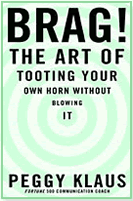
Brag!

Brag!

While last month’s read (“Networking Magic”) detailed how to approach networking, this month’s book by Peggy Klaus focuses on how to talk about you (and your business). I have followed her advice with great results (including increased confidence).

Bragging is different from boasting. Bragging is highlighting your business (in interesting ways) to build a relationship. Boasting is exaggerating your achievements to elevate your status.

Bragging’s goal is to get you noticed and to open the door for a professional relationship. Every time you talk to a stranger is an opportunity for you to build a connection.

Peggy has a great “Take 12” self-evaluation questionnaire (both in her book and her website). Answering the questions will give you great raw material to build your bragologue (a bragging dialogue).

  1. What would you and others say are five of your personality pluses?
  2. What are the ten most interesting things you have done or that have happened to you?
  3. What do you do for a living and how did you end up doing it?
  4. What do you like/love about your current job/career?
  5. How does your job/career use your skills and talents, and what projects are you working on right now that best showcase them?
  6. What career successes are you most proud of having accomplished (from current position and past jobs)?
  7. What new skills have you learned in the last year?
  8. What obstacles have you overcome to get where you are today, both professionally and personally, and what essential lessons have you learned from some of your mistakes?
  9. What training/education have you completed and what did you gain from those experiences?
  10. What professional organizations are you associated with and in what ways: member, board, treasurer, or the like?
  11. How do you spend your time outside of work, including hobbies, interests, sports, family, and volunteer activities?
  12. In what ways are you making a difference in people’s lives?

The book gives lots of “before” and “after” examples which can help you customize your raw material into an authentic (and interesting) brag.

She ends the book with “Twelve Tooting Tips For Bragging” that are gems:

  1. Be your best, authentic self.
  2. Think about to whom you are tooting.
  3. Say it with meaningful and entertaining stories.
  4. Keep it short and simple.
  5. Talk with me, not at me.
  6. Be able to back up what you say.
  7. Know when to toot.
  8. Turn small talk into big talk.
  9. Keep bragologues and brag bites current and fresh.
  10. Be ready at a moment’s notice.
  11. Have a sense of humor.
  12. Use it all: your eyes, ears, head, and heart.