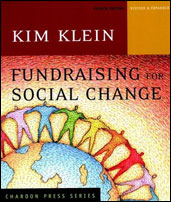
 If you work for (or with) a non-profit, this book is a must-read. Kim Klein (the editor) focuses on key problem all non-profits face: acquiring, retaining, and upgrading donors.
Acquiring is the process of getting new people to donate to your organization. Typically this is done with direct mail, web site asks, and some special events. The goal is to create an impulse donation.
Retaining is the strategy of converting an impulse donation into a habit.
Upgrading converts the “regulars” to give more than they have before. Typically this is done via a personal call, letter, or special “insider” event.
###
Finding Donors. Did you know that in 2004, 75.6% of contributions came from individuals (11.6% of foundations, 8% bequests, and 4.8% corporations)? Or, 7 out of 10 adults in the US and Canada give away money?
Asking For Money. What’s the #1 way to get donations? Ask for them! You need to identify people who: are able to make a gift, believe in your organization, and can be contacted. Formally, you ask for letter first with a letter detailing your organization and a request for monies for a specific need, following up with a phone call, and ending with a face-to-face meeting. Informally, a phone call followed by a letter would suffice.
Special Events. A special event is a two-fer: a fund-raising opportunity plus increased publicity. During the event, there must be a pitch to let people know now is the time to donate. Consider having some friends of your organization purposely start the donation process to break the ice.
Direct Mail. Use direct mail to: get someone to give for the first time, get donors to repeat their gift, and get donors to renew their gift. On a direct mail piece, expect less than 1% response (higher quality lists produce greater response) – so you’ll need to play the numbers game. Before starting a direct mail campaign, calculate the cost of the mailing vs. the likely result of the donation to arrive at a net income per donor. There a lot of information in the book about crafting the copy of the mail piece.
This book is a gold-mine of non-profit fundraising strategy. If you work with non-profits, read it often.
 The Dark Side Of Marketing
 A tagline or a slogan is a phrase (for example, “Just Do It™”) intended to get “stuck” in prospects’ heads. The tagline should be short and memorable, like a great piece of haiku.
 Ideally, you want not just customers, but fans. You want your business name to be passed around via word-of-mouth without you having to do any work. How do you find customers? How do you turn them into fans?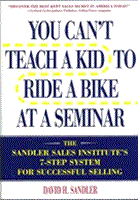


 This month I changed my logo once again. While the previous logo was clean and recognizable, it still didn’t incorporate the feeling of “creative” – which is a key component in all the marketing work I do. A client of mine (who is an artist) commented on the logo, and suggested that he could do much better. After a couple of iterations, this is the result. Initially, the logo shocked me. It was unfamiliar. It was different. I was too invested in the previous logo, so I asked for my colleagues’ opinions. The key point: Continue evolving all aspects of your marketing (and test the results).
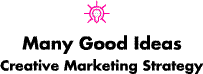 Tip: If you have no graphic talent and no budget, there are a number of free logo design websites (for example, this one I created in a few minutes online at